
Pedal power is on the rise


Play
Bangkok authorities are urged to add more public bike-rental stations
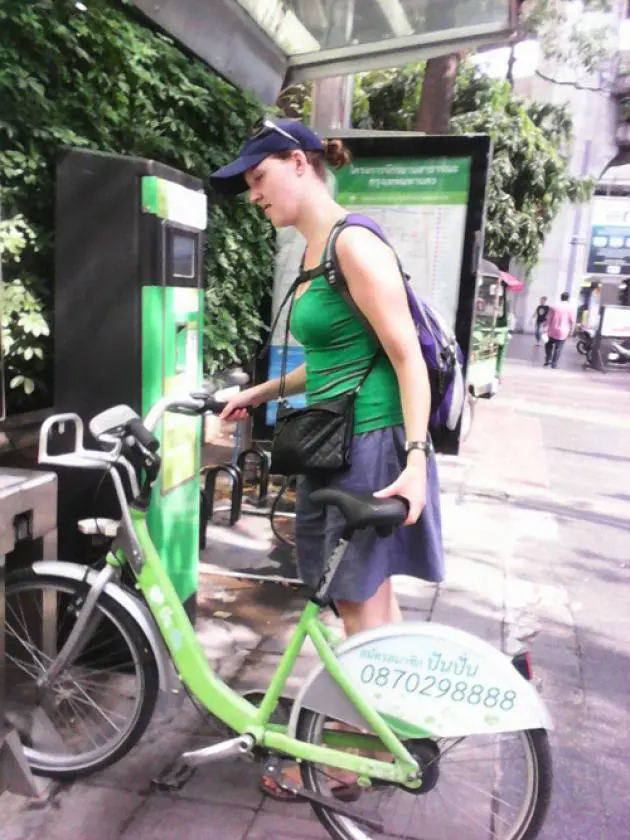
THE WAY BANGKOK |commuters are now combining modes of transport has been a boon to the Pun Pun Public Bike Sharing Programme initiated two years ago by the Bangkok Metropolitan Administration (BMA).
There are now 50 stations in the central business district – including those at Siam Square, Pathumwan, Ploenchit, Wireless Road, Rajadamri, Silom and Sathorn – where more than 10,000 registered members routinely borrow and drop off bicycles.
It adds up to an average of 1,000 trips logged per day.
Mulling requests to expand the scheme, the BMA has noted how many people use the bikes to get to Skytrain and subway stations and also to visit tourist attractions on weekends.
Churaiporn Wijackanawong, managing director of the Q-Group that runs the Pun Pun programme, says traffic jams have prompted a lot of people to make use of the bikes – and also many citizens are concerned about global warming.
Convenience is the key selling point for Pun Pun, Borrow a bike using your member card at any of the stations and drop it off at the same or any other station. It’s free for the first 15 minutes, Bt10 for the balance of the first hour, and Bt20 for one to three hours. Card credit can be “topped up” at any station.
Aided by GPS, the Q-Group constantly monitors the bike use and, if demand continues to rise, will increase the number of bikes beyond the current 500.
Churaiporn notes that more than 40 private firms support the project, such as the owners of office buildings where space is provided for the Pun Pun stations, and others that cover costs through advertisements in various media.
The Q-Group is meanwhile organising activities to encourage more people to get on a bike. This year there’ll be a ride around Rattanakosin Island and another ride doubling as a restaurant tour.
The office of Whiteline Group chief executive Purim Sahasakul is on busy Wireless Road, and he dodges the traffic gridlock astride a Pun Pun bicycle. He often rides a bike to meet clients or dine out somewhere within the scope of just one or two stations.
Taxi-motorcycles remain popular for daily commuters, Purim says, but that still means waiting in a queue at peak hours. Perhaps those people don’t feel comfortable with the idea of pedalling through city traffic. “But in countries like Australia and the UK, state agencies have raised people’s awareness about how cars and bikes can coexist,” he says. “Here, we don’t have nearly as many bicycle lanes as we should have.”
Purim would also like to see more owners of office buildings make washrooms available for cyclists. That in itself would boost the number of users significantly, he believes.
Advanced Info Service assistant vice president Titinant Jotinandana says his firm has supported the Pun Pun project since its inception in 2012, appreciating the effort to save energy and improve public heath.
He’d like to see the BMA expand the scheme to other busy areas, like Soi Aree, Phaholyothin and Thong Lor. The demand is apparent in the cycling trend’s growth, Titinant says.
