
Porcelain treasures


Play
German masterpieces take their place among luxury cars at the Bangkok Motor Show
VISITORS TO THE Bangkok International Motor Show going on now at Impact Arena in Muang Thong Thani, have more than just luxury sedans and concept cars on which to feast their eyes. There’s porcelain too and like many of the vehicles, its price runs into the millions.
Presented at Rolls Royce booth by B Grimm and royal German porcelain manufacturer Nymphenburg, “Beyond Masterpieces” is a showcase of six porcelain works worth up to Bt10 million. Two of the six handcrafted works will be auctioned off, with proceeds benefitting the Little Scientists’ House Project under the royal patronage of Her Royal Highness Princess Maha Chakri Sirindhorn.
“We invited Nymphenburg, which has been creating distinctive handmade masterpieces for more than 266 years, to join us in celebrating the fifth cycle birthday of Princess Maha Chakri Sirindhorn. Both art collectors and car enthusiasts have the opportunity to take part in the auction and contribute to the royal project,” says Harald Link, B Grimm’s president and a consultant to the Little Scientists’ House project.
The royal porcelain manufacturer to the Bavarian Crown, Nymphenburg was founded in 1747 by the Duke Elector Max III Joseph, a member of the Wittelsbach family under whose patronage has remained ever since. King Ludwig I and his successor, Ludwig II, took Nymphenburg porcelain into the world and today the private company is run by Prince Luitpold of Bavaria.
The company’s master workshops produce avant-garde and custom designs using techniques that have remained unchanged since the 18th century. The house has collaborated with a number of artists and distinguished designers and artists over the years, among them Konstantin Grcic, Christian Lacroix, Vivienne Westwood and Carsten Holler.
Nymphenburg produces its own porcelain paste using traditional recipes and the paste is then aged for three years before being used in production. Plates and round objects are hand-produced on a turning plate while the figurines are cast with numerous plaster moulds and then assembled piece by piece to recreate a whole. The entire colour palette is developed in-house and is painted by hand.
Up for grabs with a starting bid of Bt448,000 at the blind charity auction is “Commedia dell Arte”, a pair of rococo figurines designed by Franz Anton Bustelli in 1759-60. The entire collection contains eight male and eight female figurines arranged in pairs who communicate through pantomime.
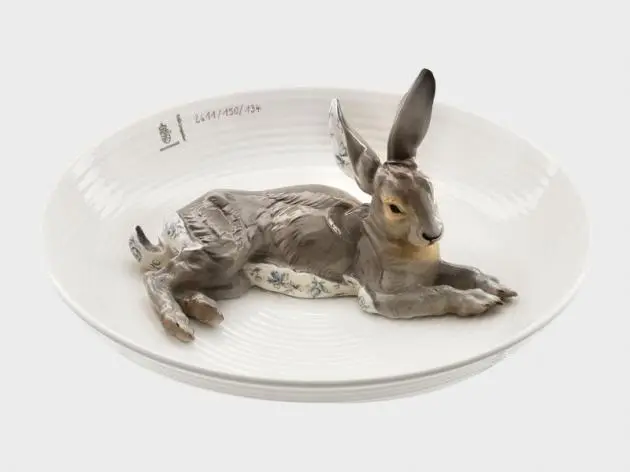
Also on the block is “Bowl with Hare”, a dinnerware piece designed by Hella Jongerius in 2004, which has a starting price of Bt114,000. From the treasure of historic shapes containing around 700 animal figures at the Nymphenburg facility, Jongerius selected eight designs and placed them in simple bowls. She then supplemented the naturalistic painting of the snail, bird, rhinoceros, deer, hare, frog, fox and dog with a different pattern from the Nymphenburg archives – from designs originally intended for a soup tureen to a drawing of the plumage of a guinea fowl.
The 40-centimetre-high porcelain peacock sculpture “Majesty Peacock”, designed by Theodor Karner in 1906, is one of the four works on show and for sale. Its elegant shape is realised by underglaze painting that was already developed to perfection at the beginning of the 1900s. In this technique, the paint is applied by brush or airbrush immediately after mild firing but before the porcelain is immersed in the glaze. Following firing, the resulting layers of colours are transparent and have the most attractive gradations.
For his “Royal Cumberland” collection, Joseph Zachenberger created a colourful and festive design with flower bouquets, single flowers, butterflies and insects framed by fine golden edging. The platter, which is on show in Bangkok, is the world’s most complex flower design still realised on porcelain: painters require up to three weeks to complete a single plate.
The final two masterpieces on view are the “Playing Leopards”, designed by Hans Behrens in 1904 and the tableware set “Golden Age”, designed by Rudolf Diewock in 1921 that represents the indulgent age of coffee, and the golden age of the art of porcelain.
DELICATE FEATURES
>>“Beyond Masterpieces” runs until next Sunday at the Roll-Royce booth at the Bangkok International Motor Show at Impact Arena. For more information, call (02) 710 3127.
