
There's life after dark


Play
The National Museum Bangkok is staying open a bit later in a new pilot project
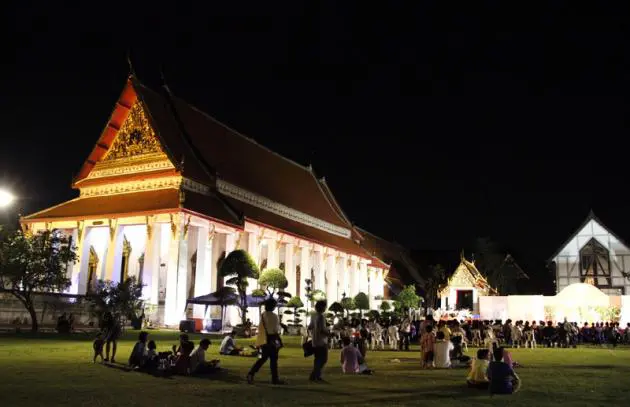
THE USUAL calm of the National Museum Bangkok, which for the most part only sees a small number of Thai visitors, was disrupted last Saturday when more than 200 people aged from five to 60 turned up for a bit of time-travelling at dusk.
It was a rare chance for an after-dark glimpse of the museum’s artefacts and exhibitions, thanks to a pilot project initiated by the Culture Ministry. Usually the National Museum Bangkok closes at 4pm, but will stay open late on weekends until April 19 under the Night Museum programme.
“The aim is to offer more opportunities for interested people to visit the museum at an unusual time and in a different ambience,” says Dendao Silpanon, chief of the museum’s curatorial section. “Normally, there are about 50 Thai visitors a day and 100 to 200 foreigners, but the Night Museum project might draw double those numbers.”
Under the Night Museum project, guided tours of four main buildings are available in two rounds, at 4.30 and 5.30pm, followed by classical music and dance by the Office of Performing Arts at 7pm.
Dendao adds that the hours can’t be extended longer because of a shortage of staff and the fact that there are several museum buildings under renovation.
Before each tour, visitors are gathered in a main room to watch a brief video about the museum’s history, which goes back to 1782 when Wang Na Palace was built on the site, the same time as the construction of the Grand Palace during the early Rattanakosin period. It was the residence of five viceroys until the reign of King Rama V.
The tour led by Dendao started at the Siwamokkhaphiman building, where an exhibition of artefacts from the Sukhothai, Ayutthaya, Thonburi and early Rattanakosin eras are on display.
The first attraction was the King Ramkhamhaeng inscription of 1292, writing set in stone that records the invention of the Thai language. It was included in the Memory of the World Register in 2003 by Unesco.
Visitors were next led to dimly lit exhibition room that took them back 10,000 years to the Holocene culture, which survived until the establishment of the Sukhothai kingdom in 1238. It was considered to be a golden age of Thai culture, with the making and trading of the famed Sangkhalok blue-glazed earthenware objects.
Ayutthaya was the next stop, with scenes depicting construction of the capital founded by King U-Thong in 1350. There’s also King Naresuan aboard an elephant, in battle against the Burmese, as well as a collection of magnificent gold treasures from the Ayutthaya period, which were recovered from the crypt of the main prang of Wat Ratchaburana, built by Chao Sam Phraya, King Boromrachathirat II.
“This is my second visit to the museum after my first visit about 20 years ago when I was very young,” said a visitor. “This time, I came with my seven-year-old son and he enjoys seeing the replica displays of King Naresuan’s elephant battle and the Nine Battalion War during early Rattanakosin period, as well as the ancient weapons. It’s a good family activity – better than spending time at any department stores,” the visitor said.
From the Thonburi period, there are mythological kinnari and theppanom figures made during the reign of King Taksin. There is also a gilded lacquered Buddhist scripture cabinet, reflecting King Taksin’s objective to collect Buddhist manuscripts for revision.
Other artefacts are the reclining chairs of King Rama I and viceroy Maha Surasinghanat, which were likely used on the field in combat. There are marionette heads of Rama and Lunkshman carved by King Rama II, and used in puppetry performances of the Ramayana. Also on display are the swords conveying power to commander-in-chief Chao Phraya Bodindecha, presented by King Rama III.
At another stop, Dendao points out a wooden block from a railroad tie that Her Majesty the Queen Sri Bajarindra of King Rama V ceremoniously placed to build the first railway in Thailand, tracks that linked Bangkok with Nakhon Ratchasima. The first train ran in 1890 from Bangkok to Ayutthaya. Equipment used to build the railroad includes a silver spade with ivory handle, a wheelbarrow, a telescope and a shovel.
After exploring significant incidents in different periods and the works and talents of many former rulers, the next visit was to the Buddhaisawan Throne Hall, where a Phra Indra statue is situated at the front and the guardians – club-wielding half-human-half-bird tantima creatures at the entrance.
The architecture of the Bhuddhaisawan Hall is rectangular and houses the sacred Phra Buddha Sihing image at the centre. Behind are several large lacquered Buddhist manuscript cabinets. The walls are decorated with painted murals from floor to ceiling, depicting scenes from the life stories of the Lord Buddha and the gathering of the angels and Hindu gods for the deva congress.
“It’s a clockwise walk to see the murals painted during the late Ayutthaya period to the 1760s. To do this, the main Buddha image will stand at the right-hand side. For Thais, it’s common to remodel the sacred images. There are another two images of Phra Buddha Sihing at Wat Phra Singha in Chiang Mai and Nakhon Si Thammarat’s city hall,” notes Dendao.
South of the Bhuddhaisawan Hall is the Red House, a traditional teak structure known in Thai as Tamnak Daeng. The red-painted residence was originally built within the Grand Palace in the late 18th century and was the home of King Rama II’s Queen Sri Suriyenthra, the mother of King Rama IV and his younger brother King Pinklao. Inside is the Queen’s exquisite wooden bed, household items and tiny dolls that belonged to Crown Prince Maha Vajirunhis, son of King Rama V.
The last stop is the Hall of Royal Funeral Chariots, which displays conveyances used in royal cremation ceremonies. A video of a funeral procession shows how the elaborate mechanisms worked for raising and lowering the casket to the high platforms of the chariots, which were pulled by hundreds of soldiers.
A model of the royal crematorium designed by HRH Prince Narisara Nuvadtivongs for King Rama VI in 1925 is seen together with the urns of HM the Queen Rambhai Barni of King Rama VII, HRH the Princess Mother and HRH Princess Galyani Vadhana.
“Thais have not been taught to appreciate and intensively understand our traditional arts and cultures,” Dendao says. “It’s not in our tradition to go to museums. At the same time, museums have to adapt themselves to meet the rapid changes in people’s lifestyles.”
The museum has leaflets and TV programmes to promote itself, but those aren’t enough, Dendao says. Among the projects in the works is a virtual museum tour and audio guides. Curators are also working on adding QR codes – those square images that smartphones can scan – to provide information on significant exhibits.
“However, a guided tour is still the way visitors enjoy most, because they can listen to the countless anecdotes from tour leaders,” Dendao concludes.
ONLY ON WEEKENDS
The Night Museum project continues today and on April 18 and 19. The guided tours, at 4.30 and 5.30pm, are in Thai only, and are followed by music and dance by the Office of Performing Arts at 7pm. Guided tours in English must be booked in advance.
Tickets are Bt30 for Thais and Bt200 for foreigners. Tickets to the music and dance shows are Bt20.
The museum is on Na Phrathat Road, next to Thammasat University. For details, call (02) 224 1333 or search for “National Museum Bangkok” on Facebook.
