
Chilling out in the urban forest


Play
Japanese cafes tempt customers with flowers and greenery
A 20-METRE-TALL tabunoki tree is the landmark symbol of the building housing the cafe Les Grands Arbres near Hiroo Station in Tokyo. As you would expect from its refreshing appearance, the cafe’s interior is filled with greenery and blooming flowers, despite its urban location.
Such cafes, many of them operated by horticulturists or florists, have opened in several large cities, becoming relaxing urban oases that attract many people.
“Cafes focusing on trees and plants began opening in urban centres around 2010,” says freelance writer Yoko Kawaguchi, who has visited more than 1,000 cafes nationwide. “As many people in urban areas live in condominiums without gardens, the greenery at these cafes gives them a respite.”
Les Grands Arbres, a favourite of Kawaguchi, is located on the third floor and rooftop area of the three-story building. A florist is housed on the first and second floors.
Branches of the tabunoki tree, which is a member of the laurel family, covers the building’s front like an umbrella.
“I feel as if I were in a forest,” says Akiko Kabasawa, the 32-year-old manager of the cafe.
At the cafe, potted foliage plants such as Schefflera and Pothos are placed on tables and near walls. The terrace seats on the rooftop area are surrounded with grape trees and rosemary.
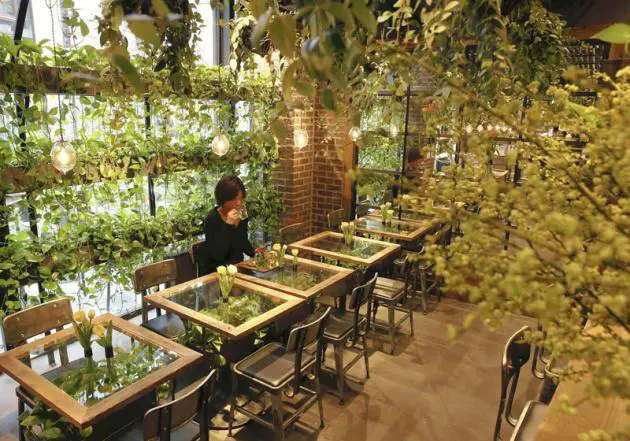
Aoyama Flower Market Tea House, another favourite of Kawaguchi, is operated by a florist. One of three outlets in Tokyo, in Akasaka Biz Tower in Minato Ward, it opened in June last year. About 80 per cent of its customers are women. The cafe is designed to be like a greenhouse, with Pothos vines dangling across the walls and seasonal flowers, such as tulips, decorating the tables. The flowers are changed every week. Quite a few customers drop in by themselves on their way home from work.
Its menu includes items that may be found only in a cafe operated by a florist, such as jelly using rose extract. Lessons for flower arrangement and making bouquets are given occasionally.
“I hope people who aren’t especially interested in flowers also come and enjoy them,” says Yuko Tamiya, 36, the Tea House brand manager.
At these cafes, if visitors find flowers they really like when they are having tea, they can buy them at the florists next door.
“These florists make bouquets for gifts, too, while you drink tea with friends,” Kawaguchi says.
Other cafes she likes are Irving place, which has a tree house, in Tokyo; Nicolai Bergmann Nomu, which is decorated with artistic flower arrangements, also in Tokyo; and Cubierta, which is located on the rooftop section of a commercial complex, in Osaka.
“At these cafes, you can be refreshed with the scents of plants and their beautiful colours,” Kawaguchi says. “They enrich your busy urban life.”
Kawaguchi suggests customers learn how to enjoy tea breaks more pleasantly at home, based on how the flowers and greenery decorate these cafes’ interior.
At Aoyama Flower Market Tea House outlet, a flower in a small glass container is placed on a tray with a pot, cup and saucer for fresh herb tea.
“If you find something beautiful or elegant, try it yourself,” Kawaguchi says.
