
Never too old to learn
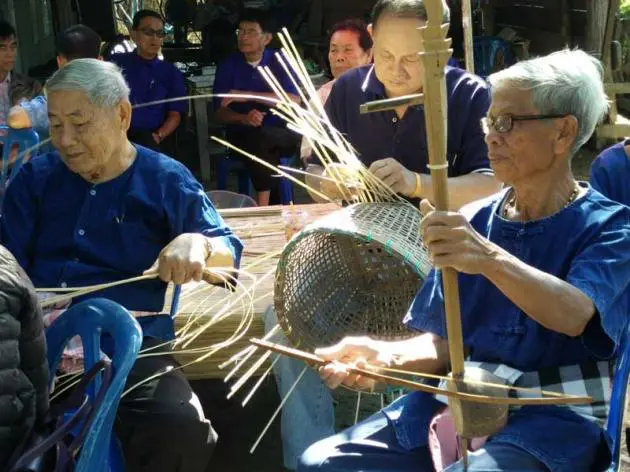


A pilot project in Thailand's rural north gives the elderly renewed confidence in their abilities and the means to support themselves
We live in a world where, as the United Nations puts it, population ageing is pervasive. Life expectancy continues to rise even as birth rates decline and the implications for work, families, health and education are enormous.
The UN predicts the rate of population ageing in the 21st century will exceed that of the previous century. Over the last 50 years, the ratio of people aged 60 or over to children younger than 15 increased by about half, from 24 per 100 in 1950 to 33 per 100 in 2000. Over the next 50 years, this ratio is projected to triple. By the year 2050, there will be 101 people aged 60 years or older for every 100 youngsters below the age of 14.
“Two people celebrate their 60 birthdays every two seconds somewhere in this world,” says Janevit Wisojsongkram, information and communication officer of the Foundation for Older Persons’ Development (Fopdev), a non-profit, non-government organisation working for the disadvantaged and vulnerable elderly in Thailand’s northern region.
The end of World War II brought a baby boom in many nations and Thailand was no exception. Today, the youngest of the baby boomers – people born between 1946 and 1964 – have already turned 50. Their older peers are leaving the workforce and venturing into the territory of senior citizenship.
“In 2012, Thailand’s elderly represented 13 per cent of the population. By 2030, the proportion is expected to reach 25 per cent. It is estimated that in 2030 Asia’s elderly will account for almost 20 per cent of its population. Within only 10 years there will be one billion senior people worldwide,” adds Teerapong Laptwan, Network and Communications Manager for HelpAge International, a global network of older people’s organisations based in London and Brussels.
While acknowledging that labour structures and health care delivery are threatened by the arriving ageing society phenomenon, Fopdev and HelpAge International with support from the European Union see this greying as an opportunity for a better future.
Their joint project, “Building capacity for promoting older people’s rights and income security in Thailand”, which was launched in 2013, aims to strengthen the capacity of civil society and promote consolidation and expansion of the right to income security for marginalised and vulnerable older people.
The project currently covers 30 villages in three provinces in the northern region namely Mae Hong Son, Chiang Mai and Lamphun.
“Senior villagers and officers from Fopdev and HelpAge looked very carefully at how the funds should be used and eventually agreed that Bt35,000 should be provided to each village. It was not considered suitable to give the money directly to each member, as it would be used for personal expenses. This way, we can use it as seed funding for other projects that can generate longer-term income for the whole group,”
“The senior groups decide what they can do to generate income while the team teaches them how to plan a project and manage the funds. In many cases, the Bt35,000 isn’t enough and so the villages go back to the old way of fund-raising like Tod Pha Pa, asking for donation for charitable purpose, while others agree to put a portion of their old age allowances into the fund. Once they get enough money they go on with their projects,” says Janevit.
Mae Chanfong Mahamai, president of the Older People’s Association in Lamphun’s Banthi district, has already mobilised her community.
“The monthly allowance provided by the government is helpful but it is not enough to cover our living expenses. Our group held a brainstorming session and decided o use part of the allowance as a fund to earn more income. Now, we have a Chicken club, a Vegetable club and a Handicraft club and we earn money selling our products. We also have fresh produce for our families. We are not useless and we no longer feel we are a burden on society.”
All too often, older people are portrayed as frail, “past their sell-by date”, unable to work, physically weak, mentally slow, disabled or helpless when in fact quite the opposite is true. Nonetheless these stereotypes often prevent older people from participating in social activities. The situation is compounded by the attitudes of younger people, who make their elders feel useless, thus building barriers to their participation.
“So many people think you become useless the day you retire. Life is not like that. Life goes on after you turn 60 and 70. Your abilities and your skills are still with you even though you might not be as fast or sharp as you were. You still can go out to see your friends and enjoy other social activities,” says Teerapong
“We have to stop stereotyping older people as weak, useless and dependent. Old people have skills, knowledge, experience and they also have more time, so if we give them the tools and teach them how to use those tools, they will make a positive impact on their communities.”
Mae Chanfong, who looks younger than her 75 years, agrees.
“I was born and bred here in the North and there’s nothing I don’t know about rural life. I’ve always believed that senior citizens know nothing about the world outside their villages. When they get old, they stay home and are not as sociable as before. Working with the Foundation has opened my eyes. I have learned that being old is not negative or passive. We can grow old with dignity. I’ve learned about old people’s rights and I’ve passed this knowledge on to my friends. Now senior citizens in at least 10 villages in Lamphun know a lot more about their rights and their abilities to earn income.
“I am an old lady who cannot even read but I am more than ready to learn and so are my friends. Please educate us. I still want to learn so I can spread the word in my community. Teach me about my rights, show me how to access health care and how to care for my health. I never knew that I had rights but with the Foundation’s help, I have learned that old people like me have the right to live independently and also with dignity,” says Mae Chanfong,
“We don’t want to depend on our families economically. We might not be able to do much independently but as a group, we can make a difference. A strong group has a louder voice to communicate our needs and concerns and even allows us to negotiate with key organisations such as municipal offices.
“Now every member in our Older People’s Association understands that being a senior citizen doesn’t mean being incapable. We know that we haven’t lost our value just because we are old. We are not useless and we know our roles as seniors in the society. We will not wait for our children to take care of us or rely on the allowance from government and other organisations. We are active and can depend on ourselves.”
“This pilot project is living proof that older people are not a burden but a resource,” adds Sawang Kaewkantha, Fopdev’s executive director.
“They are the power in driving the development of communities and we don’t have to spend millions of Baht to make it work. Educate them, work with them, help them to help themselves and once they can take care of themselves, they will help the community as a whole.”
