
Hands off our heritageI


Play
Locals are upset by the Fine Arts Department's moves to close small museums and consolidate collections
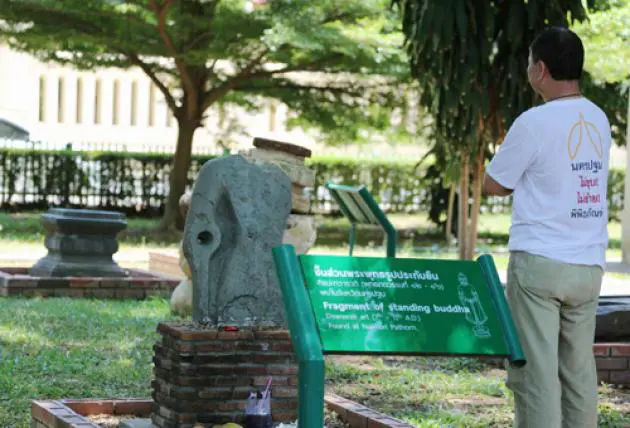
Nakhon Pathom residents angered by plans to remove 1,873 Dvaravati Period relics from the province’s Phra Pathom Chedi National Museum and relocate them to Suphan Buri have won the first round of their battle.
After a protest by more than 5,000 residents on Wednesday, the Culture Ministry’s Fine Arts Department called a temporary halt to moving the collection, which dates from the sixth to 11th centuries.
“We haven’t yet made a decision to close down the museum, only to move the collection to Uthong National Museum,” department director Borvornvet Rungrujee told a press conference on Wednesday.
The move is part of a Bt500-million reorganisation aimed at improving the administration of 104 local museums. The idea is to gather the collections from small local museums and relocate them to a single facility.
The museums affected include the Phra Pathom National Museum, Phra Buddhachinaraj National Museum in Phitsanulok, In Buri National Museum in Sing Buri and Chainat Muni National Museum in Chai Nat.
The Fine Arts Department has justified its plans by expressing concerns over security and management as well as the lack of possibilities for expansion. To date, the only closure has been the Ladya National Museum in Kanchanaburi, though the director points out that it had no heritage collection.
Led by Dr Kongdet Leetochavalit, the “We Love Nakhon Pathom” movement insists that the ancient objects found in the province must stay in the province. They also say the department never consulted the locals about the plan.
Surachai Anutthato of the Nakhon Pathom Provincial Administrative Organisation, who led Wednesday’s protest, says that if the state agency is not in a position to take care of the heritage, it should transfer the responsibility for the museum to the local body.
The department’s plan also calls for the museum to be closed and its personnel transferred to Suphan Buri.
According to the letter written by Uthong National Museum director Panombutr Chantrachot to the Fine Arts Department’s director in April, Uthong will spend Bt2.5 million moving the collection and eight staff to Suphan Buri. Once there, the artefacts will be displayed in a modern presentation in larger galleries. An exhibition, “Nakhon Pathom: Primary City of Dvaravati Era”, is planned for August to celebrate Her Majesty Queen Sirikit’s birthday and Museum Day in September.
Three security guards would remain in Nakhon Pathom to secure the items still in storage and will then be charged with closing the museum.
The transfer of the collection from Nakhon Pathom to Suphan Buri is part of a plan to develop Suphan Buri as the historical Dvaravati centre and promote it as a cultural gateway to the Asean Economic Community. The idea has received support from Suphan Buri politician Banharn Silpa-archa, a former prime minister.
The Fine Arts Department says it has looked at the possibilities for expanding or rebuilding the Nakhon Pathom museum, even discussing the acquisition of a plot from the jail next door, but to no avail.
Since the announcement of the impending move, the “We Love Nakhon Pathom” movement has hosted seminars and called on locals to sign a petition to stop the closure.
“It’s our treasure. It should belong to the city,” said one protester, adding his name to the 20,000 so far collected, but preferring to remain anonymous.
His girlfriend though was less sure, saying that she thought that it would be a good idea to provide the collection with a bigger and better space.
“Although I’d prefer to keep our heritage here, I would suggest that the collection be displayed in a proper way at one bigger museum. That way there would be a one-stop learning centre for the public in general.”
Yet like many locals, both admitted that they had only visited their museum a few times and didn’t know much about their roots.
Fortunately, experts and scholars are very appreciative of the collection and proud of their history. And the protest has even had some positive effects.
“A lot more people have come here since the protest,” curator Pattra Chaopruchyakul told XP, adding that the museum often organises educational programmes like youth workshops and outreach studies.
The Nakhon Pathom museum is a two-storey building, with the 1,837-piece collection packed into a 200-square-metre non-air conditioned gallery on the first floor. Yet despite the less than perfect conditions, the sombre display packed with valuable masterpieces is worth more than Bt200 million.
“Our collection is full of historical value and dates back to the seventh century, which provides evidence that Nakhon Pathom was an historical city in the Dvaravati Period. Both local and international museums have borrowed our collection for their displays. Last year, the Metropolitan Art Museum in New York borrowed nine masterpieces for the exhibition, ‘Lost Kingdoms: Hindu Buddhist Sculpture of Early South Asia’. Now Uthong National Museum is also displaying some of our collections,” the 32-year-old curator told XP.
The permanent exhibition at the 44-year-old museum, which recently underwent renovation, is divided into three sections. One portion shows prehistoric tools and stuccoes depicting foreign- and Indian-influenced objects. There are also examples of peroid dress, ornaments, pottery and stone inscriptions. Sculptures, sandstone carvings, Buddha images and religious stuccoes are displayed in a separate room. And the last section covers the flourishing of Nakhon Pathom up to 1932, and includes a model of Nakhon Pathom Palace, the summer abode of King Mongkut, who renovated Phra Pathom Chedi and modernised the city.
Although the Fine Arts Department has appeared to back away from its plan to close the museum, protesters are still out in force and a new and larger protest is planned for May 22 in front of the museum.
And it’s not only in Nakhon Pathom where locals are upset. A protest was held last Friday at the Phra Buddhachinaraj National Museum in Phitsanulok, against plans to close the place and move its artefacts to the Ramkhamhaeng National Museum in Sukhothai. However, the Fine Arts department has now agreed to give some 1,000 items belonging to Wat Yai Temple for display at the soon-to-be-built Bt17-million-culture centre in Phitsanulok, leaving only 300 items to be moved to Sukhothai.
