
Every page an adventure


Play
In a remarkable exhibition of book art, mystery and marvels supersede simple browsing in the hands of Li and Kay from Likaybindery
THE TWO ladies who make those lovely Likay notebooks by hand have turned a new and much larger page in book design, combining the techniques they use at Likaybindery with fine art for a fascinating exhibition at the Koi Art Gallery.
Mali “Li” Chulakiet and Phantipa “Kay” Thanchookiet are celebrating their bookbinding studio’s 10th birthday with the show “Reading the (In) Habitant”, which continues into mid-June.
Here they venture beyond the structural form of books and demonstrate the full range of potential that common plain paper holds. You see their usual meticulous folding, paper-punching, sewing and binding, but now there is more of the aesthetic of nature. Paper is die-cut into a honeycomb or chain-stitched and then torn at edge – thousands of tiny, painstaking tears – so it resembles a mountain canyon.
“We admire the contours in nature, and here we’ve merged that with our obsession with paper and bookbinding techniques,” says Li, who studied at St Martins College of Art and Design in London and now also runs the Bangkok design firm be>our>friend. “The physical structure of paper and the scale and texture are used to challenge the primary objective of books – reading and writing – and explore more abstract concepts.”
Li and Kay, both also graduates of Chulalongkorn University, founded Likaybindery in 2005. Despite the name, their label Likay has nothing to do with the traditional dance genre but simply combines their nicknames. No two books they create are the same because the colours and fibres vary so widely. Every page left blank for your jottings is bracketed between leaves of collectibles – old postcards, railway tickets, calling cards and cut-out pictures, mixed in with evocative typography and graphic designs.
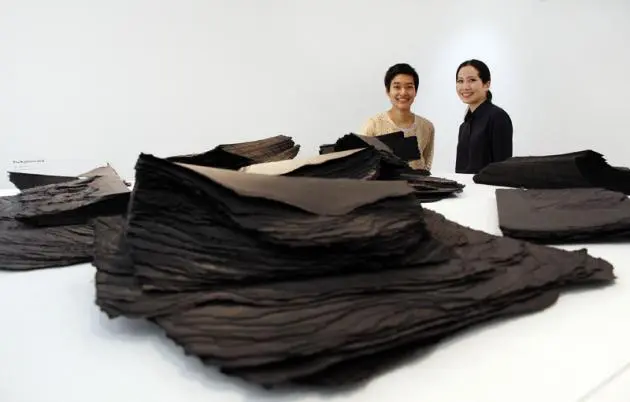
In the exhibition at the Koi, “The Nighttime Wind” takes the same structured notion much further. Seen from above, it looks like a steep-sided canyon. Spread across a table are nine masses of 250-gram black paper folded in layers, chain-stitched and torn at the edge to create the illusion. When this work was first displayed in the 2010 group show “Paper Matter”, a motor underneath actually rotated the piles of paper.
“We’d been sponsored by a leading distributor of paper at the time and opted for black paper instead of white, and it was quite thick so that the inner fibre was black even when folded and torn,” says Kay, a graduate of the London College of Printing and Camberwell College of Art. “We decided to bind them together with chain stitches, making them flexible enough to sculpt into mysterious landscape-like shapes.”
In “The Domestic Passage”, the pages of old encyclopaedias have been replaced with holes cut in the centre. The new pages are link-stitched with blue thread to form a tunnel-like shape, all mounted on a wooden desk. The messy tails of the thread become “branches” grown wild over time. “It’s like something has invaded the book, claiming its own territory,” Li says. “The distortion of the book makes it more than just an information tool for reading – people can interact and make their own interpretations.”
You might see some familiar titles in the show as best-sellers take on entirely new forms. “Stranger on the Page” has Judith Krantz’s “I’ll Take Manhattan”, Howard Fast’s “Max”, Fougasse and McCullough’s “You Have Been Warned”, J Alfred Lee’s “A Synopsis of Anaesthesia” and another tome whose cover has been lost – all stitched together and with the pages cut into organic forms. Kay – who’s also a guest lecturer in experimental design at Chulalongkorn and Bangkok universities – reports with a giggle that several people have asked why they’d brought such worm-eaten books into the gallery.
“One Wasp Section” is a gigantic “book” whose layers of sheets extend out over the cover, each “page” meticulously cut into a honeycomb. Another piece, “172 Pages of Maximilia”, is inspired by the stretching roots of big trees. It has 172 sheets moulded into elaborate forms and chain-stitched together.
“L.I.C.H.E.N” recreates the furry growth on fallen logs using an old tree trunk to which several small metal structures are attached that look like weaving looms. They appear to be weaving paper with thread, with the end result resembling crusty patches of lichen. “Book of Decay Ceremony” is a stack of huge books on a tree stump with layers of hand-marbled paper spilling out of the covers to look like sumptuous natural foliation.
Likay notebooks take a long time to make – in the past 10 years they’ve produced only about 350, and for an admittedly niche market. Li and Kay pay such careful attention to every step of the process that they even make use of the discarded material. “Archaeology of Memory No 1” is formed of cut-out birds and leaves, dipped fancy paper and artificial flowers and feathers, all shaped into book covers.
They’ve used such collages of found objects and delicate cut-outs from the start, but their new collection is more simplified, even as the crafting continues to involve many different processes. The marbling, typesetting, printing with a hot foil stamp and gold finishing on the covers is all done by hand.
The books are sold at the shop It’s Happened to Be a Closet at the Emporium, and Li and Kay also make books to order. You might have your own memorabilia or particular photos you’d like to have incorporated into a book to tell your personal story.
“One guy asked us to make a book for his girlfriend by combining the text from their chats on the Line application,” says Kay. “We made a four-volume book in a leather cover that interleaved blank pages with pages of their chats printed in distinctive typography and with graphic designs.
“Another custom job we did was a guest book for a wedding with the pages from two books cut into the form of a tiny house. When the two books were stitched into one, the two houses became one – representing the couple’s new life.”
A lot of people want to learn the craft, so Kay leads classes at the Likaybindery studio on Sukhumvit Soi 35, showing how to bind hard covers, chain stitch and other techniques, including three from Japan known as kikko toji, asanoha and yotsume. “Every bookbinding technique has its own charms, and you can develop the ideas yourself according to your own preferences,” she says. “Once you’ve made your own book, you truly appreciate the whole process.”
BEYOND THE BOOK
The exhibition “Reading the (In) Habitant” continues through June 14.
Koi Art Gallery on Sukhumvit Soi 31 is open daily except Monday from 11am to 7pm. Call (02) 662 3218 or visit www.KoiArtGalleryBangkok.com.
Likaybindery’s bookbinding classes are held on Saturdays. Find out more at (089) 699 6509, www.LikayBindery.blogspot.com or, on Instagram, “Likaybindery”
