
In search of a middle path


Play
An international conference marking Vesak, which falls today, fails to comprehensively address the religious and ethnic strife in Myanmar
Militant Buddhism as well as “religious and cultural others” were among the buzzwords being bandied about at the last week’s 12th International Buddhist Conference on the United Nations Day of Vesak 2015. Held last Friday at Mahachulalongkornrajavidyalaya University (MCU) in Ayutthaya, the two-day conference – on the theme “Buddhism and World Crisis” – brought together Buddhist scholars, believers and academics from around the world to discuss Buddhism’s role in conflict resolution, the environment, education and the Asean community.
Of the more than 100 Buddhist monks who turned out for conference, none came from Myanmar, which was represented at the event by a single female researcher. Issues concerning ethnic and religious strife in Myanmar, one of the biggest Theravada Buddhist countries in Southeast Asia, were discussed only in passing, and sparingly at best by non-Myanmar speakers during the session “Buddhism and the Asean Community.”
The speakers who were willing to touch on the religious tensions in Myanmar, albeit reservedly, were Dr Brooke Shedneck, a lecturer in Buddhist studies at Chiang Mai University and Jeff Waistell, a senior lecturer in management at Oxford Brookes University in the UK.
In her presentation, “Buddhist Cultural Exchange Programmes in Thailand: A Model for Asean Interreligious Dialogue”, Shedneck pointed out that hostility to the “religious other” is still present in parts of Thailand and Myanmar.
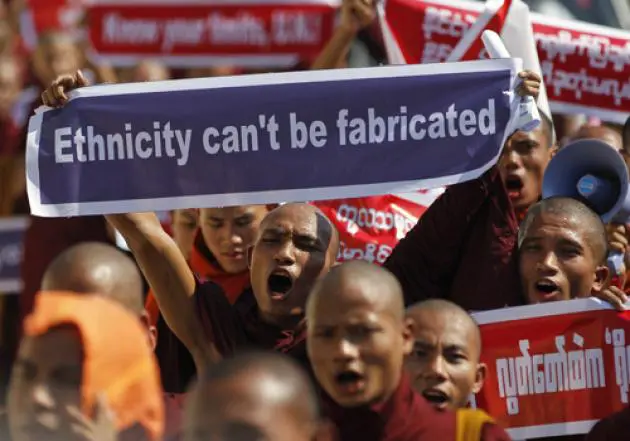
Because both countries have a majority Theravada Buddhist population, she continued, encounters with minority religious populations have led to strong moments of affirming Buddhism as a religion connected to the nation-state. Myanmar is such a situation with Buddhist monks leading violent attacks on the Rohingya Muslims in the Rakhine State.
Movements 969 and MaBaTha (the Organisation for the Protection of Race and Religion) both affirm a Burmese Buddhist national identity and the need to protect Theravada Buddhism within Myanmar.
According to her paper, Muslim populations in Thailand and Myanmar do not have the cachet of a religious or cultural “other” but are distinguished and displaced from the majority population through their non-Buddhist identities.
“There’s a coming together of Buddhism and nationalism in these countries,” Shedneck said.
Yet despite the religious tensions in Thailand’s south, Shedneck feels that the country could be a model for peace dialogue, especially given that Buddhist cultural exchange programmes in northern Thailand help to facilitate dialogue and peace among those of different religions and cultures.
In presenting his paper on “Buddhism, Asean and the Case of Myanmar”, Waistell expressed the opinion that the Myanmar government is resistant to political change, whether internal or external, and is suspicious of attempts by other countries to alter the political situation. It believes itself and its military to be the saviours of the national interest.
“However, the military has little incentive to accommodate change, preferring to retain domestic political power rather than appease the international community,” he said.
The speaker highlighted the fact that any intervention in Myanmar would need to take into account the interests of four key players – the US, Thailand, China and India – and their capabilities.
However, the peculiar mix of these interests and capabilities conspires to paralyse intervention. Firstly, although America has strong capabilities and considers any type of intervention, Myanmar does not offer it any significant material or strategic interest.
Secondly, Thailand’s interest is high (given the disruptions that flow across its borders) but it has limited military capabilities and is constrained by Asean’s non-interventionist stance.
While China and India have important capabilities, they refrain from intervening unless they perceive that their interests are under threat. Furthermore, future intervention in Myanmar would be risky because of the country’s internal situation, its geostrategic location, the reciprocal suspicions of China and India, and the unclear boundaries of the responsibility to protect policy.
Surprisingly, Saw Yee Mon, founder and course instructor of Sym Effect Education Services Freelance Research and president of the Community Service Network for Youth, Myanmar, spoke kindly of her own country on the topic “Buddhist View on Women’s Empowerment in Asean”.
“Misconceptions about women’s rights in Myanmar have been caused by the media,” she said. “According to many written records of western merchants, missionaries and explorers, among many countries in Asia, there is less discrimination but more freedom for women in Myanmar. Women in this country were socially active and could participate in many social spheres.”
According to Saw Yee Mon, Buddhism was imported to Asean directly from India and indirectly from Central Asia and China. All the Buddhist sects from India flourished in Myanmar, Thailand, Laos and Cambodia before the 12th century.
Buddhism in Myanmar first incorporated Mahayana. However, after the decline of Buddhism in India, Myanmar converted to Theravada Buddhism with the help of missionary monks from Sri Lanka.
Bhikkhu Sona and Bhikkhu Uttara were the key players in transporting Theravada Buddhist teachings to Myanmar. Theravada Buddhism was then brought to Thailand, Laos and Cambodia over the next couple of centuries.
The researcher says that from the time of King Anawratha in the 11th century and throughout the Bagan era, Myanmar maintained gender equality.
“This can be proved by the fact that women were allowed to learn and teach Buddhist scriptures at institutes and women could also be patrons of pagodas and temples. There is even evidence that at a monastic institution where monks studied the Buddhist scriptures, a well-learned princess lectured the scholar monks.
“According to this evidence, it is very clear that women were allowed not only to learn but also to teach. Besides, women’s talents were not wasted. Women were given opportunities to be in the right places to utilise their talents to the best.
“Thus, Myanmar somehow impresses historians, scholars and researchers by the fact that throughout its history, women’s rights and women’s roles were secured as an outcome of adoption and application of Buddhism and Buddhist teachings,” she writes in her paper.
Saw Yee Mon credits four females from the history of Buddhism as being superwomen: Visaka for her charity, Khujttara for her knowledge, Samavati for her loving kindness and Supiya for her nursing.
While the conference failed to do justice to some of the most pressing religious issues facing Theravada Buddhism in one of Thailand’s neighbouring countries, Venerable Bhante Chao Chu, president of the Los Angeles Buddhist Union, had this to say.
“We as Buddhists need to recognise the problems among ourselves first in order to solve long-term problems.”
One can only hope that his words are heeded.
