
Bites of knowledge from Asia


Play
At the Expo Milan, the region reminds the world of its contributions to the food chain
"FEEDING THE PLANET, Energy for Life”, the theme of the Expo Milano, takes its cue from the United Nations Food and Agriculture Organisation’s estimate that the demand for food will rise by a massive 70 per cent by the year 2050 as the population climbs to 9.1 billion.
Not surprising then that countries are seeking integrated solutions for food security and the conservation of biological diversity to feed their people. They have little time in which to do it too, as the rapid pace of urbanisation is already putting energy, water and, yes, food too, under great pressure.
Asia, the fastest-growing region in the world, with a billion people added to its cities between 1980 to 2010, is working especially hard to meet the challenges, Singapore, China, Japan, and South Korea top the Sustainable Innovation Competitiveness ranking, providing quality education, cultivating research and development, creating globally competitive products and services, and providing jobs and income for their populations.
Japan, the only Asian country in the top 20 ranking in 2013, underlines its talent for innovation by combining its traditional wooden construction techniques with advanced technology in its pavilion on the theme “Harmonious Diversity”.
Japan also goes all out to communicate the excellence of Japanese dietary cultures by taking advantage of the registration of “washoku”, as traditional Japanese cuisine is known, as a Unesco Intangible Cultural Heritage designation.
Paintings and calligraphic works run in a video loop in the first room, representing two tree trunks growing from one root and depicting of people and nature. The second room is home to an interactive installation of a rice field in all four seasons as well as a digital waterfall of information about Japanese food culture that arrives on visitors’ smartphones. The most interesting room is a restaurant of the future that brings a sense of unity through interaction with cast performances, and large screen video spatial presentations. The words “itadakimasu” and “gochisosama” express gratitude towards all people involved in food as well as the boundaries of nature.
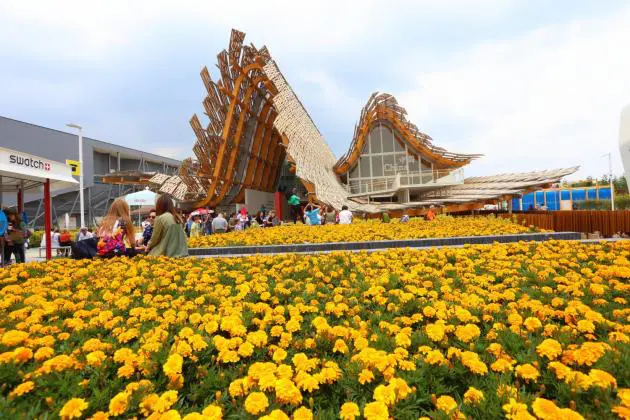
The Chinese Pavilion – the country’s first national expo pavilion overseas – uses such renewable materials as a timber structure, bamboo roof panels, and wheat straw. The roofline, which merges the profile of a city-skyline with the silhouette of a rolling landscape, depicts the hope that cities and nature can co-exist in harmony. It allows light to filter in a natural way and reduces energy consumption. Its theme, “Land of Hope, Food for Life”, relates to agriculture, food, environment, nature and sustainable development.
“The Gift of Nature” zone presents the Chinese calendar and its influence on agriculture. “Food for Life” shows the production path of foods including tofu and Beijing roast duck, as well as China’s famous eight schools of cuisine and its tea culture. “Technology and the Future”, meanwhile, focuses on the progress of science, including hybrid rice varieties.
The architecture of the South Korean Pavilion was inspired by the traditional Korean ceramic porcelain moon jar and has as its theme “Hansik, Food for the Future: You Are What You Eat”. Hansik, as Korean food is known, presents a feasible and sustainable alternative for all future generations.
The first exhibit addresses problems concerning contemporary eating habits and culinary culture. “Symphony of Food: Balance” offers a multimedia show portraying the notion of harmony and the balance of foods and sum of all objects in nature. “Science of Time: Fermentation” exhibits how fermentation is achieved in the traditional earthenware vessel called “onggi”.
The Vietnamese Pavilion is realised as a forest with 46 trees towering above the building on reusable bamboo structures. The message is that we should bring back the trees to the cityscape in order to share the importance of nature and regenerate living in harmony with nature.
The Malaysian Pavilion takes the shape of four seeds, with the curves of the design and the weaving patterns on the structure reflecting the versatility and dynamism of the nation. Inspired by the humble rainforest seed, it’s on the theme “Towards a Sustainable Food Ecosystem”.
“The Malaysian pavilion aims first and foremost to help visitors understand what Malaysia is about: what we have achieved so far and what we can contribute towards the theme of the Expo. Malaysia is not very well known here in Europe compared to some other Asean countries, so we would like to make people understand what we have to offer to the world, especially in terms of our tourism attractions and business environment,” says director Shamilah Perumal, who expects 10,000 visitors per day.
“We also want to show our contribution to sustainable development and how Malaysia can contribute to ensuring that food supply is sustained for future generations.
“Seed 1 is ‘Our Home – Now and the Future’ – and showcases our current developed state. In Seed 2, we are showcasing the rainforest, how the heritage should be protected to ensure that the entire nation as well as the world can enjoy it. Also in Seed 2, we look at how we can educate young children about the importance of the rainforest. In Seed 3 we are showing our commodities and our economic progress. We started with rubber, we went into palm oil and now we have moved into herbs. These are all products from the forest.”
The nearby Thai Pavilion, designed as the “ngob” as the traditional hat worn by farmers, pays respect to His Majesty the King in the “King of Agriculture” zone, showcasing his sufficiency economy philosophy for sustainable and balanced living.
While Thailand has a sculpture of a buffalo, the Indonesian Pavilion boasts one of the Javan rhinoceros the rarest large mammal on the planet, of which no more than 50 are left in the wild. Indonesia’s size, tropical climate and archipelagic geography have brought the country into the world’s second highest level of biodiversity thanks to its flora, fauna
and natural resources.
A virtual reality show immerses the visi
tors in Indonesia while an Oculus show displays its attractions and cuisine. Indonesia has long
been playing an important role in the world’s food supply chain. Palm oil, cocoa, coffee and tea are among the major food ingredients supplied to the global market.
