
Body Beautiful


Play
Show by Japanese female artists brings smiles to the faces of its viewers
UP-AND-COMING female contemporary artists in the Kansai region are bringing surprises and laughter to spectators, using their bodies as part of their artwork.
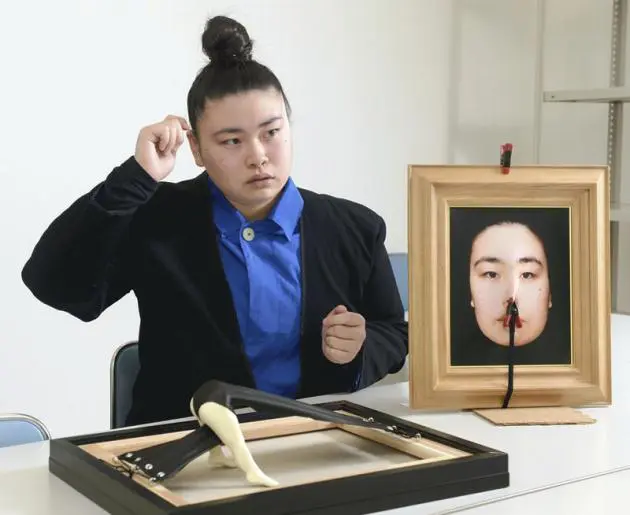
One artist puts an elastic cloth on the wall and hides only her upper body behind the cloth, sticking out both of her legs into view. Titled “Ichora” (“One’s Sunday Best”), this work is by Kansai-based contemporary artist Hiroko Taki. In another work titled “Ushirogami Hikareru” (“Hard to tear myself away”), Taki’s hair is fixed to the wall to reflect the meaning of the Japanese title, which literally means “pulled by the hair from behind”. Both works are meant to express the literal meaning of the original titles.
What particularly surprised viewers was her ability to keep balance while showing both of her legs, and the patience to keep the same pose for seven hours.
As a high school student, Taki saw a work by avant-garde artist Kazuo Shiraga (1924-2008). Known for painting with his feet, sometimes while he was suspended from the ceiling, Shiraga was an active member of the Gutai Bijutsu Kyokai, a group of avant-garde artists.
Overwhelmed by the energy of the winding lines Shiraga produced, she made up her mind to study art and entered Seian University of Art and Design. But she was lost over what she wanted to do, so she took a leave of absence.
After she went back to the school, however, Shiraga died. Then, Norio Imai, an artist and then a professor at the university, said, “Why don’t you produce an homage [to Shiraga]?”
Just as Shiraga did, Taki poured red and black paint on the canvas and painted her work with her feet, hanging from a rope suspended from the ceiling.
The performance itself took only half an hour, but Taki had to take time to prepare. She chose colours Shiraga had often used in his works, paying careful attention to how she moved her feet so as not to mix paints and turn them into dull colours.
She said that because of the performance she realised she wanted to express power and strength in her works.
Taki began taking photographs of her own face and body parts. “This helped me deepen my interest in myself,” she said.
In fiscal 2014, Taki won the Sakuya Konohana Award, an art prize sponsored by the Osaka city government, but she remains modest.
“What is important is to explore yourself. I’ll never be at a loss,” Taki said.
Kurumi Wakaki is pursuing “funny” expressions by drawing people’s portraits on the shaved back of her head. So far, she has painted the faces of about 100 people.
During an interview, a Yomiuri Shimbun reporter asked her to draw her face. Sitting face-to-face with each other, the artist drew the reporter’s portrait by alternately looking at her subject’s face and the back of her own head in a mirror, using black, white and red pens.
Carefully drawing even the shade and shadow of the reporter’s nose and wrinkles around her mouth, the artist finished the work in less than an hour.
Wakaki majored in prints at Kyoto City University of Arts. As she was pursuing her own style of expression as a third-year student, she learned about a performance titled “Hungary koku ni Hangari de Iku” by Chu Enoki from an art magazine.
In the performance, whose titled can be literally translated as “Going to Hungary with half of my body hair shaved,” Enoki visited Hungary after shaving the hair on the right side of his body.
She was surprised that that could represent a form of artistic expression.
Encouraged by Enoki’s offbeat expressions, she drew a human face on the back of her head for the first time for the 2007 Tokyo Marathon.
With the hope of relieving the tedium of the runners behind her, she ran in the race with a drawing of a smiling face on the back of her head, which naturally caught runners’ attention.
When she displayed photographs and videos taken on the day of the event in the university gallery, she received more responses than those she had had for her print works.
Though she is shy with strangers, she realised that she was able to “communicate” with others through the face on the back of her head.
“Because I use my own body, it’s a work that belongs only to me. I also became convinced that people overall want to see interesting and funny things,” she said.
In 2009, Wakaki received the Taro Okamoto Award, the top prize in the Taro Okamoto Award for Contemporary Art, which was set up to honour the namesake artist. She still produces “back-head art,” calling it “my original creations.”
Enoki, who has been giving advice to Wakaki, is also pleased to see the young artist’s success.
“In contemporary society with advanced technology, she dares to take on the challenge of creating innovative works by using her own body,” he said. “Such a daring spirit, which is very much like that of Kansai, is very stimulating.”
