
A weaving tradition in the balance


Play
The future of Nishijin brocade is being woven by young hands
The air rings with the sound of power looms clanging away in a traditional townhouse in Kyoto’s Nishijin district. It comes from the workshop of Gonomi, a project for fostering young weavers.
Homemaker Kana Tomiyama, 28, operates a loom with her year-old daughter on her back. Hoping to acquire a specific skill, she began commuting to the workshop to learn from Hideto Sasaki, 43, an accredited traditional craftsman. She still needs several more years’ training to become independent as a weaver.
Sasaki started the workshop last autumn. “I was brought up in the world of Nishijin brocade,” he says. “I wanted to do something for it in return.”
The oldest weaving method is called tsuzure-ori, done by hand.
The weavers file saw-like grooves in their fingernails so they can rake up the horizontal threads on a loom that’s operated by hands and feet. A key technique called bokashi (shading) makes the patterns appear three-dimensional.
Tsuzure-ori textiles are used as tapestries for decorating Yamaboko floats at Kyoto's Gion Festival. Only about 70 tsuzure-ori craftspeople are thought to survive.
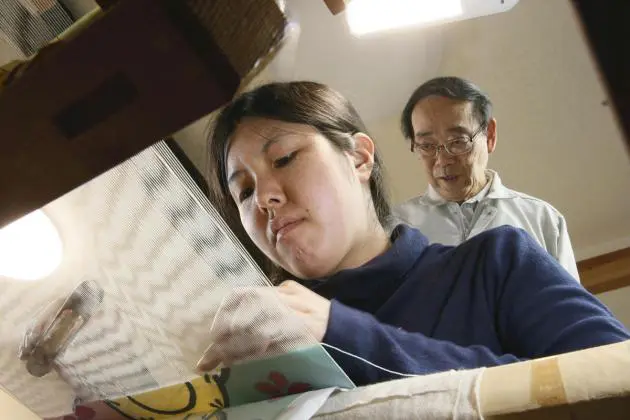
Kikuo Hirano, 75, opened a small school called Soshi Tsuzureen in 2010 to preserve the technique, after retiring from the textile company where he’d worked for 42 years.
There are 20 students, including those who aim to become professional craftspeople and those learning it as a hobby.
“I ordered an obi sash and was fascinated by the delicate, expressive power of the weaving,” says Yumiko Ono, 30, who attends the school once a month, coming from Tokorozawa. “There are no specifications to follow like they have at factories, so I have to think for myself,” says Ono, who also works temporarily at an electronic-parts factory. “It’s difficult, but interesting at the same time.”
Charmed by tsuzure-ori, Ono plans to move to Kyoto this month and undergo full-scale training to become a weaver.
There used to be nearly 10,000 power-loom weavers, but the number had dropped to about 730 in a 2011 survey, and about 70 per cent were 60 or older. Craftspeople are concerned about the industry’s future. “Weavers’ eyes and fingertips are indispensable for the job,” says one. “I’m worried about what it will be like 10 years from now.” “If we don’t do anything,” Sasaki says, “weavers will eventually disappear. I’d like to change the marketing methods, too.”
Part of that means sellling obi sashes and other kimono accessories produced in the workshop through his online store. He has surfed the Internet to see what’s selling best and then spins them into the yarn of tradition.
