
At the end of the trip


Play
Fifty years after getting together, Grateful Dead play their final show ... maybe
ON THE last day the surviving members of the Grateful Dead played as the Grateful Dead, on a lovely Sunday in Chicago before the last emotional notes rang out around midnight, the following happened: Jim Avery, a middle-aged sales manager for a beer distributor in New Hampshire, sat in the back of the CTA 146 bus wearing a T-shirt with a Jack-O-Lantern across the front.
“I am never doing this again,” he said, pausing to let his words sink in. “This is the end, I can’t see the Grateful Dead again after tonight. But ... if it’s not? If they do decide to return? Then I’m out. No more.”
When the bus stopped in the South Loop, Avery joined the shuffling, migratory crush headed for Soldier Field, a kind of tie-dyed Walking Dead. Outside the stadium a woman climbed a pole and snipped a pair of Dead banners from a lamp post and ran off. Here the thickets of Deadheads grew increasingly dense, until in places it resembled a forest of index fingers pointing at the sky.
That’s Deadhead for “I need a ticket.”
Or rather, it was Deadhead lingua franca – the finality of Sunday’s concert stripped away much of the typically casual vibe of a Dead show and replaced it with something a little more raw and teary and frantic. Theoretically, this was likely the last time for many of these people to wave a finger in the air and pray for a miracle ticket; the last time they could buy bad stir-fry from a guy in the parking lot wearing Guatemalan pants; the last time they could wiggle their arms like a malfunctioning robot, searching for a beat to dance to.
Then again, an even larger segment of the audience, a segment of less grizzled folkie and more business casual – seemed to understand nothing really goes away anymore. They were younger, and if this was a 50th class reunion of sorts, they seemed like the eager children of returning alumni, cheering the video-screen ads for upcoming CDs of the very shows they were attending and ordering pulled-pork sandwiches (without the bread) at concession stands.
These several generations of Deadheads mingled, and danced, until Soldier Field felt elastic, and it was hard to tell where pot-bellied tie-dyes ended and Instagram flower wreaths and ironic tuxedos began. A woman passed by with a photo of Drake’s crying head pasted to a stick – her way of expressing melancholy. Others gave away flowers and bought beer for neighbouring fans.
The last Grateful Dead concert was about four-and-a-half hours long, and so infused with this bittersweet poignancy that song titles (“Unbroken Chain”, “Days Between”) gathered fresh meaning, and lyrics acquired new warmth: During “I Know You Rider,” the audience seemed to surge forward in unison on the line “Gonna miss me when I’m gone”. On “Truckin’”, even the much-quoted “What a long strange trip it’s been” could no longer be taken for granted, particularly with the end of that legendary road looming.
At intermission, a man in line for the men’s room loudly, and with seeming conviction, began to argue with a friends that Jerry Garcia, who died in 1995, was going to walk out in the encores and be the show’s big, shocking surprise – his death having been naturally faked for the primary purpose of reminding us how to appreciate life. A guy in front of them turned and said, smiling, that it was a nice sentiment, however insane.
And fans began preparing for the last ride.
Tony Dwyer, who runs a Wall Street hedge fund, served as a concert producer in St. Louis in the early 1970s and booked several Dead shows. He watched the stage with a forlorn look and said: “The Grateful Dead ended, to me, in August 1995 (when Garcia died), but my love for these people started so long ago, when it was still very raw, that, yes, this is meaningful for me, because I suppose I feel very, very attached to the band. So, yeah, I will be crying soon.”
Indeed, at the end of the show, he put on sunglasses for the last numbers. Tears, throughout Soldier Field, started around the third to last song, the band’s noodling cover of Buddy Holly’s “Not Fade Away,” with it’s (slightly embellished) refrain: “Our love is real, not fade away.” The entire stadium seemed to be chiming in.
Strangers kissed strangers like it was New Year’s Eve. The floor of Soldier Field, a mass of bodies that seemed like a real-time math lesson in how many people can fit in an enclosed space, undulated.
And then the end arrived – the lullaby “Attics of My Life,” with its nostalgic “I have spent my life / seeking all that’s still unsung” – and the earth did not open and no one appeared to be wailing. But crying, swiping at tears, faces red and shiny with silent weeping – oh, yes.
The final lyrics were: “When there was no dream of mine / you dreamed of me.”
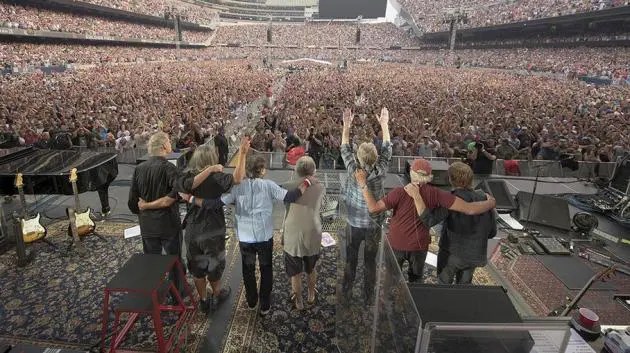
Harmonies crested. The band took a bow, and a group hug, then drummer Mickey Hart told the audience: “This feeling we have here – remember it, take it home and do some good with it.” Then the lights came up.
For a full half hour, thousands sat still.
Then they left.
