
A model of sufficiency


Play
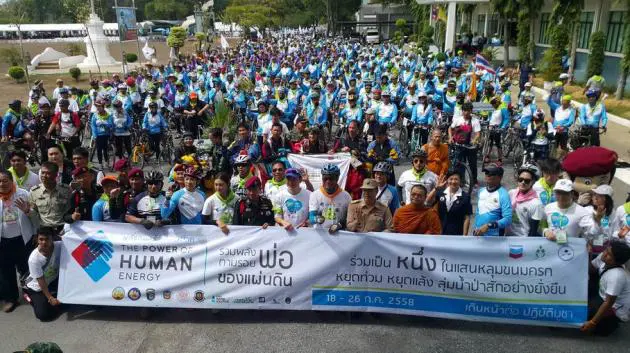
More than 2,000 volunteers take part in the third edition of the "Power of Human Energy" project
MORE THAN 2,000 people recently spent nine days on the road taking part in an annual project to protect the country from floods and drought by saving the Pa Sak River.
The project, which is known as the “Power of Human Energy: A Journey Inspired by The King” project, is centred on His Majesty the King’s sufficiency economy and new theory philosophy and draws on the notion that development must be suited to geographical and social conditions. The developments must also be based on the principles of sustainable conservation and the development of natural resources while combining promotion of knowledge with modern technology.
The King’s new theory philosophy proposes guidelines for the proper management of limited natural resources to achieve optimum benefit. Under this principle the land is divided into four parts: 30 per cent is allocated for a pond to collect water to be used for cultivation in the dry season and to raise fish, 30 per cent is used for sufficient rice cultivation for year-round home consumption, another 30 per cent is set aside for integrated garden crops and fruits, and 10 per cent is left for housing, livestock enclosures, mushroom nurseries and roads.
The first day of the project was spent cycling, running or walking the 30 kilometres from the Special Warfare Centre’s Command School at Camp Erawan to the Command’s Sufficiency Economic Learning Centre in Lop Buri, and was joined by celebrities Jirayu “Kao” La-Ongmanee, Kemmanij “Pancake” Jamikorn, Pisanu “Boy” Nimsakul and Siwat “Cee” Chotichaicharin.
On arrival at learning centre, Asst Prof Pichate Sowittayasakun, dean of the Faculty of Architecture of King Mongkut’s Institute of Technology Lat Krabang, explained the khok nong na model, a type of swale or ridge that serves as a catchment for water running down from the mountains while simultaneously controlling its flow.
On the second day, hundreds of cyclists rode the 60km to Wat Khok Salung School in Phatthana Nikhom, stopping to promote the project along the road. Jirayu was the first to make his khok nong na, designing it in the shape of the numeral 9 on land belonging to headwoman Uthumporn “Oy” Sukpaet.
Pancake worked hard at building a loom khanom khrok water catchment with Malai Khumthong at the Khao Ti Hin community at Wat Tham Phothiyan in Ban Mi. She also took time to visit the to Kok Charoen Natural Farming Centre.
Boy Pisanu went further afield, travelling to Ban Tha Mai Thong in Phetchabun to learn about the sufficiency economy and natural farming at Prasert Kwanpueak’s house. He also dug a water catchment at the house of local farmer Boontem Nasamdaeng.
Cee Siwat will later travel to Sub Lung Ka Wildlife Sanctuary to learn how to make a wet fire break and also build a water catchment on Dorn Petchnarong’s land as well as making check dams and an artificial mineral lick.
Ten foreign students – four Bhutanese and six from France – also took part. They learned about His Majesty the King’s sufficiency economy and new theory at Pootalay School, part of the Mab-Uaeng Agri-nature Learning Centre.
“I came here to study the sufficiency economy,” Lhundup “Baby” Wangmo from Bhutan told XP.
“The instruction was really good, particularly as it focused more on practice than on theory. Back home, like in the West, it’s all about theory. “The khok nong na model is a great idea, especially for a mountainous country like Bhutan. Right now people at home are facing water shortages and it’s so bad that my mother tells me we were not able to grow rice this year because there was no water. Drought is also a big problem in Bhutan, so building these run-offs to store water is a good idea as it will allow us to irrigate our fields and grow rice, vegetables and perhaps also raise fish, no matter the weather.
“I do realise though that it will be difficult to introduce this idea of khok nong na back home so first we have to do it on our own land. I already talked with my father and he is happy to let me design a small swale on our land as a demonstration model. My ambition is to start an organic garden and apple orchard and the khok nong na will help with that too,” Lhundup said.
Marion Jawl, 19, a trainee physical therapist and one of six French students from Haute Ecole Robert Schuman, belongs to a Scout group in France.
“We have learned many things about your culture, your King and your traditions. I really admire the way the Thais respect and love their King. Everywhere we go, we see a photo of your King, even in private houses,” she told XP.
“I am also impressed by the organic gardening I have seen here. I always thought of Thailand as only focusing on rice but I have found you are very receptive to all kinds of agriculture. Organic farming has been popular in France for many years and it is continually being developed in an attempt to avoid genetically modified crops but I have a feeling it is more important here in Thailand.”
The “Power of Human Energy: A Journey Inspired by The King” is an ongoing project that aims to achieve the building of 100,000 natural catchments to prevent floods and droughts in and around the Pa Sak River basin.
SEE THEM WORK
- Find out more about “Power of Human Energy” on the “Joh Jai” programme on the One digital TV channel. Broadcasts are set for 10.20pm on September 11, 18 and 25.
- For more information, call (098) 981 3631-2.
