
Anyone who has a heart


A multi-million Baht injection into a charity fund sets out to help kids born with congenital heart disease
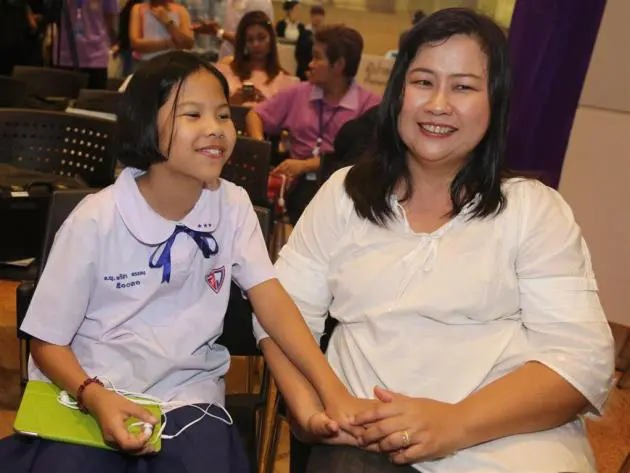
LOOKING AT 11-year-old Pharisa “Mint” Tongkhong dressed in her school uniform and playing with a tablet, it’s almost impossible to differentiate her from any other student of her age.
She’s petite – not uncommon among school kids – but her lack of inches has less to do with stature than congenital heart disease. Indeed, the youngster has already undergone three surgical interventions to help her to live like other any child.
Mint was born with a hole in the heart wall between the ventricle chambers, a defect that allowed oxygen-rich blood to leak into the oxygen-poor blood, which made her look blue. The doctors also discovered that her pulmonary valve was malfunctioning, almost completely blocking the blood flow out of the heart into the pulmonary artery and then to the lungs. That caused her oxygen blood level to stay at about 80 per cent compared to most newborns where the level is 95 per cent.
“Her condition was so severe that without surgery she wouldn’t have survived,” says Dr Suthep Wanitkun, a specialist in paediatric cardiology
Dr Alisa Limsuwan, who runs Ramathibodi Hospital’s congenital heart disease project, explains that congenital heart disease is caused by abnormalities in the heart and artery when the baby is in the womb though the condition varies from mild to severe. “About one in every hundred children are born with a congenital heart defect,” she says, adding that in most cases this is not serious and requires no treatment.
Mint was just 10 days old when she was taken into the operating surgery to close the hole and restore temporary blood flow to the lung. The operation was successful. Mint’s mother Waraporn, told XP she was shocked when the doctor informed her of the infant’s problems. Mint is her second child and there is no family history of any heart defect nor was anything amiss picked up during routine pregnancy check-ups.
But that was a decade ago and today such cardiac problems can be diagnosed before the baby is born. In some cases, treatment can begin in the womb.
Ramathibodi Hospital recently launched a project focusing on congenital cardiac disease patients with the aim of offering a complete programme of continuing treatment for patients starting in the foetal stage though infancy, toddlerhood, childhood and adolescence to adulthood.
Waraporn is relieved that she chose Ramathibodi Hospital for her prenatal care even though it’s a long way from the family’s home in Pathum Thani, as it meant that both nurses and doctors quickly noticed Mint’s problem and were able to provide timely treatment.
“Mint’s parents trusted our doctors and that helped us to take up the treatment options we needed to save the child,” Dr Suthep says.
Mint returned to the operating table at the age of three and this time was fitted with a donated valve to replace the old one. Donated valves do however need replacing and last year, she was fitted with a new valve through catheterisation
Mint was exceptionally lucky in that the hospital decided to include her as part of its charity programme, fitting her with a new Melody Transcatheter Pulmonary Valve, which cost Bt1 million. The valve is transported to the heart through a thin, hollow tube (catheter) with a specially designed heart valve inside that’s inserted into a vein. The heart valve is from a cow’s vein that has been attached to a wire frame and replaces the old one helping her heart pump blood correctly.
Doctors chose the Melody valve for Mint as it’s a technology that didn’t need open-heart surgery and the valve can work longer and help to delay the need for the next surgery. Another advantage was that the child was able to return home after just one night in hospital.
The funding came from a Bt40 million donation from Sena Development Company, which aims to help patients with congenital heart disease and purchase new ambulances.
Asst Prof Dr Kessara Thanyalakpark, executive director of Sena Development, says the idea for the charity donation was born when her father Teerawat, the founder of Sena, was hospitalised at Siriraj for a year. The “Baan Ruam Tang Fun” programme operates on a “live to give” concept, with Bt40 million a year being taken from the profit made on building houses. Both Siriraj Hospital and the Police General Hospital have already benefitted from the project.
Thanks to Sena’s generosity, 10 young children will be selected for the Melody valve replacement programme, thus helping them lead normal lives and delaying the need for the next surgery.
This Sunday Sena and the hospital are holding a “Congenital Heart Disease Camp” at the hospital’s Medical Learning Resource Centre in the School of Nursing Building.
“It’s a part of our project to offer complete care to patients with congenital cardiac disease. We educate people about heart diseases – what to do, how to stay healthy, and how to avoid infection, which could worsen the condition. We promote exercising in a manner that suits the patient’s condition, personal hygiene such as keeping the hands clean and wearing a surgical mask, and disease prevention by vaccination,” says Dr Alisa, adding that kids with congenital cardiac disease need special care and the camp provides an ideal opportunity for doctors, parents and kids to learn the best ways of avoiding infection.
For her part, Mint needs to take care of her dental health, as unhealthy teeth and gum disease can enter the bloodstream causing bacteria to build up on the valve’s wire frame. Too much build up, |Dr Alisa says, could lead to death.
-Parents with children who suffer
Parents with children suffering from congenital cardiac disease can register for the camp by calling (02) 201 1685.
