
Furry chairs, songs about Doug vie for Turner Prize


Play
The British competition remains adept at pinpointing the oddest ideas in contemporary art
Britain’s Turner Prize has long stirred debate in the art world with its unconventional choices, and this year may be no different with a song performance and an architects’ collective among the contenders.
An exhibition of the four finalists’ work begins in a room of modern chairs with fur coats sewn onto them, by London-based German artist Nicole Wermers. On the wall are ceramic sculptures resembling advertisements with numbers that can be torn off.
“Both projects are about crystallising fleeting social gestures – the placing of a coat on a chair to mark space, the tearing of a number off the wall to get information – into rigid sculptural form,” says co-curator Paul Pieroni. “This is the most conventional part of the exhibition – it’s sculptural objects in the traditional sense.”
Stepping into the next section of the exhibition, which opened on Thursday and continues through January 17 at the Tramway arts centre in Glasgow, visitors’ feet sink into thick carpet, a contrast to the rough concrete floor of the rest of the gallery. They have entered the supernatural study centre of British artist Bonnie Camplin.
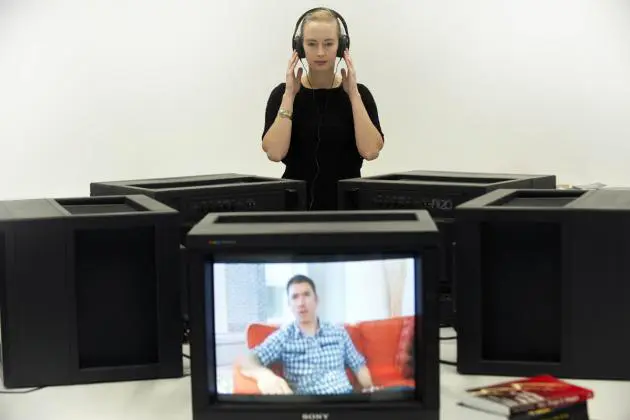
The room contains five televisions with headphones through which you can listen to people explaining supernatural events they claim to have experienced. Around the room are books and scientific articles intended to help you decide whether the tales are true.
“The project as a whole is really about questioning what it is we take to be consensus reality,” says Pieroni, “so it’s pushing the limit of what we might say is real or unreal, believable or unbelievable.”
The third component of the exhibition features the enigmatic work of 45-year-old Canadian artist Janice Kerbel. The musical composition “Doug” is performed by six opera singers dressed in black who sing songs recounting a series of disasters that happened to a person named Doug. “You can really feel the alarm, the danger and the violence,” says co-curator Claire Jackson. “It’s making something physically manifest through spoken words alone.”
The final part of the show explores the work of Assemble, a group of 18 young people working in architecture and design. They constitute one of the Turner Prize’s most unexpected candidates in recent years. The work that drew the nomination was a refurbishing of Victorian homes in Toxteth, a district of Liverpool that had fallen into disrepair and dereliction after riots in 1981, where residents have long battled against demolition.
The ongoing project works with the idiosyncrasies of the properties, making double-height rooms where ceilings have fallen in, and creating a “winter garden” inside a pair of houses that are no longer habitable.
Since the houses themselves cannot go on show, the exhibition is dedicated to the group’s Liverpool workshop, where they worked with local young people to build items such as fireplace surrounds, door handles and stools for the project.
“They are offering a really interesting new dialogue around how architecture, visual arts, design and craft interact,” says Jackson. “This idea that there is one role for the artist is becoming increasingly blurred.”
The contemporary-art prize named after painter William Turner has been awarded annually since 1984 to an artist aged under 50 who is living in, or was born in, Britain. Among its past winners was Damien Hirst, for his bisected cow and calf preserved in formaldehyde.
