
In South Africa, art from cow dung
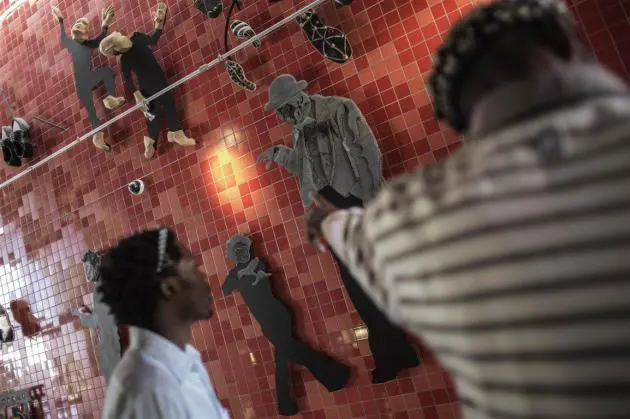


Strapped for materials, the Ubuhle Bobuntu collective makes do with whatever's available
ON LAND THAT is both a marshy field and a rubbish dump in the South African township of Soweto, artist Mzi Gojo is looking for a special material to use in his latest work – cow dung. “The good thing about summer is that the cow dung is very green and it stays very green on my canvas,” he explains.
Gojo is a member of Ubuhle Bobuntu (“beauty of humanity” in Zulu), a group of artists who use recycled materials and experimental techniques to express their own lives in modern South Africa.
The 12 artists are all from Soweto, the former heartland of the violent struggle against apartheid that has now developed into a sprawling town of brick houses and tin-roofed shanks outside Johannesburg.
Gojo, 33, carefully mixes the dung in water – and adds a little bit of glue – to achieve the variety of colours and textures needed to produce his mysterious, elegant abstract paintings. As well as a normal brush, he uses a broken comb, a blade or a piece of plastic grid.
“Cow dung is like a soccer ball. I can control it,” he says, wearing an immaculate white shirt with his brown chinos on his search through wasteland and stagnant water for the exactly right droppings.
“Winter cow dung makes a nice brown. Calf dung is yellowish because they only drink milk, but it is so hard to get it here.
“I was using this material when I was young. I used to clean the house, and we used dung to make huts. It reminds me of the good times,” says Gojo, whose paintings sell for between 5,000 and 50,000 rand (Bt13,000 and Bt133,000).
Every artist in Ubuhle Bobuntu has his own technique and recycles whatever he can best exploit for his work: plastic bottle caps, burnt matches and even old bread or human hair. “There is no art shop in Soweto. We don’t have the money. So we had to come up with an alternative way,” says Lehlohonolo Mkhasibe, one of the group’s founders. “We wanted to create a new language, away from the conventional techniques created by the old masters. I was really stressed after I left school. It is so hard to find linocard. I couldn’t buy any. I had to think outside of the box.”
Mkhasibe, who uses his garage as a studio, spent months developing a technique in which he stacks strips of old car tyres together to create a canvas and then cuts into the material to create a black and white image. It’s a method that earned a commission from energy drinks company Red Bull.
For Victor Mofokeng, bread can be transformed into the perfect means of artistic expression by moulding it or toasting it, and the stale loaves thrown away by supermarkets produce a vivid green.
One of his paintings uses a stunning spectrum of subtle colours to depict youngsters who brandish banners reading “No work, No food”.
The intriguing techniques have attracted increasing attention, with exhibitions held in Soweto and at the Museum Africa in Johannesburg.
This year, the group’s best-known artist, Pauline Mazibuko, who makes collages from recycled magazines, exhibited her work in Santa Fe, New Mexico.
For Charles Nkosi, the head of fine arts at the Funda art college, the group represents an approach that says much about how people live today. “They’re reinventing the world and beautifying it with what people dismiss,” he says.
