
Riding around the Sun Moon


Play
Picturesque parks and dramatic mountain terrain make Taiwan an ideal cycling getaway
NOK AIR HAS been busy flying cyclists to destinations around Thailand for the past couple of years, and this year alone has taken them down south to Krabi and Koh Lanta as well as northeast to Nakhon Phanom.
Now NokScoot, the low-cost Thai airline that’s the offspring of Nok Air and Singapore Airlines, is joining in the cycling trend with “Awesomely Fly and Bike in Taipei”, a bike trip aimed to promote its Bangkok-Taipei flights.
Although not yet globally well known as a cycling destination, Taiwan certainly has plenty to offer both the competitive and recreational cyclist with scenic routes taking in all types of landscapes, from breezy coastal pathways, culturally-infused urban roads to lush jungle.
After a three-hour drive from Taoyuan International Airport, our group arrives in Nantou, the island’s second largest county, for a trip that will take us around Sun Moon Lake and to other tourist destinations nearby.
Sun Moon Lake, we’re proudly told, was crowned one of “10 Breathtaking Cycling Routes” around the world by CNN Travel in 2012 and voted one of the “Top Ten Bike Routes” in an online poll organised by the Sports Administration.
“The bike pathway around the lake is very beautiful and also rather challenging. It’s best tackled by intermediate-level cyclists because not only is it a relatively long ride but the climb from Ita Thao Village to Xuanzang Temple can be quite hard going,” says Guo Yong He, 50, of the Taiwan Bike Association, which today boasts more than 40,000 members. “It is better that anyone coming to ride in Taiwan studies the bike routes first or contacts us for information on the best route for them. We have several routes that are suitable for everyone from beginners to professionals.”
The ride starts at Shuishe Pier and climbs up the mountain road to Wenwu Temple, which is our first stop. Built in 1938 in the palace style of northern China, it features a beautiful large central door giving on to the lake and two Chinese guardian lions on each side of the front plaza. This temple, we learn, is dedicated to the four Chinese Gods; namely First Ancestor Kaiji, the God of Literature, Guan Gong (the God of War), Yue Fei (the Warrior God) and Confucius.
We continue along the mountain road, passing through Ita Thao Village, the most populous area around the lake and home to the Thao Cultural Village, before stopping at Xuanzang Temple. It’s named after the Tang dynasty monk who obtained sacred texts and accompanied by his three protectors – the monkey Sun Wukong, the pig Zhu Bajie, and Sha Wujing – travelled to the West and indeed its outer walls feature carvings of Xuanzang during his travels.
Turning right at the sharp curve, we climb a steep hill to the Yuetan Bicycle Path then pass through an eight-kilometre tunnel to the Xiangshan Visitor Centre, a uniquely designed building with wood-patterned exteriors and wings that stretch like human arms embracing the earth.
We meander along the Xiangshan Bikeway and cross the Tong Xin Bridge, a favourite spot among couples for their pre-wedding photos.
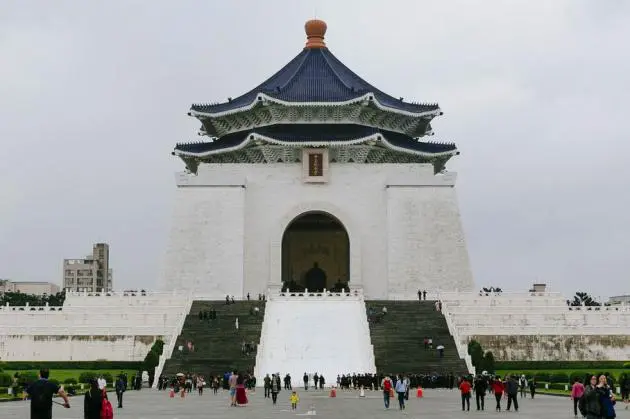
The following day we head back to Taipei – a five-hour drive – and check in at a hotel near Ximending Market before exploring the city by bike. We visit the Chiang Kai-shek Memorial Hall, an imposing blue-roofed white building with two sets of white stairs, each with 89 steps to represent Chiang’s age at the time of his death, leading to the main hall. We pose for pictures at the Gate of Integrity, walk through Liberty Square to the octagonal memorial hall and take in the National Concert Hall and National Theatre on either side. The eight sides are symbolic of the number, which is traditionally associated with fortune and wealth.
As the sun goes down, we make our way back along a road illuminated by shimmering neon lights, stopping off briefly at Sense 30, a shop that sells handbuilt vintage-style bicycles, before stopping outside Taipei 101, Taiwan’s landmark skyscraper, which was classified as the world’s tallest in 2004 and awarded the platinum certification in 2011 under the Leadership in Energy and Environmental Design (LEED) rating system.
We plan to spend the next – and sadly last – day of our trip riding the 50km from Taipei Songshan Airport, the base of Republic of China Air Force units, to Yangmingshan National Park. It’s raining hard as we set out, turning on to the bike trail along the Keelung River, passing Dajia Riverside Park, Dazhi Bridge and Mei Li Hua Ferris Wheel.
We are just 10km short of the National Park when our leader calls a halt to the trip, worried about the possibility of bike wrecks in the inclement weather.
Guo Yong He is philosophical about the change in plans.
“If we take 10 as the measurement of the difficulty level, then the bike route at Yangmingshan National Park is an 8. It is not an easy ride, even in good weather. The park is about 800 metres above sea level and in summer, the difference in temperature between Taipei and the park is as much as six degrees Celsius. It’s a shame that you will miss out on the view from the top of the park though. From up there you can see the sea on one side and Taipei city on the other.
“Another challenging bike route that you could try if you come back is Hehuanshan mountain, which rises to 3,275 at its highest point. We have cyclists from all over the world taking part in the ‘Taiwan King of the Mountain Challenge’, a 37km route that starts 400 metres above sea level and rises to 3,275 metres.”
With a challenge like that, who can resist?
FLYING BICYCLES
- NokScoot flies from Bangkok to Taipei on Wednesday, Friday, Saturday and Sunday with flights from Taipei to Bangkok on Monday, Thursday, Saturday and Sunday.
- For more information, call (02) 021 0000 or visit www.NokScoot.com.
