
Thy will be undone


Play
Christianity senses a disturbance in the Force
PROCLAIMING ITSELF “bewildered” at an unprecedented separation of church and cinema, the Church of England spared a few unkind thoughts on Sunday for the refusal by several major movie-theatre chains in Britain to screen an advertisement for the Lord’s Prayer.
The 60-second ad, depicting various Christians – including a police officer, a weightlifter and schoolchildren – taking turns reciting lines from the prayer, was supposed to be shown next month ahead of the new Star Wars film, “The Force Awakens”. It’s December, after all, and you know whose birthday is celebrated on the 25th.
Reuters reports that Digital Cinema Media, which provides 80 per cent of theatre advertising through major UK multiplex rejected the spot “on religious grounds”, lest it cause offence. No preaching, no politics and no smoking – them’s the rules.
Christians dislike being told they are offensive, however. “We are bewildered by the decision,” sputtered the Reverend Arun Arora, the chief of communications for the Anglican Church. “The Lord’s Prayer is prayed by billions of people across the globe every day, and in this country has been part of everyday life for centuries. In one way the decision is just plain silly, but the fact that they have insisted upon it makes it rather chilling in terms of limiting free speech.”
Amusingly, celebrity biologist Richard Dawkins, an outspoken atheist, has come out to defend movie fans’ right to be offended.
Forgive their trespasses
Here’s the thing about the Lord’s Prayer controversy, though: The Star Wars films are stuffed with religion.
As the Washington Post points out, some fans insist their religion is “Jedi” – and the book “How Star Wars Conquered the Universe” delves into the faith behind the Force. “Francis Ford Coppola suggested to [Star Wars creator George] Lucas that the two of them actually start a religion using the Force as its scripture,” author Chris Taylor writes. “Lucas feared for his friend’s sanity.”
Still, the first three instalments in the franchise actually trace the revival of a dead and discredited religion. In the “prequels” that followed, Lucas retroactively tried to introduce a scientific explanation for the Force, even as both Darth Vader and Luke Skywalker regard faith in the Force as some sort of cultural artefact to be preserved.
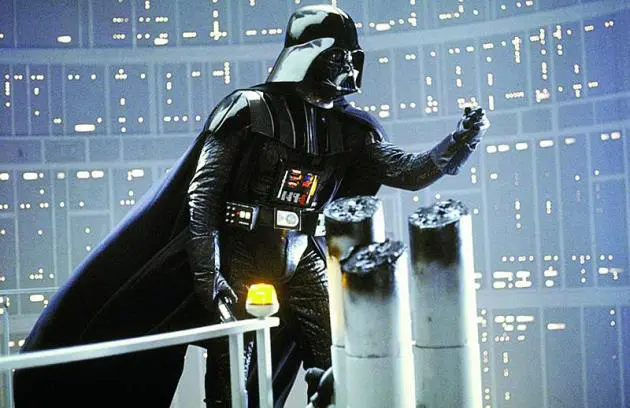
The fans know the Force is real. Obi-Wan Kenobi could change men’s minds and transcend physical form with it. Luke exploded the Death Star with it, for, um, Heaven’s sake. Vader Force-choked the life out of Admiral Motti, the Doubting Thomas in that universe far, far away.
Lucas seemed to be channelling the sad reality of supernatural powers, however, by consistently depicting these “miracles” taking place when there were few or no witnesses around.
There’s religious parody in the movies, as well. In “Return of the Jedi”, C-3PO – with the high-tea accent of a British colonialist – convinces the fuzzy Ewoks that he’s divine. In the Star Wars Expanded Universe, the Yuuzhan Vong are from outside the galaxy and outside the Force, posing a tactical and theological challenge to the resurgent Jedi, and they have a highly sophisticated faith of their own, based around a worship of pain. Or maybe that’s not parody.
