
Singapore bids for art glory


Play
Fashioned from two historic buildings, the new national museum is a testament to grand ambition
NOT CONTENT to be “merely” the region’s major trading seaport, Singapore is now promoting itself as a new international art hub. The spotlight burned bright for last week’s red-carpet opening of the National Gallery, with President Tony Tan Keng Yam presiding.
On view was a magnificent audio-visual performance, the “Share the Hope Facade Show”. Projected on the gallery’s exterior were key artworks from the collections inside, while elsewhere there were interactive exhibits, splendid dancing and three short films making their premiere.
The mega-project announced by Prime Minister Lee Hsien Loong in 2005 has transformed the former Supreme Court and City Hall buildings into a massive gallery for the visual arts.
“We aim to engage our neighbours, particularly in Southeast Asia, and collaborate with galleries and museums across the region,” gallery CEO Chong Siak Ching said. “We want to contribute the artistic excellence of the fine arts in Southeast Asia and position Singapore as an international hub of visual arts in the region.”
Both registered as national monuments, the City Hall was erected in 1926 and the Supreme Court in 1939, the latter designed by Frank Dorrington Ward. Everyone wanted the buildings preserved, and particularly the facades, so a design competition was held in 2007 for both the gallery exterior and interior, drawing dozens of entries from home and abroad.
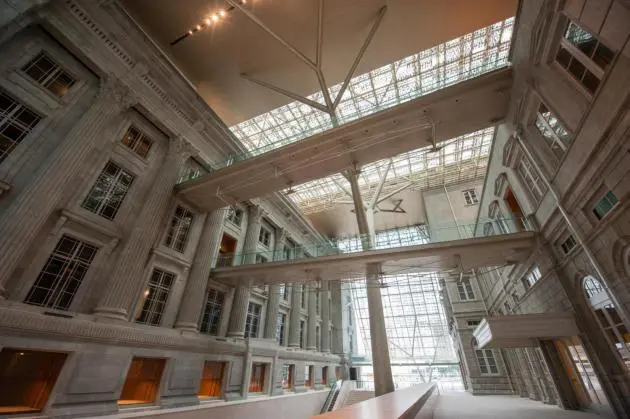
A simple, harmonic concept won Studio Milou of France the contract and work began on the S$532-million (Bt13.7-billion) project. The gallery has a canopy resting on tree-like columns and two long footbridges connecting the former municipal and judicial structures from roof to basement.
“The idea is to allow people to find the way very quickly from one level to another and the way to cross between the two buildings – it’s a very complicated ‘artwork bridge’,” says Sushma Goh, a facility director. “The three-layered roof looks simple, but it reveals the mechanical relationship between the two buildings. We’ve tried to create a new identity for both buildings.”
The six-floor, 64,000-square-metre museum is now home to two long-established galleries as well as the Keppel Centre for Art Education, the souvenir shop Gallery & Co and nine restaurants and bars offering everything from casual to fine dining.
The inaugural exhibition comprises more than 10,000 artworks from the 19th century to the present, from the state collection and from private and institutional collections in Thailand, the Philippines, Vietnam, Indonesia, Malaysia, Japan and the Netherlands.
In a nod to modern technology, a free Gallery Explorer application can be downloaded for smartphones with ios platform as a personal audio guide to the facility and a search engine for particular pieces. It covers the museum’s history, displays the art with full background text and provides details of current and upcoming exhibitions and other events.
One fascinating tour starts in the DBS Singapore Gallery on the second floor of the old City Hall. On a large touch-screen display at the entrance, youngsters can design their own poster based on the art on view.
Part of the exhibition – a survey of modern art in Singapore in the 19th and 20th centuries – is called “Siapa Nama Kamu?” (“What’s Your Name?” in Malay). That’s what’s written on a blackboard in the 1959 Chua Mia Tee painting “National Language Class”, which commemorated Singapore’s independence from British rule.
There are 400 artworks on display covering six themes – Tropical Tapestry, Nanyang Reverie, Real Concerns, New Languages, Tradition Unfettered and Shifting Grounds.
Georgette Chen’s “Self-portrait” from 1946 conveys her abiding dignity and determination following her interment during World War II. It’s a remarkable piece, composed of soft dabs delineating the contours of her face and just a few subtle changes in shades.
The woodblock print “Seascape” was a collaborative effort among six local artists for the 1966 Woodcut Show. Lim Cheng Hoe’s “Singapore River”, also from the late 1960s, bears an interesting marriage of line-work and watercolour, suggesting rather than asserting the hustle and bustle of life along the waterway.
Over in the Supreme Court wing is the UOB Southeast Asia Gallery, which is hosting the exhibition “Between Declarations & Dreams”, with 400 artworks, rare books and other artefacts. The title comes from a 1948 poem by Indonesian Chairil Anwar, and the show focuses on the experiences of artists in Southeast Asia, reflecting their opinions on history and politics.
In this group is Thai photographer Manit Sriwanichpoom, who has one of his famous “Pink Man” photos on show. This was the series that used artist Sompong Thawee as a pink-clad model to comment on consumerism and materialism.
The late Montien Boonma is also represented, through a reconstruction of his 1993 installation “The Pleasure of Being, Crying, Dying and Eating”. It has ceramic bowls stacked into stupa-like shape, as an observation on Buddhist teachings about the cycle of life.
And Navin Rawanchaikul’s 1995 mixed-media installation “Homage to Fon Pan-Ya” is there, a paean to the rural poor and a lament for the environment damaged by development. It features a glass cabinet full of medicine bottles, each containing a photo of an elderly person.
Other Thai artists with work in the gallery include Prasong Luemuang, Chatchai Puipia, Kamin Lertchaiprasert, Somboon Homtienthong, Michael Shaowanasai and the late Prayat Pongdam.
The former Courtroom 1 has lost none of its sombre sanctitude now that it’s showcasing rare antiques from across the region. A portrait of King Nangklao (Rama III) painted by Phra Soralaklikhit in 1916, based on a commemorative sculpture, is an interesting focal point, as are the black-and-white photographs of King Chulalongkorn (Rama V) and his family.
In the adjacent chamber are dozens of marvellous artworks old and new from near and far. Redza Piyadasa’s “May 13, 1969” is an upright coffin draped with an abstract rendering of the Malaysian flag. From a century earlier, there is “Forest Fire” by Indonesia’s Raden Saleh, depicting wild animals driven by the flames to the edge of a cliff. Filipino Juan Luna’s painting “Espana y Filipinas” evokes that colonial relationship as a glorious one, with two female figures climbing a staircase towards a radiant dawn.
Meanwhile the Keppel Centre is set up like a giant playground where kids can enjoy art workshops.
HALLS OF WONDERS
Admission to the National Gallery is S$20 (Bt500), $15 for children seven to 12 years old.
It’s open Sunday to Thursday from 10 to 7 and Friday to Saturday from 10 to 10.
Visit www.NationalGallery.sg for more details.
