
Dining with presidents


Play
French flatware brand Puiforcat brings its finest cutlery and more to Bangkok
FOUR HUNDRED years ago, long before the birth of the throw away society, high-society travellers, royalty included, would pack up and take furniture and household items with them whenever they moved between their homes.
Proper packing materials didn’t exist in those days either but breakage of dinner and tableware was surprisingly low thanks to the clever invention of French silversmiths, who added a sterling silver ring around the edge of plates, saucers and cups to prevent chipping.
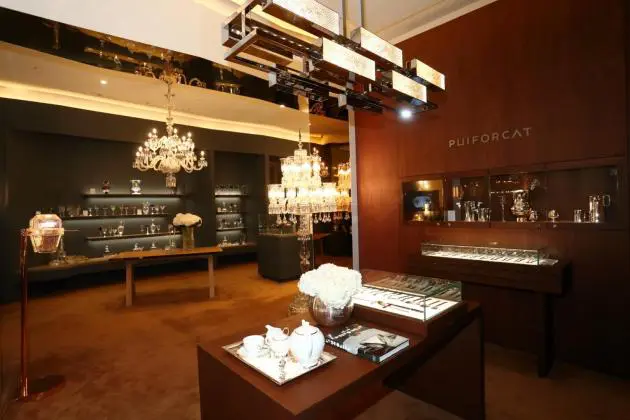
Today, the House of Puiforcat, founded in the early part of the 19th century by a family of those silversmiths, has crossed the world and landed in Bangkok, where it shares a store at Siam Paragon with fellow French brand, glassware and crystal maker Saint-Louis.
“We pay tribute to the days when the finest porcelain was ringed with silver by offering the very finest tableware,” says Amelie de Cagny, the brand’s communication director.
Offering outstanding functional and art de vivre objects in a variety of styles, Puiforcat largely owes its fame to Jean E Puiforcat, a master silversmith and one of the leading proponents of the Art Deco movement who, in the 1920s applied his modernist thinking and rigorous, geometric design to the art of silversmithing.
“Jean Puiforcat was an outstanding personality and a great designer,” Cagny says. “He was very much inspired by Art Deco design and he came up with modern silversmithing; very clean and lean items completely different from what silversmiths used to manufacture. Today the company is blessed by his large archive collections. Unfortunately, he died very young, at the age of just 42.”
In 1993, the brand became part of the Hermes group and has carried on the tradition of contemporary silversmith creations, continuously adding to its heritage with unique items that celebrate the art of fine taste, as well as decorative pieces and functionally elegant objects for everyday use. Among the most popular items are a champagne beaker that offers a unique experience in champagne tasting and the range of Zermatt flatware designed by Patrick Jouin.
“Today, we have two missions.
One is to perpetuate the know-how of our workshop and we now have 15 trained silversmiths working fulltime. The second mission is to keep the archive alive and re-edit the ancient pieces while anchoring Puiforcat in contemporary life by collaborating with designers and creating new collections adapted to modern lifestyles,” she explains.
The Sphere tea and coffee set is a true example of Puiforcat’s savoir-faire and is one of many examples of Jean Puiforcat’s Art Deco sets listed in the House’s archives. First designed by the silversmith in 1928, the sterling silver replica, hand-made in Puiforcat’s workshop, has been expanded to include a two-cup coffeepot, a six-cup teapot as well as a milk jug and sugar bowl.
The Champagne beaker is a unique vessel contoured to exalt the sparkling wine. As the wine is slowly poured, its bubbles form against the guilloche inside the beaker.
Elysee flatware is a reproduction of an early Regency design and was chosen by the French presidency at the end of the 1940s for the tables at the Elysee Palace. It is still used for all the official receptions held by the French president.
“All the know-how in the workshop is pretty much the same as 200 years ago. The silversmiths now have to develop the mould to fit with the new designs but the technique itself is the same. They still use the same kind of tools and work with their hands. The engraving process uses a needle or graver to extract thin shavings from a minuscule notch in the metal producing fine lines, curves, stippling, or perhaps a figure, number, or a coat of arms. A few technologies are infused in the workshop but these are very few and far between. However, we do have a few lines made in stainless steel that we produce with partners using new technologies.”
“Silver is beautiful in its finish but has a warmer brightness than other materials, which is why it has always been so popular. It is also a little soft and that makes it easy to work. It gives you more flexibility to create ornamented and intricate shapes. But silver tarnishes and no one wants to polish the silver anymore. That’s why we have developed some collections using stainless steel. However, our core business remains the finest cutlery and flatware for tables and so the materials we use must be safe in contact with food,” she explains.
In Asia, Puiforcat is presently represented in China, Hong Kong, Taiwan, Japan, Singapore, Indonesia, and now Thailand. A boutique is due to open soon in the Philippines.
“In the Maison de Hermes boutique in Shanghai, we also have Puiforcat’s champagne bar and customers are offered to taste champagne served in the Puiforcat champagne beaker. We are slowly trying to develop the Asian market. It’s quite new for us; sterling silver is not an Asian tradition but today’s connoisseurs are interested in European know-how and tradition. That’s why we are delighted to enter into partnership with Chanintr Living for our first showroom in Thailand.
“Designed to highlight the best of French elegance in tableware, this exclusive setting illustrates Puiforcat’s dedication to craftsmanship,” she concludes.
STERLING STUFF
>>The Saint-Louis and Puiforcat showroom is on the third floor of Siam Paragon.
>> Call (02) 129 4577.
