
The big stretch


Play
Cycling, running and triathlons surged in popularity in 2015, and the trend won't be slowing down in 2016
ONE OF THE most popular tests of stamina in the world, the triathlon has been going strong in the West for 40 years. Here in Thailand it made its debut some 20 years ago and slowly but surely has continued to grow in popularity with several events now being organised countrywide every year.
Combining three individual sports – usually cycling, swimming and running – in a single event, the endurance competition is considered the ultimate individual athletic endeavour and today many more Thais are discovering the physical and mental rewards from successfully training for and completing in a triathlon event.
“The triathlon trend really followed on from the cycling trend,” says actor and singer Navin “Tar” Yavapolkul, who plans to take part in an Ironman triathlon in order to qualify for the gruelling world championship held annually in Hawaii.
“Many more people are riding bicycles and increasingly they are turning to the triathlon. Thais today are paying more attention to working out and their health. I’m very happy to see more of them taking part in triathlons. It is a good sign for triathlons in our country.”
Vijitr Sitinawin, secretary general of Asian Triathlon Confederation and president of Triathlon Thailand Federation, is also delighted at the increasing participation.
“The competition is booming because people are changing their attitudes towards their health. It is a challenging sport and requires a lot of stamina so it’s really important that those wanting to take part train gradually and work up to each of the three events,” he says.
“The triathlon is very popular around the world and in New Zealand and Australia the age of the participants ranges from eight to older than 70. Some 10,000 children are now actively taking part in the Iron Kids and Kids of Steel events. Hong Kong and Singapore are also enjoying a boom in triathlons and the number of Singaporeans regularly entering the competition has gone from next to nothing to equal the foreign participants working in the country.”
The triathlon arrived in Thailand more than 20 years ago though the first event in Pattaya attracted only a small number of Thais. Phuket was next to jump on the triathlon bandwagon and while for several years international competitors far outnumbered the locals, the figures are now much more equal.
“Formerly, most Thais people had a bad attitude towards sports. That has changed radically and everyone now realises that exercising is vital to good health. They sign up for marathons and mini marathons, go swimming and cycle,” Vijitr says.
“Not that many years ago, the only people cycling as a sport were the members of the national cycling team. Now it’s so big that it’s become a tourism sector in its own right.”
Triathlons, usually sticking to the most popular format of bike, swim and run, are now held worldwide and come in many lengths and types. Among the best known international events are Norway’s Norseman Extreme Triathlon, which finishes on top of a mountain, and St Anthony’s in Florida, which attracts more than 4,000 entrants every year. The sport has been part of the Olympics and is being adopted by the Paralympics from this year.
Before taking part in triathlons, Vijitr was a marathon runner, a cyclist and a swimmer. He took part in the first triathlon in Pattaya.
“I spent a lot of time reading foreign books to learn about the triathlon until I felt confident I could write about it myself. It’s a truly awesome sport,” says Vijitr, who has won many trophies, among them the Gen Pijit Kullawanich trophy for a half Ironman – 1.9km swimming, 90km cycling and 21km running – at Khao Sam Roi Yod National Park in Prachuab Khiri Khan and the Ironman triathlon – 3km swimming, 189km cycling and 42.9km running – at Baan Kon Ao in Had Mae Ram Pueng, Rayong.
“The triathlon is a tough sport,” says Vijitr, who has set up a preliminary triathlon curriculum, called “Term Hai Tem.”
“I have many doctors, professors and executives in my group, some of them 50 years old. Last week, I led them in an exercise that saw us cycling uphill on Khao Ito on the outskirts of Khao Yai National Park and swimming the 5.5 kilometres between Koh Samet and the mainland,” he says.
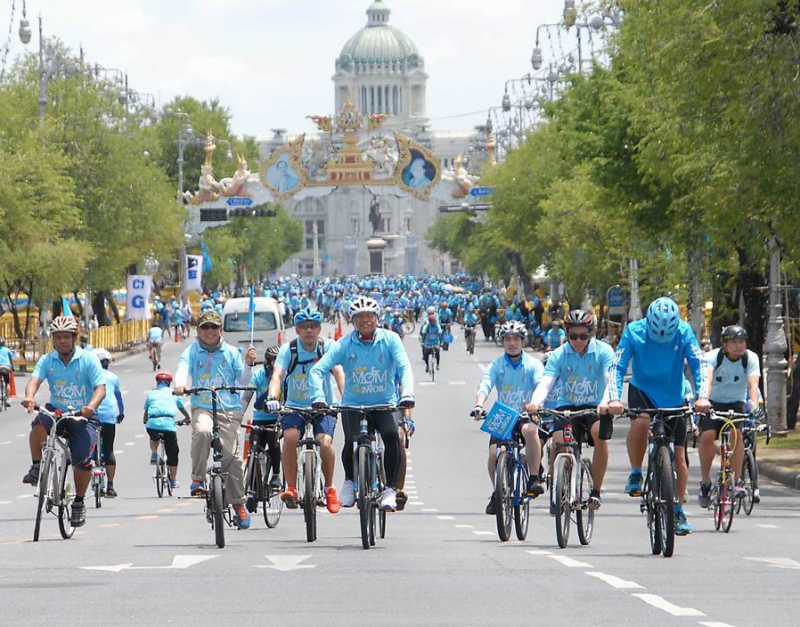
As Vijitr notes, cycling has gone beyond being just a trend. Earlier this year, Thailand was recognised by the Guinness World Records for 136,411 people taking part in the bike event, “Bike for Mom” in tribute to Her Majesty the Queen on her 83rd birthday. Almost 295,000 people registered in advance for the “Bike For Mom” event, made up of 40,000 in Bangkok and 254,863 in the provinces, but the actual number of participants nationwide was higher, estimated at between 300,000 and 400,000.
Last month’s “Bike for Dad” event marking His Majesty the King’s 88th birthday broke that record with 607,909 people signing up to take part: 498,105 in the provinces, 99,999 in Bangkok and another 9,805 overseas.
“The cycling boom is similar to that of the triathlon. Many more people are pay attention to cycling. People from several countries in Scandinavia ride a bicycle as part of their everyday lives. I used to ride from my house near Kasetsart University to Chulalongkorn University or Hualamphong Railway Station. I can’t do that now because the traffic is too dangerous. Taiwan’s cyclists can spend five days travelling 1,000 kilometres around their country, taking breaks at designated bike rest areas. I think Thailand should set up similar rest stops every 100 kilometres, where cyclists can enjoy a range of bike-related services, food and beverages. It would be good for the economy too.
“Many more foreigners are coming to Thailand to cycle and that is also good for the economy as well as for political stability. Our country is better than Taiwan, which frequently gets hit by massive storms. If we built proper bike routes like in Taiwan, I believe that people from Singapore, Malaysia and Hong Kong would come in their thousands. The route from Tak to Lampang, Chiang Mai and Phayao offers beautiful scenery but has few to no services. Same with the routes from Bangkok to Nakhon Sawan and from Chonburi to Chanthaburi,” says Vijitr, whose idol was Preeda Chullamondhol, a Thai cyclist who competed in the 1000m time trial and team pursuit events at the 1964 Summer Olympics.
While they may not all be taking part in triathlons, many people have taken up running as a way of keeping fit. They can be spotted early in the morning or in the evening jogging around the city parks such as Suan Lumphini, Chatuchak, Suan Rot Fai or Benjasiri, dressed in smart, colourful outfits and wearing earphones. Indeed, running is simple and, like walking, the cheapest form of exercise. Unlike walking though, it is difficult to achieve over distance unless you are in decent physical condition.
Running becomes more challenging when it involves a long-distance race such as the 5km fun run, 10km mini marathon, 16km super mini marathon, the 21km half marathon, and the granddaddy of them all, 42km full marathon.
Several such race events are regularly organised in Bangkok and the provinces on different themes and draw thousands of would-be marathoners.
Running, it seems, like cycling, has become the preferred lifestyle choice of the Thai middle-class both in Bangkok and other large urban centres. And with improved awareness of what constitutes a health life, it can only expand.
On the Web:
astc.triathlon.org
www.RunThailand.com
