
Meet Hanuman’s tailors


Play
A crafts centre in Ang Thong is preparing the costumes and masks for this autumn's Royal Khon Performance
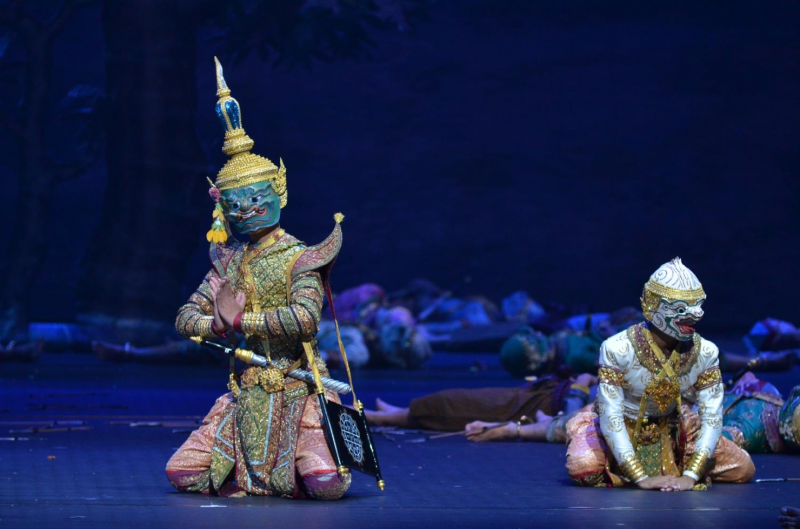
THE ROYAL Khon Performances initiated by Her Majesty the Queen have been entertaining audiences since 2007 but, for most people, behind-the-scenes glimpses remain a rarity. One such peek at the elaborate costumes used in the shows can be enjoyed, though, at the Si Bua Thong Handicraft Centre in Ang Thong province.
There, a group of gifted artisans are busily readying the apparel and props for the string of performances coming up on November 5 at the Thailand Cultural Centre – “The Episode of the Allegiance of Phiphek”.
Her Majesty established the Royally Initiated Example Farm Project in Si Bua Thong in 2006 to help the local people recover from a devastating flood, and the following year had the handicraft centre built. Her Support Foundation runs classes in ceramics, weaving, embroidery and woodcarving.
Then in 2013 the Queen commissioned Professor Weerathamma Tragoonngoenthai to lead course in weaving gold brocade at the centre so that the craftspeople could join similar efforts at Ban Neun Thammang and Ban Trok Khae in Nakhon Si Thammarat in producing outfits for the Royal Khon Performances.
“Initially Her Majesty wanted to give the villagers alternative sources of income following the floods in 2006,” says Thanpuying Charungjit Teekara, secretary general of the Support Foundation and chair of the committee that presents the performances.
“We built a porcelain factory and also taught the people how to weave cotton and silk. Then we trained them to weave phaa yok [brocade of silk and metal thread], embroider golden braid and make khon masks for the performances. The centre now has 150 member artisans.”
Professor Weerathamma and his team devoted three years to teaching the villagers how gold brocade is traditionally woven and how to embroider with gold braid. This is the ornamentation that gives the actors’ draped trousers and short jackets such vibrancy onstage, particularly in the form of sashes at the waist and chest and the hanging panels and collars.
The designs are modernised versions of the court attire in the time of King Rama V, which photographs from the period abundantly document.
The centre has four separate areas, the main one being the textile mill, which is cluttered with old wooden looms. The high-quality silk thread that’s used, originating in the Northeast, produces flexible and durable phaa yok. It’s woven into the royal Phumkhaobin lotus pattern, the material dyed with lac, indigo and other local plants to create a full palette of colours that tend not to fade.
“Nakhon Si Thammarat has been famous for its phaa yok since the late Ayutthaya Period,” says Weerathamma, an expert in textiles who hails from Surin and is in charge of the costume design.
“This style of clothing gradually disappeared after King Rama V ordered changes in the court dress, but now it’s been revived, complete with the royal Phumkhaobin motif. Some of the original outfits from the 19th century can be seen at a museum in Nakhon Si Thammarat.”
The centre in Ang Thong focuses on making the brocades and ornaments for the leading khon characters, including Phra Ram and Phra Lak.
Jarunee Phodee and three other weavers are skilfully applying brocade to a phaa yok that’s a metre wide and three metres long.
“I had a month’s training for this,” she says. “It normally takes two or three months to brocade the phaa yok in the Phumkhaobin pattern, and we can make four pieces a year. We earn a daily salary and also get between Bt3,000 and Bt3,500 extra when we’re done.
“I used to be a farmer and then worked in a factory, but I joined the Handicraft Centre six years ago. I earn enough to get by – it’s all part of the sufficiency economy.”
In another area the golden braid is embroidered onto cloth. A pattern called Rachavatra Yormummaisib-song is used to adorn a gorgeous jacket worn by Phiphek, the title character in the upcoming shows, while Hanuman and the army of demons wear outfits bearing the motifs known as Phumkhaobin Nakob, Rachavatar Dok Loy and Khon Daksinavatara.
The embroidering is delicate work, says 42-year-old artisan Wasawan Tongam, and every year there’s a different theme to the shows.
“I started out embroidering very basic patterns, drawn from nature,” she says. “Now I spend three to four months creating a single piece of braid embroidery.”
Elsewhere Somchai Suppalakum-paiporn of the Fine Arts Department’s Office of Traditional Arts and other craftsmen whose usual trade is sculpting wood are showing visitors how stiff paper is made from the pulp of the khoi, sometimes called the toothbrush tree. They mould it into khon masks, following another tradition that dates made to the Ayutthaya Era.
“The khoi paper is expensive to make, so people began using mulberry paper instead, even though it doesn’t last as long, but we’ve managed to give new life to a lost art,” Somchai says.
“The wood sculptors have been trained to make the khoi paper, a process that takes over two weeks, and then mould masks from 15-layered sheets of the paper.
“The masks are covered with lacquer and gold leaf, so they’re waterproof, and the lacquer is made using an old technique too, which requires banana leaves, burned bricks, palm stems, husk and coconut shells. A stone mould is also carved with Thai patterns, onto which different parts of the masks are pressed.”
In the centre’s fourth area, ceramic plates, mugs, bowls and teacups are made and painted by hand in various floral patterns. Safe for the microwave, they’re sold in the Support Foundation’s shops, earning additional revenue to keep the operation going.
TRADITIONS KEPT ALIVE
>> The Si Bua Thong Handicraft is located in Amphoe Sawangha, Ang Thong province.
>> “The Royal Khon Performance: The Episode of the Allegiance of Phiphek” will run from November 5 to December 5 at the Thailand Cultural Centre.
>> Seats cost Bt620 to Bt1,820 at www.ThaiTicketMajor.com.
