
Foreigners seek out Japan’s whisky


Play
Helped along by a popular TV series, distilleriesare becoming bigger tourist attractions
Japanese whisky is growing in popularity overseas, with exports drastically increasing in recent years.
Thanks to the international recognition being earned by domestic whisky brands such as Nikka Whisky Distilling’s Yoichi and Suntory group’s Hibiki, more and more foreign tourists are visiting distilleries in the country.
Whisky production in Japan dates back to the Taisho era (1912-1926), when Suntory founder Shinjiro Torii hired Masataka Taketsuru, who learned how to brew whisky in Scotland. Taketsuru, who went on to establish Nikka, was even featured in the NHK TV morning drama “Massan” with his Scottish wife Rita. “Massan” aired for six months, starting in September 2014, and drew high TV ratings.
It is said that Japanese whisky started receiving overseas accolades in 2001, when Nikka Single Cask Malt Whisky Yoichi 10 Years Old was named Best of the Best – the highest score for world whiskies – at a tasting event organised by Britain’s Whisky magazine.
Suntory’s Hibiki 30 Years Old was awarded a trophy at the International Spirits Challenge in 2004.
Since those achievements, whiskies from both companies have gone on to win several other international prizes.
The total export value of Japanese whisky has increased nearly tenfold over the past 10 or so years, from 1.07 billion yen (Bt370 million) in 2006 to 10.378 billion in 2015. Major importers include Europe, the United States, China and Taiwan. And an increasing number of foreign tourists visit Japanese distilleries.
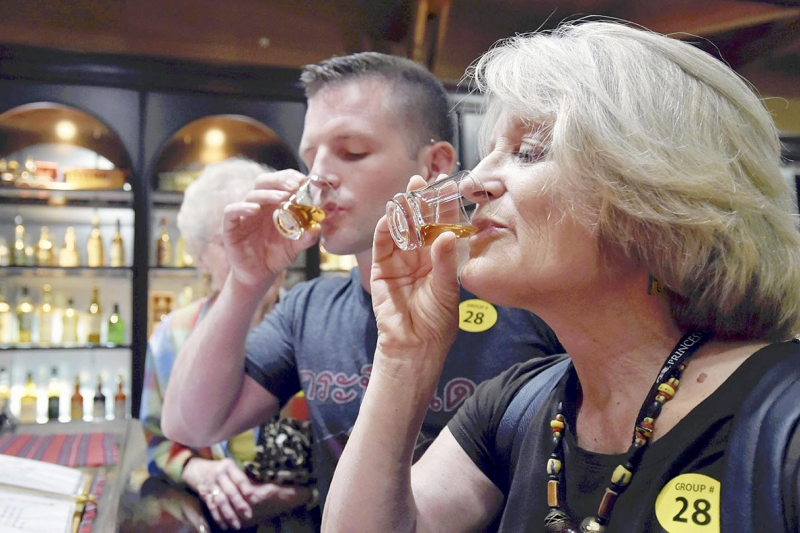
I visited Nikka’s Yoichi Distillery in Yoichi, Hokkaido, on a weekday in June. Groups of 20 to 30 foreigners were coming in one after another, speaking English, Chinese and Korean.
Daniel James, from San Francisco, studied in Edinburgh and is knowledgeable about Scotch whisky. The 28-year-old, who teaches English in Lebanon, said he tried Japanese whisky in the US on the recommendation of his mother, who’d lived in Japan.
At Nikka James sampled a Yoichi 20 Years Old whisky and was impressed by the “smoky flavour” that lingers in the mouth. He liked the story about how whisky production was built on the love story between Taketsuru and his wife.
Torii and Taketsuru were attracted to Scotch whisky, which is said to date back 500 years. Japanese whisky might have a history of less than 100 years, but I felt the tastes and flavours based on the subtle Japanese senses are also well regarded by foreigners.
Eric Wang from Taiwan bought several bottles of Nikka as souvenirs, calling the subtle flavour of the blended whisky “excellent”.
Nikka’s distillery is about an hour by train from Sapporo Station. Accessibility isn’t great, but many foreigners visit on chartered buses from nearby Otaru Port after arriving on large passenger vessels.
The number of visitors to the distillery in Yoichi, which served as the main setting for the NHK drama “Massan”, sharply increased last year to about 900,000 – more than triple the number in 2012. The number of foreigners visiting for reasons other than the drama has also been on the rise.
Based on information including reservation names, it is estimated the numbers visiting the distillery were 7,400 in 2012 when it started compiling statistics, 14,000 in 2013 and 46,000 in 2015. This year 21,000 foreigners had been there as of the end of June – 2,000 more than the same time last year.
Meanwhile, based on foreign-language-guide rentals, an estimated 760 foreigners visited Suntory Yamazaki Distillery in Shimamoto, Osaka Prefecture, in 2009. The number dramatically increased in 2015 to 9,410, despite the distillery closing in November and December for renovations.
The popularity of Japanese whiskies is likely to last for some time. “Japanese whiskies have been re-evaluated after receiving many overseas awards,” says a public-relations official at Asahi Group Holdings, which has Nikka under its umbrella. “It’s likely that distilleries are being recognised as tourist destinations.”
