
Where culture crosses borders


Play
Moroccan artists delight audiences with their contemporary takes on rituals
The tragic incidents that shook France and Belgium in the past 10 months have understandably led to security measures being stepped up. You now need to show your passport at the border even if you are arriving from another Schengen country. All bags are checked at the entrance to theatres and fully armed police and army officers on patrol are now the rule rather than the exception.
Yet even at such a time, art prevails. Artists and audiences, bringing along their cultures, are still crossing borders. And while Lyon’s 17th edition of the Biennale de la danse, which concluded on Saturday, had evidently been a victim of budget cuts and thus featured fewer foreign productions than before, it remains one of the world’s major showcases of dance.
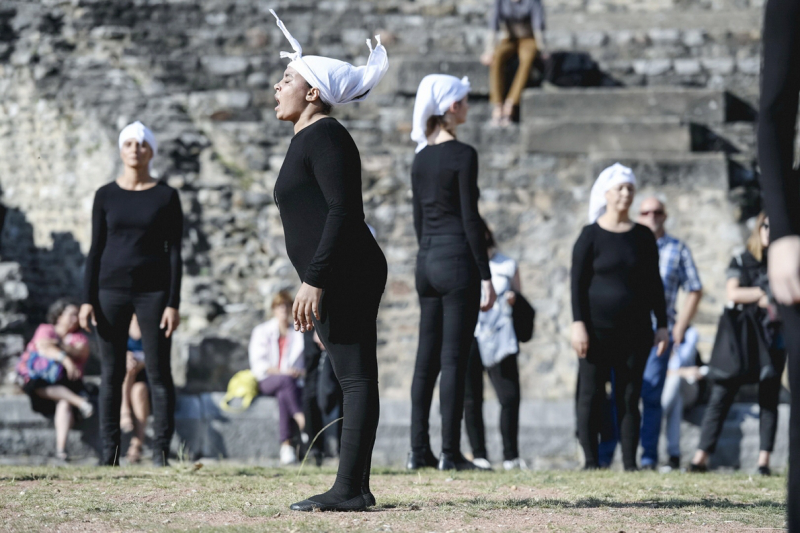
Morocco-born and France-educated choreographer Bouchra Ouizguen worked with a large group of women, of various ages and body types all dressed in dark clothes with white cloth around their heads, in her new work “Corbeaux” (“Ravens”). This had its world premiere on the forecourt of Marrakech train station, a non-theatre space, and its French premiere at the Amphitheatre des Trois Gaules in Lyon.
Entering the space in a group, the women spread out to different corners where they faced different directions. For the next 30 minutes or so, they rocked their heads back and forth as their voices, all in unison, gave off a sense of being in a trance. Notably, about 20 minutes in, some audience members started to leave their seats in the stands to move closer to the performers – some just to watch, others to take photos. One by one, the performers stopped, the last to do so was also one of the oldest. Later, in a deep contrast to such intensity, they regrouped and sang and danced with sheer jubilance.
The same evening at the Celestins, Theatre de Lyon, another Moroccan troupe, Groupe Acrobatique de Tanger, presented its new work “Halka” (“Energy”). Abdeliazide Senhadji, the leader of this group and founder of XY Company, who has worked with internationally renowned French choreographer Aurelien Bory, also staged a work at the last biennale and it proved very popular with the crowd.
“Halka” certainly lived up to its title, as the ensemble of 12 acrobats, who not only defied gravity but also sang and danced tirelessly, and two musicians, on drums, banjo and ribab, kept the audience’s full attention. Stunning acrobatics were so keenly interspersed with Moroccan dance and music traditions that this nouveau cirque has created a new signature by not forgetting the old roots.
A crowd-pleasing show featuring both the familiar and the unfamiliar, Moroccan traditions and French innovations, “Halka”, after its world premiere in Lyon, is now touring in France and Belgium until May.
As much as I enjoyed these fine blends of traditions in contemporary frameworks, I would be curious to know if these former colonies have contemporary dance and theatre works that have no relation to their traditions. I also wonder whether the former imperialist countries would be, against their expectations, interested in presenting them on their shores.
The writer’s trip was supported by the Biennale de la danse’s press office and the Embassy of the Republic of France in Thailand.
