
Cannabis buds remain prescription-only, ONCB warns retailers
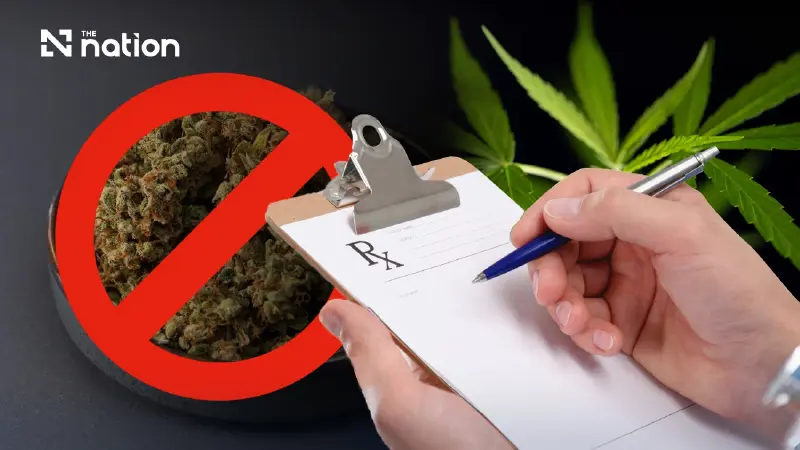


Thailand’s ONCB reminds retailers that cannabis buds require a medical prescription, while tougher Customs penalties target illegal exports.
The Office of the Narcotics Control Board has reminded cannabis retailers that buds may be sold to members of the public only against a prescription covering no more than 30 days, warning that Thailand does not permit unrestricted recreational sales.
Areephak Ngunbumrung, ONCB deputy secretary-general and spokesperson, said on July 11 that cannabis flower remained a controlled herb under the Ministry of Public Health’s 2025 notification.
She warned that unlicensed sales, processing or exports — as well as sales to customers without a valid prescription — could result in up to one year in prison, a fine of up to Bt20,000, or both.
Although the Public Health Ministry oversees the principal legal framework, Areephak said the ONCB would continue monitoring cannabis misuse and issuing warnings, particularly to prevent the drug from reaching children and young people.
Licences, prescriptions and certified supplies
Businesses wishing to research, export, sell or process cannabis flower for commercial purposes must hold a licence under Section 46 of the Protection and Promotion of Traditional Thai Medicine Knowledge Act.
Licensees must maintain records showing where the cannabis came from, how it was used and how much was held at their premises, and submit the information to the registrar.
Cannabis flower sold or exported must also come from farms certified under the cultivation and collection standards recognised by the Department of Thai Traditional and Alternative Medicine.
Licensed exporters are required to notify the licensing authority of each shipment separately using the prescribed form.
Commercial sales are generally restricted to transactions between Section 46 licensees. The exception is a sale to a member of the public who has a prescription issued by an authorised medical, pharmaceutical or traditional-medicine practitioner.
The amount prescribed must be medically necessary and may cover no more than 30 days of treatment.
Online sales and advertising prohibited
Cannabis businesses are not permitted to sell flower for smoking at their premises, except when it is administered as part of treatment by an authorised practitioner.
Sales through vending machines, websites, social-media platforms or other electronic and computer networks are prohibited. Advertising cannabis flower through any commercial channel is also banned.
Commercial sales are forbidden at temples and other places of religious worship, registered dormitories, public parks, zoos and amusement parks.
Areephak said businesses that secretly supplied cannabis flower to people without prescriptions risked allowing it to become accessible to children and young people.
Violations involving illegal sales, processing or exports are punishable under Section 78 of the traditional Thai medicine knowledge law by up to one year in prison, a maximum fine of Bt20,000, or both.
Smugglers face tougher Customs fines
The ONCB also warned against taking cannabis out of Thailand without completing Customs procedures or attempting to evade inspections.
Such offences can carry up to 10 years in prison, a fine equal to four times the duty-inclusive value of the goods, or both, together with confiscation.
The Customs Department has also introduced a tougher method for calculating fines based on the amount seized. From June 17, 2026, the rate has been set at Bt30,000 per kilogram, with the confiscated cannabis forfeited to the state.
Areephak urged travellers to check and obey the laws of their destination countries, noting that cannabis remains a serious illegal narcotic in several jurisdictions despite Thailand’s framework allowing tightly controlled medical and health-related use.
From cash-crop promise to tighter controls
Thailand’s cannabis policy began shifting before the 2019 general election, when Bhumjaithai Party leader Anutin Charnvirakul made liberalisation a central campaign policy.
The party promoted cannabis as a potentially valuable cash crop that could increase farmers’ incomes while supporting the country’s medical, health and wellness industries.
After Bhumjaithai joined the coalition government, Anutin became deputy prime minister and public health minister, placing him in a position to advance the policy.
On June 9, 2022, the cannabis plant, including its flowers, was removed from Thailand’s Category 5 narcotics list. Cannabis extracts containing more than 0.2% tetrahydrocannabinol, or THC, remained classified as narcotics.
The government accompanied the change with a campaign to distribute one million cannabis plants to households. Thousands of people imprisoned for cannabis-related offences were also released following the legal change.
However, the delisting took place without a comprehensive cannabis law governing the emerging market. Thousands of cannabis shops subsequently opened, including in major tourist destinations, while recreational access expanded despite the government’s stated focus on medical and economic use.
Prescription rules introduced in 2025
The government did not return the entire cannabis plant to the narcotics list when it tightened the rules in June 2025.
Instead, the Public Health Ministry replaced its earlier controlled-herb notification with a stricter order under the Protection and Promotion of Traditional Thai Medicine Knowledge Act.
The notification was published in the Royal Gazette on June 25, 2025, and took effect the following day. It continued to designate cannabis flower as a controlled herb but placed public retail sales on a prescription-only basis and imposed tighter restrictions on sourcing, advertising, online sales and consumption at business premises.
Members of the public who witness suspected illegal cannabis sales or drug-related gatherings causing a nuisance may contact the ONCB’s 24-hour hotline on 1386. The agency said information provided by callers would be handled confidentially.
