
State audit flags procurement and payment issues at Thai PBS
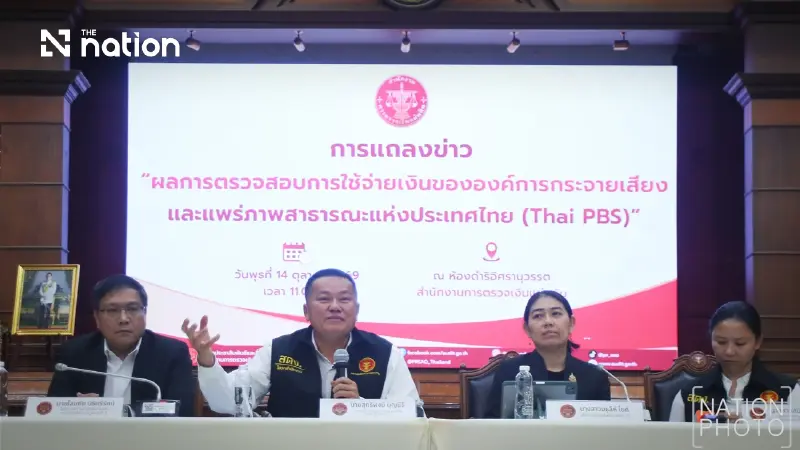


Thailand’s State Audit Office flags procurement, payment and management weaknesses at Thai PBS, with a vehicle-use review due next week.
- Thailand’s State Audit Office (SAO) identified significant weaknesses in procurement, payments, and operational management at Thai PBS following an investigation triggered by internal complaints.
- The audit questioned procurement contracts for an externally produced news program, finding they could be inconsistent with the Public Procurement Act and may have caused financial losses.
- Payments made to presenters, guests, and contributors were found to lack specific formal regulations and were inconsistent with fiscal discipline requirements under a new financial framework.
- The investigation also found improper use of company vehicles, with some executives who received vehicle allowances also using the organization's pooled vehicles due to a lack of clear rules.
Thailand’s State Audit Office (SAO) has identified weaknesses in procurement, payments and operational management at Thai Public Broadcasting Service (Thai PBS) following a six-to-seven-month investigation triggered by internal complaints.
Deputy Auditor General Sutthipong Boonnithi said on October 14 that the audit covered several allegations concerning spending, procurement, use of organisational assets by senior officials and the overall effectiveness of management.
He stressed that the announcement was a report of audit findings rather than a dispute between the two organisations.

The SAO began the investigation on January 26 after receiving complaints from within Thai PBS concerning spending that was allegedly inconsistent with laws, regulations and government procedures.
Separate teams were assigned to examine procurement, organisational performance and specific-selection procurement involving individual officials.
Sutthipong said any evidence suggesting corruption or misconduct would be referred to the National Anti-Corruption Commission for further action.
An audit report on organisational performance and efficiency was issued on October 2, followed by a procurement-compliance report on October 9. A separate report concerning possible responsibility of individual officials in specific-selection procurement remains pending.
Audit finds weaknesses in performance management
Sineenat Photichai, director of Performance Audit Office No. 3, said Thai PBS receives an annual budget of more than THB2 billion, with around half related to acquiring and producing media content.
The SAO found that while Thai PBS met several organisational key performance indicators, some indicators had been changed frequently, making it difficult to compare performance consistently over time.
Some internal units responsible for programme production and acquisition also failed to meet their targets, while projects that were discontinued were not always systematically analysed to determine why they had fallen short.

In some cases, the SAO found that performance indicators were changed rather than underlying problems being addressed.
Viewer-behaviour information collected by Thai PBS was also not being used efficiently in content planning, while data held through the One Thai PBS membership system had yet to be fully integrated for audience analysis.
The SAO recommended that Thai PBS establish clearer organisational goals, use consistent indicators that allow year-on-year comparisons and improve the integration of audience data when making decisions about content.
Internal systems fail to give complete picture
The audit also identified weaknesses in systems supporting programme production, acquisition and distribution.
The Budget Management and Planning system, or BMP, was unable to provide complete comparisons between actual performance and plans or clearly display organisation-level indicators for monitoring project results.
The SAO found that monitoring had tended to focus on whether more than 80% of planned budgets had been disbursed rather than whether the spending produced the intended outputs and outcomes.
Programme files were also stored separately by individual departments rather than through a central database.
Meanwhile, the Broadcast Management System was being used mainly for television programming and did not fully cover content distributed through online channels.
As a result, collecting information on programmes produced, acquired and distributed across different platforms required additional time and processes, limiting management’s ability to obtain a timely organisation-wide view.
The SAO also raised concerns over the measurement of Thai PBS’s growing “Online First” content.
Website active-user figures from Google Analytics were being used as part of the assessment, although the SAO said these did not directly show whether specific target audiences were consuming individual types of content.
It also found no written criteria governing the selection of programmes or external evaluators for Social Return on Investment assessments.
Audience surveys stopped interviews when respondents said they had not watched a programme, meaning Thai PBS did not collect information on why potential viewers had chosen not to watch it.
The SAO recommended developing a central data-management system, improving BMP and broadcast-management systems to cover all platforms, establishing formal criteria for social-impact assessment and collecting deeper audience feedback.

Programme-production contracts questioned
Matulee Yokee, an SAO auditor involved in the compliance review, said auditors examined the procurement of an externally produced news programme under specific-selection contracts from 2017 to 2025.
The SAO found that the contracts involved production services and equipment, including cameras, while programme ratings were not assessed.
Auditors said the procurement arrangement could be inconsistent with the Public Procurement and Supplies Administration Act and could have caused losses to Thai PBS.
The SAO is continuing to consider responsibility connected with the procurement process.
Presenter and guest payments lacked formal rules
The audit also examined payments to presenters, programme hosts, guests and contributors between 2023 and 2025.
The SAO found that Thai PBS did not have specific formal regulations setting rates and conditions for those payments.
Instead, internal units relied on administrative guidelines covering payments to news sources, presenters and contributors, together with temporary delegated spending limits.
A new Thai PBS regulation on finance, accounting and budgeting took effect on September 20, 2024.
The SAO said previous internal guidelines and delegation orders could no longer serve as the formal basis for such payments after the new regulation took effect.
It therefore found that payments made in 2025 lacked the rules, procedures and conditions required under the new financial framework and were inconsistent with fiscal discipline requirements.
The Auditor General has recommended action concerning officials involved, although the audit findings themselves do not constitute a criminal conviction.

Vehicle-use findings expected next week
The SAO is separately reviewing the use of pooled vehicles by Thai PBS executives.
Auditors said Thai PBS had rules covering transport allowances attached to positions but did not have clear regulations governing the use of central or pooled vehicles.
The investigation found that some executives who received vehicle-related allowances also used the organisation’s vehicles.
The SAO said public organisations are required to establish clear rules governing the use of state assets under fiscal-discipline and public-procurement laws.
The audit committee has completed its consideration of the vehicle issue, with the findings expected to be submitted for the Auditor General’s signature and formally sent to Thai PBS next week.
Sutthipong said the SAO had allowed those concerned to explain and respond to all audit observations during the process.
He added that where deficiencies are identified, the audited organisation can be instructed to correct them, seek compensation for losses or take disciplinary action, while any indication of corruption would be referred to the relevant anti-corruption authorities.
