
RTA says another Thai soldier feared dead, raising possible death toll to two
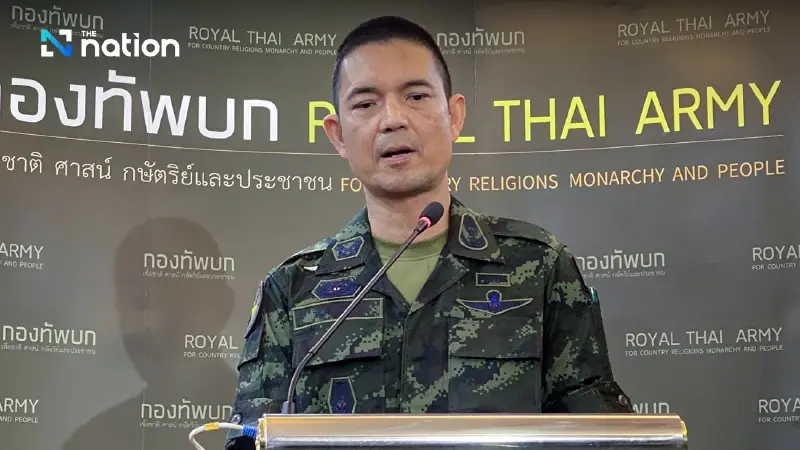


Royal Thai Army confirms one soldier dead, another feared killed and eight wounded, as Thai jets strike Cambodian positions amid escalating border clashes.
- The Royal Thai Army (RTA) has confirmed one soldier has been killed and reports a second is feared dead in clashes along the Thai-Cambodian border.
- In addition to the potential two fatalities, eight other Thai soldiers have been wounded in the attacks.
- The casualties resulted from what the RTA described as prepared Cambodian military operations involving artillery and other weapons at multiple border locations.
One confirmed death, second feared killed, eight wounded
The Royal Thai Army (RTA) on Monday said there were unconfirmed reports that a second Thai soldier may have been killed in ongoing Cambodian attacks along the Thai–Cambodian border, raising the possible death toll to two.
RTA spokesman Maj Gen Winthai Suvaree announced the updated casualty figures at Army headquarters.
“I would like to confirm that there is one officially confirmed fatality and another unconfirmed death, while eight other soldiers have been injured,” Winthai told a press conference.
The first death and four injuries were reported after Cambodian troops opened fire on Thai positions at Chong An Ma at 5am. Subsequent clashes at other locations along the border led to four more Thai soldiers being wounded.
Cambodian forces ‘prepared attacks on multiple Thai targets’
Winthai said it was clear that Cambodia had prepared its military operations, heavy weapons and fire-support systems with the intent of attacking several targets inside Thailand.
He added that Cambodia was likely to use long-range weapons to strike areas deep inside Thai territory, including Buri Ram airport and Prasat Hospital in Surin, which is about 30 kilometres from the border.
Winthai said the latest attacks followed Cambodia’s repeated violations of ceasefire conditions and its use of landmines to secretly target Thai troops, which he said underscored Phnom Penh’s hostile intent towards Thailand.
From late Sunday night until dawn on Monday, clashes erupted in several areas, he added.
Heavy fighting and multiple flashpoints along the border
According to Winthai, heavy fighting broke out at about 5am at Chong Bok Pass in Nam Yuen district of Ubon Ratchathani, when Cambodian troops used rifles, artillery and fire-support weapons to attack Thai positions.
Evidence showed that Cambodian forces also opened fire in the areas of Chong An Ma, Prasat Khana, Prasat Ta Kwai and Prasat Ta Muen Thom in Surin, as well as Huai Ta Maria in Si Sa Ket, he said.
Thai troops returned fire in line with area-specific response plans and the rules of engagement, targeting Cambodian military positions and fire-support weapon sites.
Thai air strikes ‘highly precise’ and limited to military targets
Ground forces also requested air support from the Royal Thai Air Force to neutralise Cambodian weapons threatening Thai territory, Winthai said.
He stressed that air operations targeted only Cambodian military bases in order to halt attacks that could have injured more Thai personnel.
Weapons deployed by Thai fighter jets were highly precise and did not affect Cambodian civilians, he insisted.
Winthai also explained that an F-16 fighter jet struck a casino complex because it was being used as a command centre for Cambodian military drone operations.
RTA on heightened alert, focused on civilian safety
Asked whether the fighting could spread into areas under the responsibility of the First Army Area, Winthai replied that Thai operations would remain limited to responding to Cambodian attacks.
He said RTA commander-in-chief Gen Pana Klaewplodthuk had ordered the army to be fully prepared to respond to Cambodian aggression, given the volatile situation.
The army chief was particularly concerned about civilian safety and wanted to minimise casualties, Winthai said, so he had ordered the destruction of Cambodian fire-support weapon sites.
Winthai added that the Thai military had also prepared to protect airports, hospitals and arms depots with anti-drone systems. Although airports are normally located far from the border, the army would not be complacent and would step up protective measures, he said.
Proactive strikes and evacuations as part of defence plan
Winthai said it was difficult to say whether the current clashes had escalated to the same level as the fighting in late July, as Thai operations were still being strictly limited to proportionate responses to Cambodian attacks.
For proactive operations, the Thai military would seek to destroy Cambodian BM-21 rocket launcher sites as much as possible, he said.
For defensive operations, the priority would be to continue evacuating civilians from affected zones along the Thai–Cambodian border.
