
Border standoff eases on K5, but mines and bombs still found daily


The Royal Thai Army says Cambodian personnel disguised as civilians along the K5 road have not made any further advances, easing immediate pressure in the disputed Ta Phraya border area. However, troops warn the danger remains high as residents return and continue to encounter explosive devices, including improvised bombs and old and new landmines, which are still being found every day.
The Royal Thai Army said the situation along the K5 road in Ta Phraya district, Sa Kaeo province, has not worsened, with no further advances detected by Cambodian personnel allegedly disguising themselves as civilians. However, officials warned that explosive ordnance clearance remains urgent as residents return to the disputed border area and continue to discover explosive devices, including improvised bombs and old and new landmines—items that are still being found daily.
K5 movement “unchanged” as troops keep positions
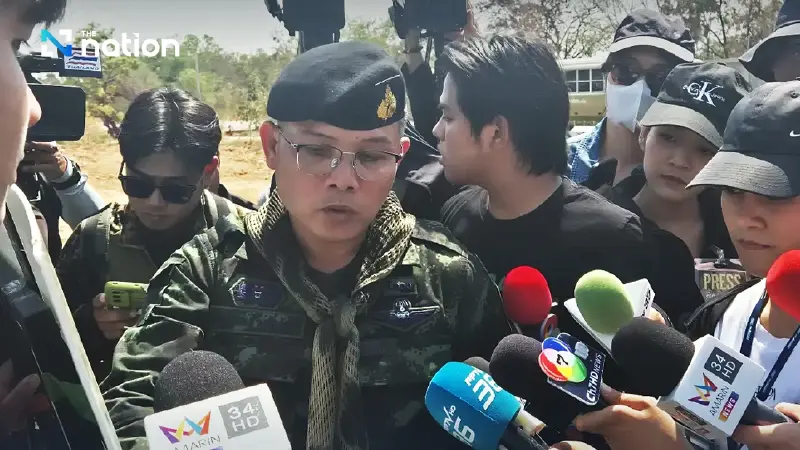
Colonel Pathomphon Wongpidech, deputy commander of the Ta Phraya Task Force, briefed journalists during a visit led by Maj Gen Winthai Suvaree, chief of the Public Relations Centre of the Army Operations Centre and Royal Thai Army spokesman. The delegation, which included officials from the Army Public Relations Centre and the Burapha Task Force, inspected the Ban Khlong Phaeng area in Ta Phraya—an overlapping-claim zone along the Thai–Cambodian border.
Maj Gen Winthai said Thai forces continue to control the area cautiously, particularly in locations where civilians live, to avoid damaging the country’s image. He said intelligence indicates some movements involve Cambodian soldiers or officials operating in civilian guise, rather than ordinary residents.
Daily explosive finds as residents return
Col Pathomphon said the immediate concern now is explosive clearance, as returning residents continue to encounter explosive devices. He said items found—ranging from improvised explosive devices to old and new landmines—will be collected and separated into those that can be destroyed on site and those that must be destroyed elsewhere. Explosive items are still being found every day, he said.
Marker 36 dispute and overlapping claims
Col Pathomphon said the dispute in Ta Phraya is concentrated around the border relaxation points of Ban Bueng Ta Kuan and Ban Khlong Phaeng, where the two sides disagree over the boundary line. He said the issue is linked to Boundary Marker No. 36, where only the upper portion remains and the base is missing, leading to suspicions that the marker was moved. As a result, Thailand and Cambodia cite different reference lines, leaving the area disputed to this day.
Along the stretch of border under the Burapha Task Force, he said there are 24 boundary markers in total, with 13 agreed by both sides and 11 disputed. The disagreements, he said, have contributed to encroachment issues in several areas, including Nong Chan, Nong Ya Kaeo and Ban Khlong Phaeng. He said Cambodia has previously claimed land between Boundary Markers No. 33 and No. 36, placing markers and repeatedly moving personnel into the area, while Thailand has maintained its own reference line. Both sides, he added, had agreed not to change the condition of the area.
389 structures cleared; defensive line held for 56 days
Col Pathomphon said Thai authorities found covert encroachment activity involving villagers and personnel presenting themselves as civilians, including the digging of defensive positions along the K5 road and the use of structures as operational bases. More than 389 houses were found in the area, he said, and Thai authorities have dismantled the structures and cleared the zone.
He said Thailand has now established defensive positions and can maintain firm control of the area, marking the 56th day since troops took control on December 22. During the clashes, he added, Cambodian civilians evacuated about two days earlier than Thai residents. Thailand evacuated later, he said, because it did not intend to destroy or encroach, but had to respond after Cambodia opened fire first, requiring evacuation and fighting on that day.
Army says restraint, no troop increase; RBC talks continue
Maj Gen Winthai said Thailand now controls all key areas, particularly locations previously used to threaten or attack troops and civilians. He said operations have been conducted in line with international norms and bilateral agreements, while coordination continues through local- and regional-level mechanisms, including the Regional Border Committee (RBC).
The army also said there has been no troop build-up, with forces remaining at the same level. It said it is focusing on strengthening defensive positions, surveillance and preventing provocation, while avoiding the use of weapons, and monitoring the situation closely to protect personnel and residents.
BM-21 damage: resident awaits compensation
During the visit, troops took journalists to inspect homes damaged by BM-21 rocket fire, including the house of Ms Phongsri Raphan. She tearfully said she was devastated at having nowhere to live, noting that about seven people lived in the house and are now facing severe hardship. She said she initially stayed with her younger sister, but felt cramped because her sister has a family, and is now sleeping in the kitchen, in a room where she can manage to sleep.
She said seeing soldiers and tanks along the border makes her feel reassured, describing the military as something people can rely on. On compensation, she said she has not yet received the main payment but has heard she will receive 230,000 baht. So far she has received only about 70,000 baht for living expenses. After the BM-21 strike, she said everything was destroyed, leaving only clothes, and she becomes tearful whenever anyone asks about her home, which she described as a legacy from her parents.
She said decisions on whether to demolish and rebuild the house will depend on the budget. She added that authorities initially planned to bring in a backhoe to demolish the house, but she refused because she had not received compensation. She said she follows border updates closely, citing a January 28 notice to prepare for evacuation that ultimately did not happen. She said she remains in the area and does not feel afraid because she sees soldiers passing by, and will stay until authorities order an evacuation.
