
Thailand briefs ASEAN partners on Cambodia and Myanmar issues
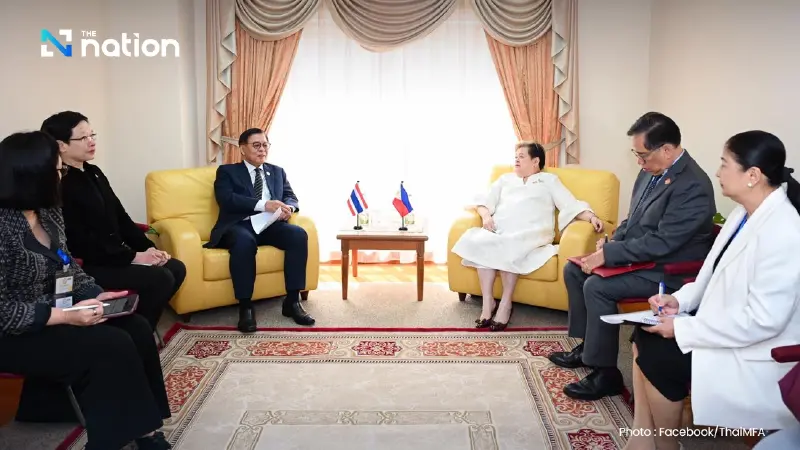


Sihasak discussed Thai-Cambodian ties with the Philippine foreign affairs secretary and Myanmar with Singapore’s foreign minister during AEMM talks.
- Thailand briefed the Philippines on its conflict with Cambodia, emphasizing the need for a ceasefire and citing border disputes and a lack of trust from the Cambodian side.
- In discussions with Singapore, Thailand explained that due to their shared border, it must engage with Myanmar to encourage its internal peace process.
- Thailand highlighted the broader ASEAN dilemma of whether to continue isolating Myanmar's leaders or to re-engage to promote regional stability and prevent geopolitical competition.
Sihasak Phuangketkeow, Minister of Foreign Affairs, held bilateral talks with Ma. Theresa P. Lazaro, the Philippines’ Secretary of Foreign Affairs, and Dr Vivian Balakrishnan, Singapore’s Minister for Foreign Affairs, during the 25th ASEAN-EU Ministerial Meeting (AEMM) in Bandar Seri Begawan, Brunei Darussalam, on Tuesday (April 28, 2026).

During the talks, the Philippine foreign affairs secretary expressed interest in relations between Thailand and Cambodia, and Sihasak briefed her on the latest developments and the importance of the two countries moving beyond the conflict.
Sihasak said that during his talks with Prak Sokhonn, Cambodia’s Deputy Prime Minister and Minister of Foreign Affairs and International Cooperation, on Monday (April 27, 2026), the Thai side told the Cambodian side that there must be both a “ceasefire” and a “halt” to verbal warfare.

This was because the conflict between Thailand and Cambodia involved border issues, a lack of trust and public sentiment, which could not be resolved without sincerity from the Cambodian side, particularly regarding the Joint Boundary Commission (JBC) meeting, on which the two sides had yet to reach an agreement because it had to go through internal procedures.
The Cambodian side, meanwhile, announced a meeting date abruptly, without the Thai side having known beforehand, which was akin to pushing Thailand into the position of being the side that refused.
In the bilateral talks with Singapore’s foreign minister, Dr Balakrishnan paid particular attention to the Myanmar issue.

Singapore’s foreign minister expressed concern about the timing of moves on Myanmar, as Singapore was still hoping to see more concrete developments.
Sihasak clearly agreed with this point and saw the need to address problems inside Myanmar, including the peace process and talks among various groups.
However, because Thailand shares a border with Myanmar, Thailand could not simply allow the situation to continue while only looking on.
It therefore had to try to engage in order to encourage the Myanmar government to move the peace process forward.
Ultimately, however, ASEAN would have to decide collectively between maintaining its position of not inviting Myanmar’s foreign minister or leader to attend meetings and opening space for the revival of relations.
This was because, if Myanmar continued to be isolated, it could lead to greater geopolitical competition in the region.
But if relations were revived, ASEAN would benefit from regional stability and ASEAN unity.

