
Thai Army vows response if Cambodia breaches ceasefire deal
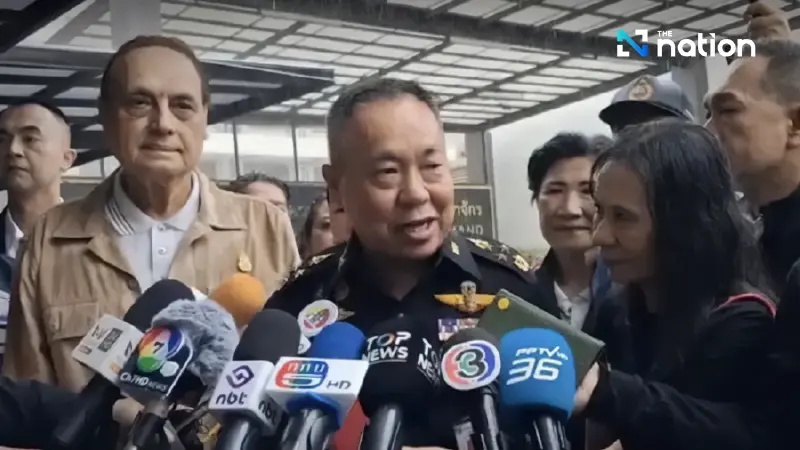


Thai Army Chief of Staff General Chaiphruek Duangpraphat says Thailand will respond under agreed guidelines if Cambodia violates the December 27 ceasefire, as border tensions widen from troop movements to canal dredging and temple restoration disputes.
Thai Army says Cambodia must respect ceasefire terms
The Thai Army has warned that it will respond under established military guidelines if Cambodia violates border agreements, after Cambodian troops reportedly moved close to Thai positions near the barbed-wire fence.
General Chaiphruek Duangpraphat, Army Chief of Staff, said on April 30 at the Internal Security Operations Command (ISOC) that Cambodia must comply with the agreement reached on December 27, 2025.
He said the reported troop movement close to the border line was considered a breach of that understanding, prompting the Thai side to issue a warning by setting off firecrackers.
Chaiphruek said Army Commander-in-Chief General Pana Klaewplodthuk had already laid down clear guidelines on the use of force and warning measures, and that all units had been instructed to follow them strictly.
“If Cambodia violates anything that has been agreed upon, we will respond in accordance with the established guidelines,” he said.
Army says it will not tolerate actions that alarm residents
Chaiphruek said the latest incident occurred as Cambodia brought ASEAN Observer Team (AOT) personnel to the area, while Cambodian troops were seen close to the fence line guarded by Thai forces.
He said Thailand had its own response measures to prevent a repeat of such actions.
“I have stressed that we will not tolerate anything that disturbs or provokes our areas, causing panic among local residents. The Army will not accept such actions,” he said.
Asked whether such incidents could damage mutual trust and future cooperation, Chaiphruek said senior figures at the government and military policy levels had already discussed the matter and made clear that such actions must not happen.
“If they do so, it will be considered a violation of the agreement. We will not remain idle. We will act in line with the guidelines already laid down,” he said.
Ta Khwai Temple dispute ‘no problem’, says Army chief of staff
Asked about Cambodia’s protest against Thailand’s involvement in restoration work at Ta Khwai Temple, Chaiphruek said there was no problem.
“They cannot do anything beyond this. Therefore, I ask the public to have confidence. We are fully prepared to take care of our site,” he said.
His remark reflects Thailand’s position that the site remains under its responsibility, even as Cambodia continues to object to Thai activity in the area.
Canal dredging row adds to border tensions
The latest warning came as Thailand also raised concerns over alleged Cambodian activity at Khlong Nam Sai in Khlong Hat district of Sa Kaeo province.
At the Khlong Luek border checkpoint in Aranyaprathet district on April 30, Major General Benjapol Dejatiwongse Na Ayudhya, commander of the Burapha Task Force under the 1st Army Area, said the canal area was under Thai sovereignty. He was responding to allegations that Cambodia had dredged the canal to change the direction of water flow and potentially alter the border line.
Benjapol said water naturally changes direction, but if inspections found that any arrangement was incorrect, Thailand would take action. He insisted that the Thai side was not acting aggressively and had not encroached on any area, adding that Cambodia’s protest would not stop Thai forces from entering what he described as “our home”.
The canal issue has added another layer of sensitivity to the already fragile border situation, alongside disputes over troop movements, ceasefire monitoring and activity around ancient temple sites.
December ceasefire aimed to halt renewed fighting
The current tensions follow the latest ceasefire agreed by Thailand and Cambodia on December 27, 2025, after a renewed round of border clashes.
Under the joint statement, both sides agreed to an immediate ceasefire from noon local time on December 27, covering all types of weapons and prohibiting attacks on civilians, civilian infrastructure and military targets. The agreement also required both sides to avoid unprovoked firing, troop advances or movements towards the other side’s positions.
Thailand’s Ministry of Foreign Affairs said the ceasefire was subject to a 72-hour monitoring and observation period to ensure good-faith implementation. It also said civilians in border areas would be able to return safely once the situation stabilised.
Long-running border dispute remains unresolved
The Thai-Cambodian border dispute has long been shaped by unresolved demarcation issues, competing territorial claims and periodic confrontations along sensitive frontier areas.
The December ceasefire was designed to stop the latest round of fighting and allow both sides to resume dialogue through existing mechanisms, including border coordination channels and observer arrangements. However, the latest warnings from the Thai Army, together with disputes over Khlong Nam Sai and Ta Khwai Temple, show that the truce remains fragile.
