
Thai army warns of immediate response to Cambodian border fire
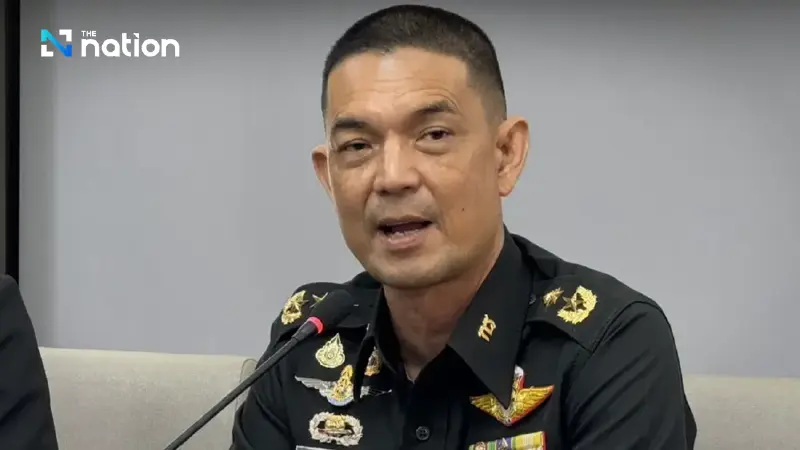


Royal Thai Army accuses Cambodian troops of repeated border provocations near Chong Chom, warning Thailand is ready to respond if Thai territory is affected.
The Royal Thai Army has warned it is ready to respond immediately if Cambodian gunfire affects Thai territory, after accusing Cambodian troops of repeated provocative firing along the border and of using information warfare to blame Thailand for escalating tensions.
Maj Gen Winthai Suvaree, the Royal Thai Army spokesman, said at Army Headquarters on Thursday that Cambodian soldiers had fired 11 rounds of small-arms fire from the Cambodian side along the Ban O’Smach area, opposite the Chong Chom border checkpoint in Kap Choeng district of Surin province.
Army accuses Cambodia of provocation
Winthai said senior Cambodian commanders and the Cambodian government often made public statements that did not match actions taken by troops on the ground.
Since a ceasefire was put in place, he said, Thai forces had continued to hear gunfire along the border, and in some cases explosions. He described the incidents as provocative, though he said they did not appear to be aimed at causing casualties or damaging Thai property.
Rather, he said, the pattern appeared intended to create irritation and tension along the border.
“Incidents of this nature have occurred several times since early this year,” Winthai said. “We believe this was not just an isolated case that happened because it became news, but part of a continuing pattern along more than 400 kilometres of the Thai-Cambodian border.”
Thailand says troops did not return fire
The latest Thai army account followed a May 13 report that Thai forces had detected two incidents near O’Smach, close to Chong Chom. In one, Thai troops said they spotted 10 to 15 Cambodian soldiers accompanied by two foreign nationals moving near a barbed-wire boundary line and recording video. Thai officers said they issued a verbal warning before firing two warning shots after the warning was ignored. Later that day, Thai forces said they heard 11 shots from the Cambodian side along the Or Samed area, but did not return fire.
The Second Army Region assessed that the gunfire was scattered and not tactically targeted, while the situation remained under control. It also ordered troops in the area to maintain round-the-clock surveillance along the border.
Cambodia denies Thai claims
Cambodia has rejected the allegations. Cambodia’s Ministry of National Defence said on May 13 that Thai media reports alleging Cambodian forces had fired 11 rounds at the O’Smach International Border Checkpoint were false and distorted the facts. The ministry said Cambodia remained committed to peace, stability and existing border-cooperation mechanisms.
Winthai, however, said the Thai army believed some incidents stemmed from a lack of discipline among Cambodian troops, while others appeared designed to provoke Thailand into using weapons first. He said such a response could then be used to accuse Thailand of initiating violence.
‘Information battlefield’ now key front
The army spokesman said Cambodia was giving more weight to the “information battlefield” than to direct military confrontation.
He said Cambodian personnel had in some cases tried to bring individuals, foreign media or influencers close to restricted areas. When Thai soldiers issued warnings or fired warning shots under procedure, he said, images or claims were then circulated to portray Thailand as the side that used weapons first.
Winthai said the Thai army was aware of the tactic and was monitoring it closely.
He also pointed to fake news circulating online, including a fake audio clip of the Prime Minister concerning the opening of border checkpoints. He urged the public to rely mainly on official information and to use judgement when consuming rapidly shared content on social media.
Thai forces ready to respond if territory affected
Asked how Thailand would respond if shots were fired into Thai territory while Cambodia continued to deny responsibility, Winthai said Thai forces were ready to respond immediately if weapons fire affected the Thai side.
Any response, he said, would depend on the judgement of commanders responsible for each area, as local conditions and cross-border relationships differed from place to place.
He stressed that recent firing incidents were still viewed as “provocative fire” and had not affected the lives or safety of local residents. People living along the border, he said, should follow warnings from official channels such as kamnans, village heads and local administrative officials.
“If there is no warning signal, people can continue their daily lives as normal,” he said.
Border tensions remain fragile after ceasefire
The latest dispute comes amid continuing strain along the Thai-Cambodian border following deadly clashes last year. Troops remain deployed on both sides of the long-disputed 817-kilometre frontier after fighting in July and December 2025 escalated into air strikes and heavy exchanges of artillery and rockets. Close to 150 people were killed and at least 300,000 were displaced in the two rounds of fighting, with each side accusing the other of starting the clashes.
Thailand and Cambodia agreed to an immediate ceasefire on December 27, 2025. Under the agreement, both sides pledged to halt all types of weapons use, avoid attacks on civilians and infrastructure, and maintain existing troop deployments without further movement.
However, the truce has remained fragile, with tensions linked to troop movements, ceasefire monitoring, canal works near the border and disputes around ancient temple sites.
Army says no sign of heavy-weapons escalation
Winthai said the army was not complacent and continued to monitor the situation day by day and week by week.
However, he said there was currently no information indicating that the situation would escalate into the use of heavy weapons by either side.
“For now, what remains is the communication battlefield, which the Cambodian side continues to use as its main tool,” he said.
