
Chinese car exports accelerate as overseas NEV demand keeps rising
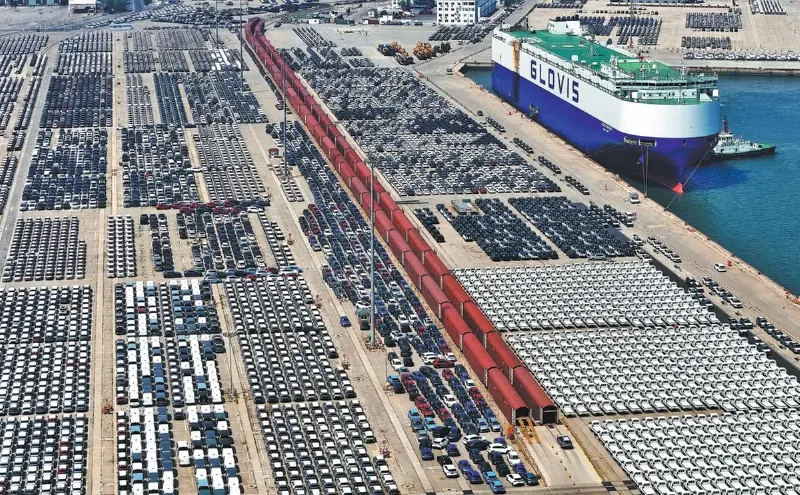


April shipments rose 74.4 per cent year on year to about 901,000 units, while NEV exports reached 430,000 as Chinese carmakers stepped up localisation and R&D abroad.
- China's vehicle exports grew by 74.4% year-on-year in April, strongly supported by new energy vehicle (NEV) shipments which more than doubled.
- Rising overseas demand, particularly in Europe, South America, and Southeast Asia, has helped Chinese brands capture 61% of the global new energy passenger vehicle market in the first quarter.
- In response to this demand, Chinese automakers are expanding beyond simple exports to establish localized production, R&D, and operational centers in key international markets.
China’s vehicle exports kept expanding at a rapid pace in April as the country’s automotive sector widened its global presence, supported by strong new energy vehicle shipments and faster overseas moves by leading domestic manufacturers.
About 901,000 vehicles were exported from China in April, a year-on-year increase of 74.4 per cent, according to data released on Monday by the China Association of Automobile Manufacturers. New energy vehicles accounted for 430,000 of those exports, with the figure more than doubling from the same period last year.
Chen Shihua, deputy secretary-general of the association, said China’s vehicle exports had maintained fast growth this year, offering stable support to the wider auto industry. He also said the NEV market had continued to show steady momentum, with NEVs making up 53.2 per cent of all new vehicle sales in April.
Chinese NEV producers are also strengthening their position in the global market. Figures from the China Passenger Car Association showed Chinese brands held 61 per cent of the global new energy passenger vehicle market in the first quarter.
“Although lower than the 68 per cent peak recorded in 2025, the figure still reflects the country’s leading position worldwide,” said Cui Dongshu, secretary-general of the CPCA.
The CPCA said the 10 largest overseas markets for Chinese NEV exports in the first quarter were Brazil, Belgium, the United Kingdom, the United Arab Emirates, Italy, Australia, Germany, Thailand, Spain and South Korea. South America, Europe, the Middle East and Southeast Asia were the main regions generating additional growth.
The expansion of Chinese NEVs, together with high global fuel prices, is helping speed up the shift towards greener consumption choices. CPCA data showed the worldwide NEV penetration rate continued to climb, reaching 20.2 per cent in the first quarter.
Demand is also rising among overseas consumers. The Straits Times reported that inquiries for electric vehicles priced below 30,000 euros, or $35,241, on Mobile.de, Germany’s major automotive marketplace, had increased 87 per cent since early March.
In the United Kingdom, interest in used EVs also grew sharply. Autotrader, the country’s largest automotive marketplace, said inquiries for electric vehicles aged five to seven years tripled in April from a year earlier, far outpacing demand for newer, higher-priced models.
Chinese automakers are responding by pushing further into overseas markets, with their focus shifting from product exports alone to the creation of localised industrial ecosystems.
BYD is moving ahead with production projects in Hungary and Malaysia, while Chery Automobile has opened its first overseas regional operation centre in Barcelona, Spain. XPeng said it plans to increase overseas manufacturing capacity this year, with Europe, Southeast Asia and Latin America among its target markets.
Automakers are also expanding overseas research and development. Xiaomi Auto has chosen Europe as its first major overseas market, while Leapmotor and Geely have recently enlarged engineering and innovation operations in Germany and elsewhere in Europe to support long-term international growth.
China Daily
