
Trump opens Beijing summit with broad trade and security push
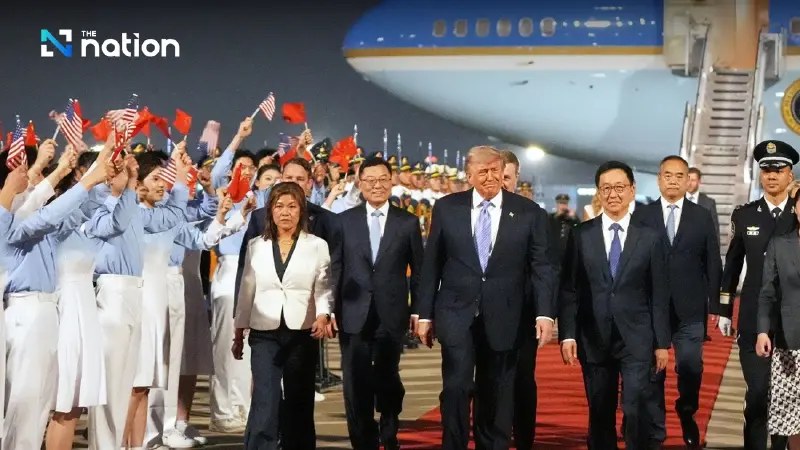


A lavish Beijing welcome frames Trump’s push with Xi over market access, rare earths, Boeing orders, Taiwan and Middle East mediation.
- President Trump is pushing for greater access to Chinese markets for US businesses, bringing a corporate delegation to seek deals on products like Boeing aircraft and resolve issues such as restrictions on Nvidia's AI chips.
- The summit's security agenda addresses several points of friction, including US arms sales to Taiwan, the war involving Iran, and a US proposal for a new nuclear arms control framework that includes China.
- In response to US demands, China is expected to press for the easing of American restrictions on its technology sector, particularly on semiconductors, and seek market access for its own products like electric vehicles.
US President Donald Trump arrived in Beijing on Wednesday (May 13) opening a two-day summit with Chinese President Xi Jinping after several weeks of delay and marking the first visit to China by a US president since November 2017, when Trump last travelled there.
Trump and Xi have met several times over the years, with their most recent talks taking place in Busan, South Korea, in 2025.
That meeting led to US tariffs on Chinese imports being cut from 57% to 47%, and Trump later described the outcome as a 12 out of 10.
In Beijing, Trump was joined by a high-profile business delegation that included Nvidia chief executive Jensen Huang and Elon Musk.
Chinese officials staged a formal welcome with dignitaries, a military honour guard and students waving US and Chinese flags as Trump stepped off Air Force One in the fading evening light.
As the students chanted “welcome, welcome, warm welcome” in Mandarin, Trump stopped partway down the red carpet, raised his fist and smiled before leaving in his limousine.
The summit comes at a tense moment for both countries.
The US-China relationship is being strained by national security concerns, supply chain competition and technological rivalry, while the war in the Middle East has disrupted global energy markets and added pressure to an already fragile relationship.
Trump is also seeking economic gains to support his public standing, which has been bruised by the war with Iran.
Trump said his first request to Xi would be for China to open further to American business. Referring to the executives travelling with him, he wrote on Truth Social: “I will be asking President Xi, a Leader of extraordinary distinction, to ‘open up’ China so that these brilliant people can work their magic.” He added: “I will make that my very first request.”
The corporate delegation is mainly drawn from companies trying to resolve business issues with China.
Nvidia, for example, has struggled to secure regulatory permission to sell its powerful H200 artificial intelligence chips in the Chinese market.
A source familiar with the matter, speaking on condition of anonymity, said Trump asked Huang at the last minute to join the trip.
Huang was later spotted boarding Air Force One during a refuelling stop in Alaska.
China responded in measured terms.
Foreign ministry spokesperson Guo Jiakun said Beijing was ready to “expand cooperation, manage differences and inject more stability and certainty into the turbulent world”.
While the ceremony unfolded around Trump’s arrival, the groundwork for the talks was being handled in South Korea.
US trade negotiator Scott Bessent met Chinese Vice Premier He Lifeng in a VIP reception room at Incheon airport for about three hours.
A US official said the meeting ended shortly before 4 pm local time, or 0700 GMT. China’s Xinhua news agency later called the discussions “candid, in-depth and constructive”, though neither side released a detailed account.
Trump’s Beijing programme includes a formal reception at the Great Hall of the People, a visit to the 600-year-old Temple of Heaven and a state banquet.
The talks are expected to cover trade, investment, technology and security, as well as Iran, Taiwan, nuclear risk and wider efforts to stabilise relations.
Trade remains the central test.
Both sides are trying to keep alive the truce reached last October, under which Washington put threatened triple-digit duties on Chinese goods on hold, and Beijing moved away from measures that could have squeezed global rare earth supplies.
Those minerals are vital to supply chains for products ranging from electric cars to weapons.
The pressure is clear in the trade figures.
After the Trump administration imposed tariffs ranging from 34% to 125%, China’s exports to the US fell by nearly 20% in 2025.
The October 2025 agreement reduced tariffs and helped secure US access to critical minerals, but Chinese shipments to the US still dropped 11% year-on-year in early 2026.
Washington is expected to seek a more structured way to manage trade.
US Trade Representative Jamieson Greer has discussed a “Board of Trade” proposal that would formalise and rebalance bilateral flows by identifying priority goods for import and export.
Such a mechanism would mark a shift away from improvised tariff measures and towards a more institutionalised framework.
The US side is also looking for major commercial wins.
Officials have said Washington wants China to buy Boeing aircraft, farm goods and energy to help narrow a trade deficit that has long frustrated Trump.
One possible deal involves the purchase of 500 Boeing aircraft.
The two governments are also expected to discuss forums to support trade and investment, along with dialogue on AI.
Beijing, for its part, wants the US to ease curbs on chipmaking equipment and advanced semiconductors.
China is also expected to press for protection against tighter US regulatory and investment restrictions, especially in advanced technologies such as artificial intelligence.
Market access for Chinese carmakers is another likely issue.
BYD, which earlier this year became the world’s largest electric carmaker, is among the companies affected by restrictions.
Trump signalled in January that he was willing to allow Chinese carmakers to sell vehicles in the US, but US lawmakers have recently urged him not to ease restrictions, warning that Chinese cars could pose a competitive threat to the American auto sector.
China has also worked to reduce its reliance on the US market by expanding trade elsewhere and presenting itself as a more stable and reliable partner across global markets.
In January, at the World Economic Forum’s Annual Meeting in Davos, Chinese Vice-Premier He Lifeng said China was “fostering common prosperity with its trading partners through its own development, and making the pie bigger for the global economy and trade.”
In the first two months of 2026, China’s exports rose 21.8% year-on-year, helped by a shift towards non-US markets.
Security disputes are expected to be more sensitive, with Taiwan among the biggest flashpoints.
China again voiced strong opposition on Wednesday to US arms sales to Taiwan, while the status of a $14 billion package awaiting Trump’s approval remained unclear.
The United States is bound by law to provide Taiwan with the means to defend itself, despite having no formal diplomatic ties with Taipei.
China claims the democratically governed island as part of its territory.
During a phone call with Trump in February, Xi said the “Taiwan question is the most important issue in China–US relations” and urged Washington to “handle the issue of arms sales to Taiwan with prudence.”
The war involving Iran is also expected to feature.
Trump is widely expected to encourage China to convince Tehran to reach a deal with Washington to end the conflict, although he has said he does not think he will need Beijing’s help.
China’s position is complicated by its strong commercial links with Iran and a 25-year strategic partnership agreement signed in 2021 covering economic, security and technology cooperation.
Venezuela is another geopolitical point of friction.
China has provided more than $100 billion in oil-backed loans there, while US intervention in Venezuela has added another strain to the relationship.
Trump has repeatedly called for a new nuclear arms control framework that includes China, arguing that existing US-Russia arrangements no longer reflect current strategic realities.
Strategic stability, nuclear risk and risk reduction could therefore come up during the summit.
China is expected to stress the importance of people-to-people ties as well.
Academic, cultural and business exchanges have weakened in recent years, and Beijing sees rebuilding those links as part of a broader effort to stabilise the relationship beyond trade negotiations alone.
Trump enters the summit with a weakened hand.
Courts have limited his ability to impose tariffs freely on China and other countries, while the Iran war has pushed up inflation at home and increased the risk that the Republican Party could lose control of one or both chambers of Congress in November’s midterm elections.
China’s economy has also faltered, but Xi does not face comparable economic or political pressure.
“The Trump administration needs this meeting more than China does, as it needs to show American voters that deals are signed, money is made,” said Liu Qian, founder and CEO of Wusawa Advisory, a Beijing-based geopolitical advisory firm.
Although Trump has praised his personal rapport with Xi and expressed respect for China, some residents of Beijing viewed the visit with a mix of hope and suspicion. “I don’t know if he’s genuinely sincere,” said Lou Huilian, a 44-year-old oil trade worker, outside a metro station. “But speaking as a Chinese person, and as someone working in trade, I just hope some good policies can come out of this.”
Reuters
The World Economic Forum
Xinhua
