
Trump’s China visit puts trade, AI chips and Taiwan on the table
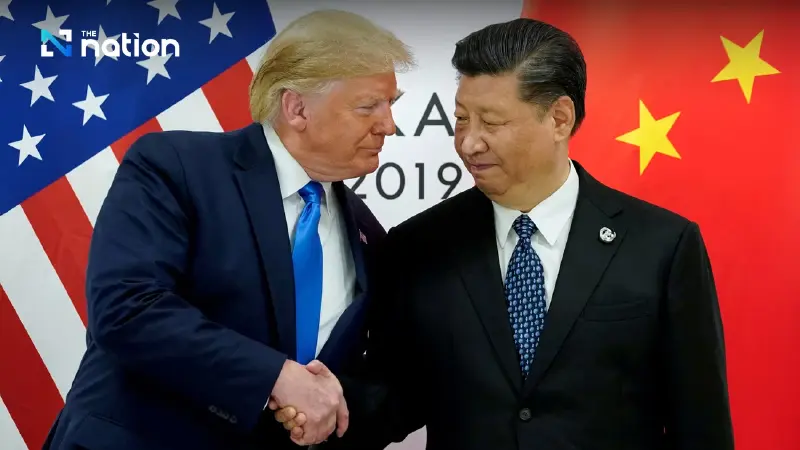


Donald Trump’s China visit is expected to focus on trade, Iran, AI chips, rare earths and Taiwan as talks with Xi Jinping begin
- Discussions on trade will focus on extending an existing truce and a US push for China to purchase more American goods, such as Boeing aircraft, soybeans, and beef.
- Artificial intelligence and semiconductors are a core battleground, with talks covering US export controls on advanced chips and concerns over China's use of American AI technology.
- The status of Taiwan is a highly sensitive topic, with discussions expected to include US policy and a potential $14 billion arms sale to the island, which China opposes.
US President Donald Trump’s visit to China is being watched as a high-stakes test of whether the world’s two largest economies can steady relations after years of confrontation.
Trump is scheduled to arrive in Beijing on Wednesday (May 13, 2026) for talks with Chinese President Xi Jinping, making him the first US leader in almost a decade to make an official visit to China. The summit comes as global attention remains fixed on the Iran war, trade tensions, artificial intelligence, Taiwan and China’s control over rare earth supplies.
The meeting is being framed as a possible attempt to reset relations, but the backdrop remains one of deep strategic rivalry. Officials and analysts expect several major issues to dominate the two-day talks.
Iran war tests China’s peace posture
The Iran war is expected to be one of the most sensitive issues on the agenda, as Trump faces pressure to end a conflict that has pushed up energy prices and shaken the global economy.
Washington is expected to press Beijing over its close ties with Tehran. China is Iran’s largest oil customer and has also offered diplomatic support to Iran internationally, leading US officials to argue that Chinese money has helped Tehran withstand sanctions.
The United States has previously imposed sanctions on several Chinese companies accused of buying Iranian oil or providing satellite information related to US military bases to Iran. Trump has also suggested that the US detected a vessel that may have been carrying weapons or military support from China to Iran, a claim rejected by China’s Foreign Ministry.
China has pushed back against US sanctions, telling Chinese companies not to comply with measures linked to Iranian oil. Beijing has also used a 2021 law designed to shield Chinese firms from foreign rules it considers unfair.
Hiroshi Nakanishi, a professor of international politics at Kyoto University, said that without a comprehensive deal, the question of how to end the Iran war would become one of the key issues in Beijing. For China, the incentives are mixed: it wants stability in the Middle East and open shipping routes, but analysts say a prolonged US focus on the Persian Gulf could also work to Beijing’s strategic advantage.
Trade truce likely to be extended
Trade is another central issue. Although the two sides have had a temporary truce since last October, most tariffs remain in place.
After returning to the White House, Trump moved again to raise tariffs on Chinese goods, prompting China to retaliate. Both sides later eased some tensions by reducing certain tariffs and delaying some export controls, including measures linked to China’s rare earths.
The Beijing meeting is therefore expected to focus on extending the trade truce to prevent tensions from escalating again.
However, distrust remains high. China has repeatedly criticised US tariffs, while the Trump administration continues to investigate Chinese trade practices, which could open the door to further tariffs.
One area of growing cooperation is fentanyl. Trump previously used the issue to justify a 10% tariff on Chinese goods, later raised to 20%, to pressure Beijing to restrict the production and export of drug precursors. Two days before Trump’s arrival, China announced that it had worked with the US to break up a transnational drug network, a move seen as a positive signal.
Trump pushes ‘5 Bs’ in China talks
A major US goal is to encourage China to buy more American goods and conclude more business deals with US companies.
Analysts say the summit could produce several business agreements, with one of the most closely watched possibilities being a major Chinese order for Boeing aircraft. The White House has also said the two sides may discuss agricultural trade, aviation and energy.
Scott Kennedy, an analyst at the Center for Strategic and International Studies in Washington, said the US objectives could be summed up as the “5 Bs”: Boeing, Beans, Beef, Board of Trade and Board of Investment.
The phrase reflects Washington’s push for China to buy more US aircraft, soybeans and beef, while also creating clearer mechanisms for trade and investment cooperation.
Emily Kilcrease, a senior fellow at the Center for a New American Security, said she would be watching how much detail emerged if a Board of Trade were announced, including whether it had real institutional structure and a clear plan.
The US has long pushed to expand agricultural exports such as soybeans and beef to China, the world’s largest soybean importer. During last year’s trade war, China halted some purchases of US crops for several months, hitting American farmers before imports recovered after the October trade truce.
Investment remains more complicated. US officials said before the meeting that there were no current plans to launch major new Chinese investment projects in the United States because of security concerns.

AI chips remain a core battleground
Artificial intelligence and semiconductors are expected to be among the most important areas of competition.
US officials said Washington was preparing to raise AI during the talks and could propose a direct channel for continuing dialogue with China on the issue.
The US is concerned that Chinese firms may be using the output of advanced American AI systems to develop their own models at far lower cost. Several US technology companies, including OpenAI, Anthropic and Google, have complained that some Chinese companies may be using data or output from American AI systems to train their own models.
Market access and AI acquisitions are also sources of tension. One recent example cited was China’s move to block Meta’s planned US$2 billion acquisition of Manus, an AI start-up, reflecting Beijing’s desire to limit foreign access to domestic technology.
China, meanwhile, remains unhappy with US export controls on chips, which have restricted Chinese companies’ access to advanced AI chips from Nvidia. Beijing argues that Washington is using chips as a weapon to contain China’s technological rise.
Trump allowed Nvidia last December to sell a downgraded AI chip, the H200, to Chinese customers, with the US government receiving a 25% fee from sales of the chips in China. It remains unclear how far chip controls will feature in the summit, but AI and semiconductors have become one of the defining battlegrounds between the two powers.

Rare earths give China strong leverage
Rare earths are also expected to feature prominently. China is currently the most powerful player in the sector, accounting for about 70% of global rare earth production, according to Now-GmbH, a German government research organisation.
These minerals are crucial to defence technology, electric vehicles, clean energy, chips and advanced electronics. That has turned them into a key economic weapon for Beijing.
China has used export controls on rare earths as a pressure tool. Although trade in these materials improved after the October truce, volumes remain below levels seen before China imposed export restrictions.
The US is trying to diversify supply, but Washington may need several years to reduce China’s influence over the rare earth market. China’s advantage is not limited to mining; it also dominates processing, a crucial step before the materials can be used in high-tech industries.
Beijing has also introduced new rules in response to Western efforts to shift supply chains away from China and restrict access to Chinese technology and raw materials. While China has moved to simplify some export licensing through general permits, many global companies remain concerned that approvals are still slow and could be used to control the market.
Taiwan remains the most sensitive flashpoint
Taiwan is expected to be another highly sensitive subject.
China regards Taiwan as part of its territory and insists the island must eventually come under Beijing’s control. The United States does not have formal diplomatic relations with Taiwan but continues to support Taipei with arms and security ties.
China has previously urged the Trump administration to state clearly that it opposes Taiwanese independence. Such wording would be seen as a major diplomatic win for Beijing.
US officials said they did not expect any change in Washington’s Taiwan policy during the summit.
The current US position recognises Beijing as the sole government of China, but does not clearly state Washington’s view on Taiwan’s legal status. The US is legally required to help Taiwan defend itself, while maintaining “strategic ambiguity” on whether it would intervene militarily if China used force.
Trump was asked shortly before the meeting whether he would discuss a US$14 billion arms sale to Taiwan with Xi. He replied that President Xi wanted the US not to proceed and that he would discuss the issue.
Analysts at Eurasia Group said a shift in Trump’s language may not be the most likely outcome, but if it happened, it would be significant because it could set a new precedent and deepen concern in Taiwan about US reliability.
For now, Taiwan remains one of the most dangerous flashpoints in US-China relations, linking sovereignty, security and military influence in Asia.

