
Thailand Vows to Bring Myanmar Back Into the ASEAN Fold
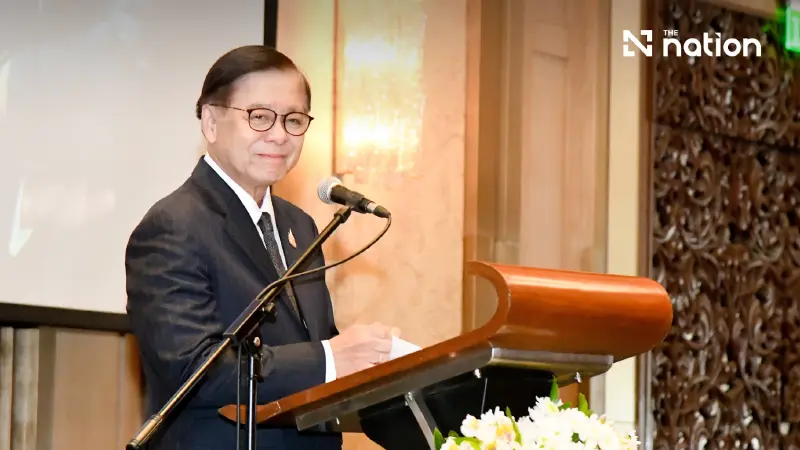


Foreign Minister Sihasak Phuangketkeow calls for "calibrated re-engagement" with Myanmar in step with ASEAN consensus, as Bangkok hosts the bloc's first bilateral summit with Naypyidaw in eight years
- Thailand's Foreign Minister announced a policy of "calibrated re-engagement" with Myanmar, focusing on implementing the ASEAN Five-Point Consensus rather than just repeating it.
- The stated primary goal of this policy is to bring Myanmar back into the ASEAN community, which Thailand views as essential for the bloc's unity and stability.
- This diplomatic effort was highlighted by Bangkok hosting the first bilateral summit with Myanmar's leadership in eight years.
- Thailand justifies its direct engagement by citing practical necessities, such as managing their 2,400 km shared border and the belief that dialogue is more effective than isolation for achieving peace.
Foreign Minister Sihasak Phuangketkeow calls for "calibrated re-engagement" with Myanmar in step with ASEAN consensus, as Bangkok hosts the bloc's first bilateral summit with Naypyidaw in eight years.
Thailand's approach to Myanmar is guided above all by respect for ASEAN's collective consensus, Foreign Affairs Minister Sihasak Phuangketkeow told reporters on Thursday, stressing that Bangkok's priority is not to restate the bloc's Five-Point Consensus but to see it actually implemented.
Briefing journalists after bilateral talks between Prime Minister Anutin Charnvirakul and Myanmar President Min Aung Hlaing, Sihasak was pressed on why Thailand continues to engage directly with the Myanmar leadership.
His answer centred on what he called "calibrated re-engagement" — a policy he said was designed to work within, not around, ASEAN's shared position.
"For Thailand, what matters is not repeating the consensus. It's been repeated every time," Sihasak said. "What matters for Thailand is how to have the consensus implemented... It's better to try to do something — maybe we won't be fully successful, but it's better than just waiting for things to happen."
He said Thailand's underlying policy objective was to bring Myanmar back into ASEAN, arguing that Myanmar's return was essential to the bloc's cohesion at a time when the region is navigating intensifying major-power competition.
"Our policy is we want to bring Myanmar back to ASEAN, because we see that Myanmar is important to ASEAN unity," he said.
First Visit in Eight Years
Thursday's summit marked President Min Aung Hlaing's first official visit to Thailand in eight years and his first as an elected head of state following Myanmar's recent election.
Sihasak said Bangkok's willingness to engage reflected geographic and practical necessity rather than an endorsement of any particular outcome, noting that the two countries share a border of roughly 2,400 kilometres.
"We live with reality," he said. "We have problems that we face along the border, and at the same time we have to be proactive in terms of helping peace and stability. The best way to achieve that is to have talks with those who are in a position of power."
He added that Thailand was not seeking to dictate Myanmar's political path.
"We're not asking others to follow — it's up to them to decide what they want to do," he said, while reiterating Bangkok's view that the conflict could not be resolved militarily.
"There is no military victory, and we should not try to perpetuate the military situation." Thailand, he said, remained ready to host or facilitate talks among all parties once they were prepared to engage, though he acknowledged no firm timeline was yet in sight.
Asked about the peace process, Sihasak noted that some armed groups remain in dialogue with Naypyidaw under the Nationwide Ceasefire Agreement while others are still working out a common position. Thailand's role, he said, was to remain ready to help without forcing the pace.
"We just want to help," he said.

Sihasak also pointed to what he described as recent positive developments, including the transfer of Aung San Suu Kyi from prison to house arrest and a visit to her by the head of the International Committee of the Red Cross in Yangon.
He said Thailand hoped ASEAN's Special Envoy would soon be granted similar access.
Security, Environment and Trade on the Agenda
Beyond the political questions, Sihasak set out a wide-ranging bilateral agenda covering security, the environment, trade and infrastructure.
Both governments agreed to intensify joint efforts against transnational crime, including drug trafficking, online scam operations and human trafficking, and to deepen cooperation under the trilateral Clear Sky Strategy with Laos on transboundary air pollution.
On water pollution, the two sides signed a Terms of Reference establishing a joint technical working group to address chemical and industrial contamination in the Kok and Sai rivers, which straddle the border.
Sihasak said the two countries' foreign ministers planned a joint field visit to the affected areas and that the new working group would convene as soon as possible.
On the economic front, both leaders agreed to reactivate key bilateral mechanisms, including the Joint Commission, the Joint Trade Commission and the High-Level Committee linking the two countries' military leaderships.
They reaffirmed a bilateral trade target of US$12 billion and welcomed the formal reopening of the second Thai-Myanmar Friendship Bridge connecting Mae Sot and Myawaddy — a crossing Sihasak said carried significance well beyond immediate trade flows, forming part of the proposed Thailand-Myanmar-India Trilateral Highway.
A new joint working group on connectivity will be set up to advance land, air and maritime links, supported by Thai development agencies Neighbouring Countries Economic Development Cooperation Agency (NEDA) and Thailand International Cooperation Agency (TICA).
Sihasak stressed that Thailand's economic engagement was intended as a long-term development partnership rather than an opportunistic one, citing planned cooperation in agriculture, public health and education.
The two governments also renewed a memorandum of understanding on labour cooperation, safeguarding continued legal employment for Myanmar workers in Thailand.
Closing the briefing, Sihasak said Thailand's approach was driven by long-term regional stability rather than short-term gain.
"Our intention is we want to see peace and stability for the benefit of the people of Myanmar," he said, adding that he hoped more countries would come to recognise the value of constructive engagement over isolation.
