
Pansak cites billion-dollar toll from Thai-Cambodia conflict


An analysis shared by Pansak Vinyaratn says the return of about 900,000 Cambodian workers exposes the two economies’ deep dependence.
Thailand and Cambodia are paying a mounting economic and humanitarian price for their border conflict, with the mass return of Cambodian workers exposing how deeply the two neighbouring economies depend on each other, according to a third-party analysis shared by veteran Thai policy adviser Pansak Vinyaratn.
The commentary argues that the departure of about 900,000 Cambodian workers has delivered a shock on both sides of the border. Cambodia has lost remittance income and must absorb a large returning workforce, while Thai farms, factories and other labour-dependent businesses face worker shortages.
Entitled “The Billion-Dollar Border: Five Surprising Truths About the Thailand-Cambodia Conflict”, the analysis was posted on Pansak’s personal Facebook account.
Pansak chaired former prime minister Paetongtarn Shinawatra’s policy advisory board and previously served as an economic policy adviser to former premier Thaksin Shinawatra from 2001 to 2006.

In a personal preface, Pansak wrote that he was nearing the end of his life’s journey and wanted to present a third-party perspective on the conflict. The post did not identify the author of the analysis or provide detailed methodology for every estimate it cited.
The commentary traces the present crisis to the unresolved demarcation of the countries’ border and a disputed map drawn in 1907 under French colonial rule. It argues that a century-old territorial dispute has developed into a modern economic, diplomatic and humanitarian emergency.
Thailand and Cambodia signed an immediate ceasefire on December 27, 2025, at the Ban Pak Kard-Prum border crossing between Chanthaburi and Pailin provinces. The agreement froze troop movements, prohibited further attacks and assigned a monitoring role to the ASEAN Observer Team.

Worker exodus reveals mutual dependence
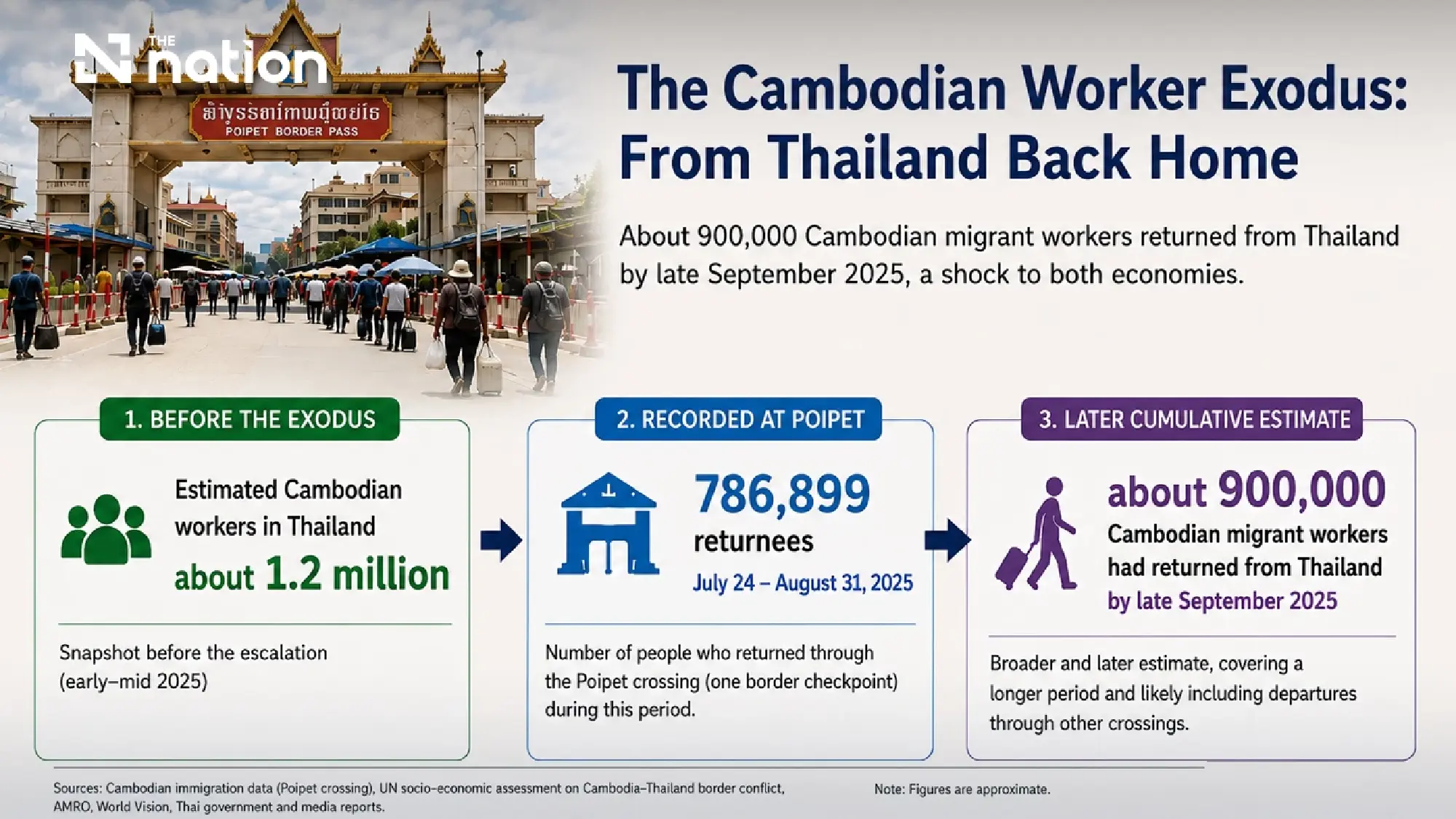
Thailand accounted for about 93% of Cambodia’s outward labour migration before the fighting intensified, hosting approximately 1.2 million Cambodian workers across agriculture, construction, manufacturing and other industries.
Cambodian immigration figures cited in regional reporting showed that 786,899 people returned through the Poipet crossing between July 24 and August 31, 2025. A subsequent UN-backed assessment said around 900,000 Cambodian migrant workers had returned from Thailand by late September.
The analysis describes the movement as an economic double-edged sword.
For Cambodia, the loss of wages earned in Thailand has reduced remittance income supporting households and domestic consumption. The commentary put Cambodian workers’ remittances at US$2.8 billion in 2024, equivalent to 6.1% of GDP.

An assessment by the ASEAN+3 Macroeconomic Research Office used a lower estimate of about US$2 billion, or 5.6% of GDP, but reached a similar conclusion about the risk. Under its worst-case scenario, a 37.5% fall in remittances could reduce Cambodian economic growth by more than 0.3 percentage points.
Thailand does not depend on those remittance flows, but the analysis says it has been left with a “production vacuum” in sectors that had relied heavily on Cambodian labour. An ageing domestic population cannot immediately replace the departing workers, it argues.
The labour shortage prompted Thailand to authorise the recruitment of 10,000 Sri Lankan workers in August 2025, while officials also considered workers from Nepal, Bangladesh, Indonesia and the Philippines.
Border closure adds a regional logistics bill
The commentary argues that the conflict has imposed a hidden “logistics tax” on Southeast Asia.
With many border crossings closed and traditional trade routes disrupted by fighting, some freight has had to be redirected through Laos and Vietnam. The analysis estimated that the longer routes had raised logistics costs by between 25% and 40%.
It said the higher costs were feeding through to consumer prices and threatening cross-border gas projects valued at trillions of baht, with potential implications for regional energy security.
The analysis also presented a tariff-risk scenario in which continued regional instability could expose exports to US tariffs of 25-30%, potentially causing a further 201.9 billion baht in losses.
Those figures were presented as scenarios rather than confirmed outcomes, and the Facebook post did not provide the underlying calculations or identify the gas projects concerned.
The broader argument is that even geographically limited border fighting can weaken trade corridors, interrupt production networks and reduce the attractiveness of both countries within global supply chains.
Uneven resilience tests both economies
The analysis portrays the confrontation as highly unequal on paper. It says Thailand’s economy is more than 10 times larger than Cambodia’s and compares Thailand’s US$5.7 billion defence budget with Cambodia’s US$739 million allocation.
Cambodia might therefore have been expected to suffer economic exhaustion first, it says, but the events of 2025 and 2026 have produced a more complicated outcome.
The commentary argues that Thailand entered the crisis with significant domestic vulnerabilities, including high household debt and political instability. It cited the change of prime minister following the leaked telephone-call controversy as an additional constraint on the country’s response.
Two Thai macroeconomic figures in the commentary require qualification.
It described household debt as equivalent to 170% of GDP, but SCB Economic Intelligence Centre reported a household debt-to-GDP ratio of 85.9% in the first quarter of 2026. Although still high, that is approximately half the ratio stated in the post.
The analysis also attributed to the University of the Thai Chamber of Commerce a forecast that Thailand’s economy would contract by 0.74% in 2026, with export losses of 66.6 billion baht.
The Bank of Thailand’s baseline forecast published on June 24 instead projected economic growth of 2.3% for 2026. The Facebook post did not explain whether the 0.74% figure represented a specific conflict-impact scenario rather than a forecast for the economy as a whole.
For Cambodia, the commentary links greater-than-expected resilience to stronger ties with China and a diversification of economic partners.
It says Cambodia accelerated its military modernisation with Chinese support after the United States suspended military financial assistance in 2023, including through the expansion of the disputed Ream Naval Base.
The analysis also cited US$5.1 billion in Chinese foreign direct investment in Cambodia during 2025 and export growth of 17.7%, arguing that these inflows and new trading relationships helped soften the impact of the confrontation.
Humanitarian costs keep diplomacy fragile
The economic disruption has been accompanied by two major waves of fighting and displacement.
Five days of clashes in July 2025, involving air strikes, artillery and rocket fire, killed at least 43 people and displaced about 300,000 on both sides of the border.
Fighting resumed in December and continued for 20 days. At least 101 people were killed and more than half a million were displaced before the December 27 ceasefire took effect.
A UN socio-economic assessment recorded a peak of 644,589 displaced people in Cambodia between December 25 and 27, including more than 200,000 children.
World Vision reported that 20,923 people remained unable to return home as of July 8, 2026, because of damage and continuing disputes over villages and residential areas. The Cambodian government had constructed more than 4,000 temporary shelters, while World Vision had mobilised US$1.8 million to assist families across five provinces.
The analysis characterises the ceasefire as a pause driven by exhaustion rather than a final settlement. It argues that the disputed boundary remains the underlying driver of the confrontation, regardless of the economic damage suffered by both countries.
The December joint statement called for the Thailand-Cambodia Joint Boundary Commission to resume survey and demarcation work, but the commentary says the unresolved 1907 map dispute continues to cast a shadow over bilateral relations.
It contrasts the use of modern aircraft, rockets and other 21st-century military technology with a boundary document drawn before television was invented.
Pansak concluded:
“The Thailand-Cambodia crisis shows that ‘sovereignty’ carries a very real price tag. When two countries choose a line on a map over billions of dollars in trade ties, the true cost is paid by workers, families and consumers caught in the crossfire of history.”
Source: Pansak Vinyaratn
