
Farmer well-being index hits 81.39, South continues to lead
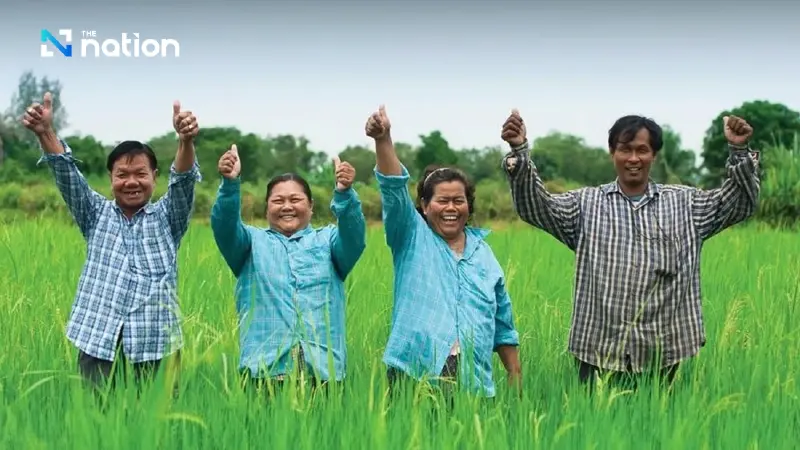


Farmer well-being index 2024 hits 81.39, with the South topping the rankings. Health and social aspects are strong, but education and environment need improvement.
Winit Atthisuk, deputy secretary-general of the Office of Agricultural Economics (OAE), Ministry of Agriculture and Cooperatives, said the OAE compiles the annual Farmer Well-being Index as a key tool for assessing the success of policies to improve farmers’ quality of life.
The index is also one of the performance indicators of the Agricultural and Cooperative Action Plan 2023–2027. It covers five dimensions of farmers’ livelihoods: economic, health, education, social, and environmental.
For 2024, the national index stood at 81.39, up from 80.79 in 2023, reflecting overall improvement in farmers’ well-being at a “good” level. Regionally, the South scored highest at 83.04, followed by the North (82.07), Central (81.48), and Northeast (80.51), with all regions assessed at the same “good” level.

Strong performance in health and social well-being
Health scored 99.87, rated “very good”, similar to last year. This was attributed to households paying greater attention to healthy diets and food safety, alongside state programmes such as the “home vegetable garden” initiative and promotion of Good Agricultural Practices (GAP), safe agriculture, and organic farming standards.
Social well-being reached 93.43, also “very good”, improving on 2023. This reflected stronger household relationships, as well as government efforts to prepare for an ageing society and to promote occupational training suitable for older people.
Moderate economic gains, but weak education and environment
Economics scored 77.96, classed as “moderate” but up from the previous year. The survey found that net farm household cash income in 2024 averaged 308,294 baht, up 1.9% from 2023, driven by higher demand for agricultural products both domestically and abroad, as well as the ongoing recovery of the tourism sector.
Environment scored just 61.46, down from last year, in the “needs improvement” category. The decline was attributed to reduced targeted land restoration, shrinking forest cover due to economic expansion, and increased wildfire damage.

Education remained the weakest area, at 56.30, still in the “urgent attention required” category despite a slight increase. The OAE noted that more than 50% of farm households are elderly (aged 60 and above) and most have below-compulsory education levels, dragging down the overall educational score.
Farmer well-being index shows gradual long-term improvement
When compared with the closing years of previous National Economic and Social Development Plans, the Farmer Well-being Index has shown steady progress. At the end of the 10th Plan in 2011, the index stood at 76.97. It rose to 80.51 by the end of the 11th Plan in 2016, and to 80.46 at the conclusion of the 12th Plan in 2022. The current reading of 81.39 for 2024, therefore, reflects a gradual upward trend.
Policy recommendations for further development
Education: Ensure universal access to compulsory education for farmers, and expand training in modern agricultural technologies, with a particular focus on innovations suitable for older farmers.
Environment: Promote continuous forest restoration with community participation, alongside stronger support for environmentally friendly farming practices.
Economy: Enhance household income by encouraging the production of crops aligned with local potential, applying technology to cut costs, and improving financial management skills to build long-term discipline and strengthen overall well-being.
Further information on the Farmer Well-being Index can be obtained from the Farmer Policy and Development Planning Division, OAE.
Tel: 0 2579 2816 (office hours)
Email: [email protected]
