
Toxic pollution in Kok River causes 1.3 billion baht annual economic losses
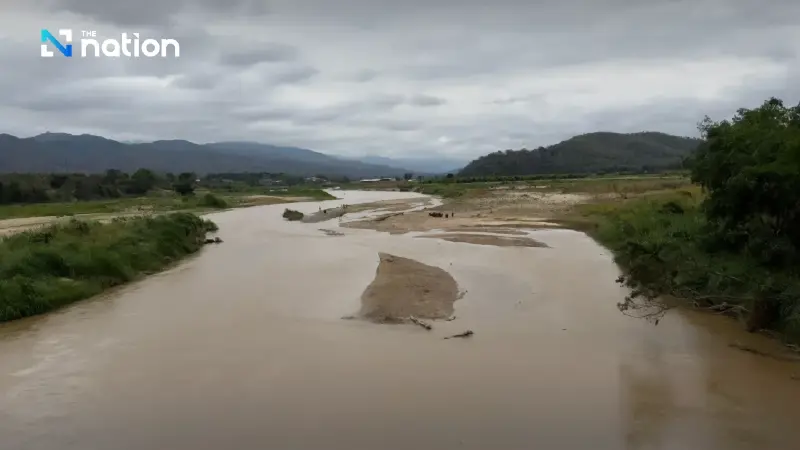


Kok River pollution from mining and waste causes up to 1.3 billion baht in annual losses, hitting farming, fishing and tourism in northern Thailand.
The Office of Environmental and Pollution Control Region 1 in Chiang Mai has reported heavy metal contamination in the Kok River, Mae Ai district, Chiang Mai.
Tests revealed lead and arsenic levels exceeding safety standards. The lead pollution is believed to stem from wastewater released by factories and mining operations, while arsenic contamination is thought to be linked to pesticide runoff.
Another suspected cause is upstream mining activity, particularly gold mining near the Thai–Myanmar border, which has contaminated tributaries, including the Sai, Ruak, and Kok rivers, before they flow into the Mekong.

Supatchaya Techachoochert, an expert in nature-based solutions at the Mae Fah Luang Foundation under Royal Patronage, highlighted the economic damage caused by this pollution at the MFLF Sustainability Forum 2025 on September 22.
Citing research by Lanner, a local media outlet specialising in northern Thai social issues, she said the contamination has inflicted losses worth an estimated 511 million baht on communities across 20 subdistricts in Chiang Rai.
When factoring in losses to the fishing and tourism sectors, the figure could rise as high as 1.3 billion baht annually.
She emphasised that greater attention needs to be paid to the environmental impacts of industrial activity. The contamination of the Kok River and its subsequent flow into the Mekong reflects a failure to address environmental risks, as industries discharge toxic chemicals and wastewater to maximise short-term gains.
This neglect, she said, has snowballed into widespread economic damage and disrupted the daily lives of local people.
“It echoes the saying that money is an illusion, while rice and fish are real. The livelihoods of villagers, rice farming and fishing, have been deeply undermined.”

Supatchaya added that choices are already being shaped by safety concerns:
“Today, if we must choose between tom yum made with Nile tilapia or Mekong fish, most would pick tilapia, because we value our health more than risking exposure to toxic contamination. But riverside communities may not have that choice. They still depend on the Mekong for drinking water, farming and aquaculture. If we eventually discover that the agricultural produce and meat we consume come from polluted sources, we would all feel uneasy.”
She went on to say that today we are experiencing slow but steady changes in nature, often without realising it. Rising temperatures, for instance, are already having long-term consequences for agricultural yields.
She cited the case of pineapples, where early flowering has reduced both quality and quantity, forcing processing plants to shut down as operators can no longer predict supply with certainty.
Environmental issues are now seen as shared challenges across multiple sectors worldwide. In the United States, for example, when President Donald Trump expanded logging concessions and withdrew from the Paris Agreement, it triggered widespread domestic protests and campaigns under the banner “make polluters pay”, calling for polluters’ profits to be reinvested in environmental protection.
In China, meanwhile, the government has stepped up funding for biodiversity and improved production processes, providing greater momentum for sustainability efforts.
Thailand, however, still lags. Despite relatively high carbon and greenhouse gas emissions, investment in sustainable development remains limited, while the country’s natural resources and ecological assets are being steadily depleted.
Supatchaya concluded by noting that since the Industrial Revolution, the average global income per capita has increased by 13%, yet natural capital has declined by as much as 40%. “If we want real change, it has to begin today,” she said. “The cost of doing nothing is that, by the time the problem fully arrives, it may be too late for us to cope.”
