
Baht firms on inflows, weaker dollar; gold trading app planned
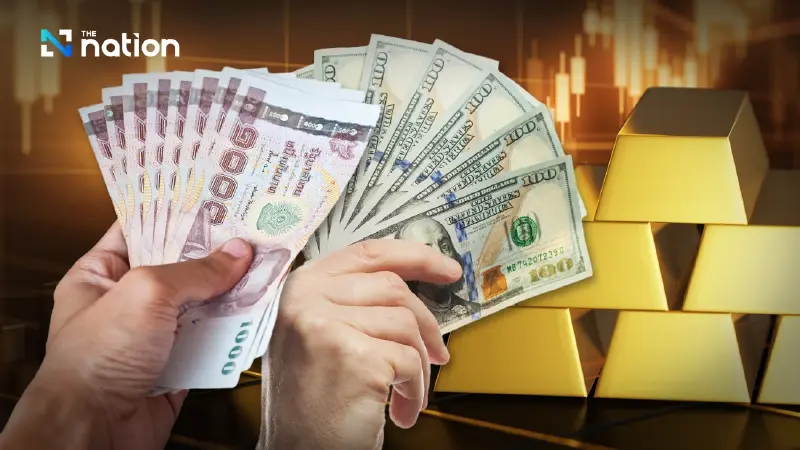


Baht gains on gold rally, foreign inflows and a softer dollar. Krungthai says strength may slow; BOT and gold traders plan a US$ gold-trading platform in H1.
The baht began 2026 on a stronger note, supported by a rise in global gold prices after the US operation in Venezuela and by signs of foreign inflows, as the US dollar weakened.
On Monday, January 5, 2026, the baht closed at 31.30 per US dollar, strengthening from 31.45 at the open and from 31.55 at the previous close. The currency tracked the jump in global gold prices, while additional support was seen from foreign fund flows. On Tuesday, January 6, foreign investors were net buyers of Thai shares worth 2,371.54 million baht and Thai bonds worth 929 million baht.
On Tuesday, the baht opened flat at 31.32, then strengthened through the morning to test 31.25, and extended gains in the afternoon to test 31.15, before closing at 31.26.
The baht ended 2025 with a rapid appreciation, marking a new five-year high after a volatile year, finishing at 31.02 per US dollar. Over the full year, it strengthened 9.42% from around 34 at the start of the year, helped by a softer dollar, foreign-currency selling by the gold trade after gold prices surged, and foreign inflows into Thai bonds.
KResearch: geopolitics and gold support the baht
Kanjana Chokpaisalsilp, an executive in the research team at Kasikorn Research Center, said the baht strengthened in line with rising gold prices, supported by the US–Venezuela conflict, and by foreign fund-flow momentum. As of January 6, foreign investors recorded net purchases of Thai shares and bonds of 2,371.54 million baht and 929 million baht respectively.
She said the baht also moved in line with most Asian currencies, while the dollar softened alongside lower US bond yields after the US ISM manufacturing index fell to 47.9 in December 2025, its lowest since October 2024, below market expectations of 48.4 and down from 48.2 in November 2025.
Key factors to watch, she said, include foreign fund flows, moves in Asian currencies and global gold prices, signals on US rates from Fed officials’ remarks, and December services PMI readings for the euro zone, the UK and the US.
Krungthai: baht stronger than expected, but support may slow
Poon Panichpibool, a strategist at Krungthai GLOBAL MARKETS, said the baht has strengthened more than expected. However, he said the pace of appreciation could slow in the near term as markets await key US labour-market data, which could reshape expectations for the Federal Reserve’s rate path.
He said some market participants see a risk of baht weakness in the first quarter, but a sustained reversal would likely require three broader shifts: (1) a clear change in market expectations for Fed rates based on strong US data, especially jobs numbers; (2) a continued drop in gold prices or a new consolidation phase, while noting that a sharp rise in gold could also pressure the baht weaker through “FOMO” buying flows; and (3) domestic shocks severe enough to hit fundamentals such as tourism and exports or trigger foreign sell-offs of Thai assets, such as a major political crisis.
With baht volatility rising above previous periods and above historical averages, he suggested market participants consider options strategies or using local currencies to manage exchange-rate risk more efficiently.
Krungsri: chance of a temporary break below 31
Roong Sanguanruang, a senior director in global markets planning at Bank of Ayudhya (Krungsri), said the baht could strengthen through the 31-per-dollar level, though she expects any break to be temporary. She said the baht’s direction still hinges on global gold prices, while other flows have thinned around the year-end period, meaning low liquidity could amplify moves.
For 2026, she put the baht in a range of 30.80–33.00 per US dollar, supported by potential Fed rate cuts and Thailand’s current account surplus. Headwinds include Thailand’s low growth outlook and the risk of a gold pullback if US labour data comes in stronger than expected.
BOT and major gold traders plan a US$ gold-trading platform
Kritcharat Hirunyasiri, executive chairman of MTS Gold (Mae Thong Suk), said a meeting on January 6 between the Bank of Thailand and 14 major gold traders made positive progress on four key issues:
- A US dollar-based gold trading platform: A plan to develop a gold-trading platform using the US dollar as the main currency, expected to take no more than six months and possibly finish sooner — within the first half of the year.
- Transaction reporting: A preliminary agreement to report only high-value transactions to avoid impacting retail and mid-sized investors, which are a smaller share of the market. Retail trading would not be affected, while large investors would be encouraged to trade more through a dollar index.
- Work with commercial banks: Close coordination with banks to develop payment rails such as EFCD or a wallet system to make transactions faster and more efficient.
- Role of gold shops: Gold shops would help promote greater use of the US dollar and provide ongoing public education through various media, with concrete steps starting this month.
Previously, the central bank had sought cooperation on reporting in two main areas: (1) baht-denominated gold trading, and (2) gold imports and exports. The Bank of Thailand wants more detailed daily information to link gold trading, import-export activity and payment flows, including exchange-rate related details, though traders have said the reporting burden is heavy, particularly for the largest operators.
