
FBI, foreign attachés inspect O'Smach scam hub with Thai Army
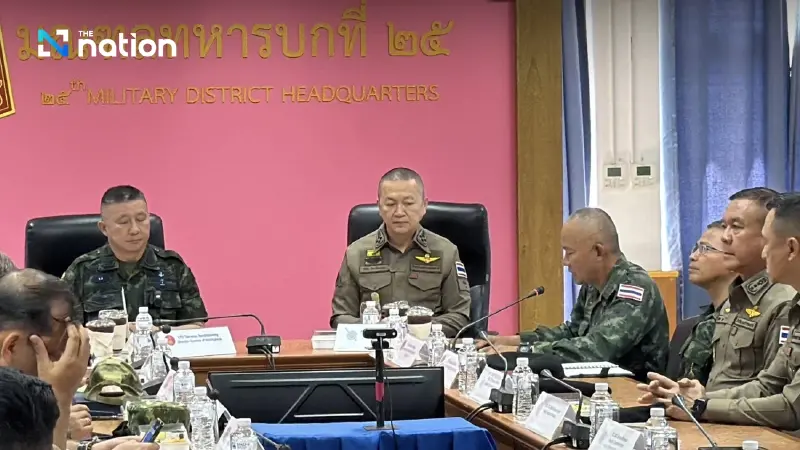


Thailand’s Army intelligence chief led the FBI and military attachés from 20 countries to Chong Chom border area, citing evidence of organised scam operations
On February 2, 2026, Lt Gen Teeranan Nandhakwang, Director-General of the Royal Thai Army’s Directorate of Intelligence, led a group of foreign military attachés based in Thailand from 20 countries — including the United States, Malaysia and Vietnam — along with FBI officers, on an open-house visit to a military unit and a field inspection along the Thai–Cambodian border.
The visit took place at the Chong Chom border crossing in Surin province to monitor the border situation and anti–transnational crime operations, with a particular focus on scam networks that have affected multiple countries and undermined regional security.
Pol Gen Thatchai Pitaneelaboot, deputy national police chief overseeing cybercrime suppression, joined the delegation to follow progress in operations targeting scam groups in the Chong Chom–O'Smach area. An NGO representative, Sunai Phasuk, an advisor for Human Rights Watch in Thailand, also attended as an observer.

The foreign attachés and FBI officers inspected the area around the permanent Chong Chom crossing in Kap Choeng district, Surin, opposite O'Smach, to gain an on-the-ground understanding of the scammer problem in O Smach following border clashes in December 2025.
According to Thai officials, two main scam bases were identified in O'Smach: O'Smach Resort and Royal Hill. They said Royal Hill includes three six-storey buildings that were used as accommodation and workspaces for scam operators, separated by nationality groups such as Vietnamese, Singaporean and Indian nationals. They also cited a separate management building, along with facilities such as a restaurant and shops.
Inside the buildings, officials said they found extensive evidence allegedly used to deceive victims, including staged sets resembling government agencies in different countries — such as mock police stations and banks — as well as documents listing victims in multiple countries, police-style uniforms, and personal belongings and appliances left behind.
Lt Gen Teeranan said the purpose of the visit was to communicate to the international community that crimes affecting “humanity” are being committed. After checking buildings believed to be connected, he said authorities found signs of a structured scam-centre operation with detailed work processes, as well as simulated props used in fraud. He said police had already collected all evidence, while the military’s role was to facilitate access to the area.
Asked about past cooperation requests to Cambodia, he said Thailand had sought cooperation in several areas and had found cases in which Thai nationals were victims of human trafficking, held against their will and abused. However, he said Thailand was told that inspections found no Thai nationals, and assistance was not provided.
Asked whether the area could also have been used as an operations base linked to drone activity, he said that during the second clash Thai forces detected large numbers of drones, including explosive-laden drones, which injured Thai personnel. He said this made the area a clear military target, and an operation was carried out there. He added that at the time they did not know it was a scam base, but later observed heavy vehicle movements and frequent military traffic in and out, which he said indicated the area had been used for military activity.
Asked how much land Thailand now controls in the area, he said discussions with operational units indicated roughly 100 rai, consisting of buildings linked to scam operations.
On reports of lights still visible at night, he said solar panels could be seen on buildings and Thai observation posts still noted brightness at night, but inside the buildings no electricity was found.
Asked whether the evidence would be used to show the world Cambodia is a scam hub, he said collecting evidence is part of building such a case, but the immediate aim was to inform the public and show the situation clearly, which is why media were brought to the site.
Asked whether there might be Cambodian government backing due to the scale of the “empire”, he said that would depend on evidence linking actors and is a matter for the investigative process beyond the military’s remit.
Asked how long Thailand would maintain control of the area, he said deployments were being carried out under joint statements and positioning, while negotiations would return to the relevant bilateral mechanisms, including the JBC and GBC.
Asked whether Cambodian forces had attempted to re-enter the area after clashes ended, he said no return had been detected, though he could not confirm the reasons, and Thai forces would prevent entry. He added that defensive construction on both sides after operations is normal military practice and not necessarily a sign of imminent aggression, though vigilance remains necessary. Future conditions, he said, would depend on upcoming meetings, and for now forces must hold the area pending the formation of a new government.
Asked about the number of foreign nationals involved in scam operations, he said figures compiled from discussions and collected information suggested around 8,000–10,000 people, and that movements out of the area were observed around the time of military operations on December 8.
