
Brick-red Moon rises tonight in rare total lunar eclipse
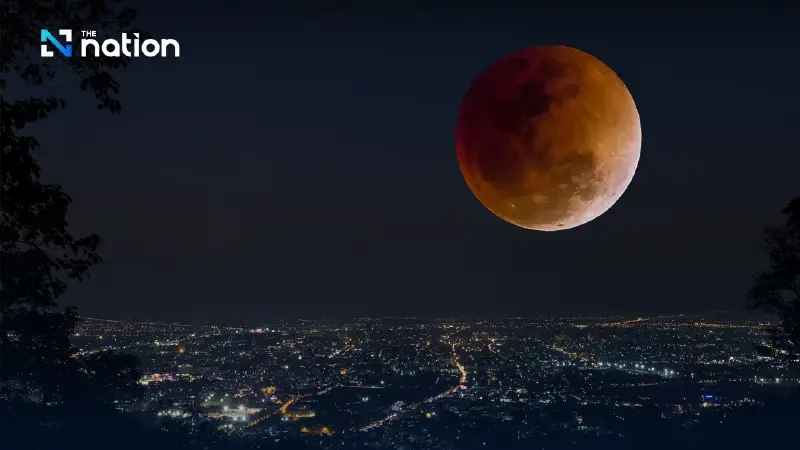


A total lunar eclipse will be visible on Makha Bucha Day (March 3), with a brick-red Moon expected to appear for around 39 minutes.
Tuesday (March 3) — Makha Bucha Day — will not be just another full-moon night. Over Thailand, a rare skywatching moment is set to unfold: a total lunar eclipse, with the Moon appearing brick red as it rises in the east.
The eclipse will run from 3.44pm to 9.23pm (Bangkok time), as the Moon gradually moves into Earth’s shadow. The total eclipse phase will take place from 6.04pm to 7.02pm.
For observers in Thailand, the most striking period begins at around 6.23pm, when the Moon rises above the horizon already fully covered by Earth’s umbra. That means the Moon can appear brick red from the moment it first becomes visible — and this dramatic view will last for around 39 minutes, until 7.02pm.
After that, the Moon will slowly re-emerge, looking “bitten” or partially shadowed, before returning to normal.
Why does the Moon turn red?
A lunar eclipse happens when the Sun, Earth and Moon align in a straight line, with Earth in the middle. Earth’s shadow then falls across the Moon. However, some sunlight is bent (refracted) through Earth’s atmosphere, and much of the shorter-wavelength light scatters away — leaving mostly red-orange light to reach the Moon’s surface.
This produces the “blood moon” effect. In traditional Thai belief, this phenomenon is known as “Rahu swallowing the Moon”.
Where to watch in Thailand
Because the Moon will be low near the horizon, it is best to choose an open area with a clear view to the east, such as a rooftop, viewpoint, seaside location, or wide-open field. Check the weather in advance, as cloud or rain could block visibility. Moonrise times may also vary slightly between provinces.
A total lunar eclipse does not happen often. The next time it will be clearly visible in Thailand is expected on the New Year’s Eve night of December 31, 2028, continuing into January 1, 2029.
What is a lunar eclipse?
A lunar eclipse occurs when the Sun, Earth and Moon move into the same orbital plane, with Earth positioned between the Sun and the Moon. It happens only on a full moon (around the 14th–15th night of the lunar month).
As the Moon passes into Earth’s shadow cast into space, people on Earth will see the Moon gradually become shadowed, until it is fully covered — and then see it “uncover” again as it exits the shadow. In ancient Thai tradition, this event was called “Rahu swallowing the Moon.”
Although the Moon orbits Earth every month, lunar eclipses do not occur at every full moon because the Moon’s orbital plane is tilted by about 5 degrees relative to Earth’s orbital plane. As a result, the Moon often passes above or below Earth’s shadow rather than through it.
On average, lunar eclipses occur at least about twice a year, though visibility depends on geographic location. The date, time and viewing areas can be calculated in advance with high accuracy.
10 quick tips before watching the total lunar eclipse
- Get the time right: 6.23pm is the key moment in Thailand — the Moon rises above the horizon for observers in the country.
- Look east: When the Moon first appears, it will coincide with the total eclipse phase and look brick red, visible to the naked eye.
- Remember the window is short: In Thailand, the brick-red Moon will be visible for only 39 minutes — from 6.23pm to 7.02pm.
- Higher ground helps: Choose an elevated, open spot with a clear eastern horizon, such as a rooftop or viewpoint.
- If you are on flat ground, go open: Seaside areas or wide fields are ideal. Trees, tall buildings, and thicker atmosphere near the horizon can obstruct the view.
- Naked-eye friendly: You can watch without equipment, but binoculars or a telescope will reveal more detail.
- Watch online: The National Astronomical Research Institute of Thailand (NARIT) will livestream from around 5.00pm onwards via its Facebook page.
- Keep watching after 7.02pm: From 7.02pm to 8.17pm, the Moon will move out of Earth’s umbra, creating a partial lunar eclipse and a visible “missing bite” effect. From 8.17pm to 9.23pm is the penumbral eclipse phase, which is harder to observe.
- If you miss it, you will wait two years: The next total lunar eclipse visible from Thailand is expected on December 31, 2028.
- Join public viewing events: NARIT is inviting the public to watch for free at five main venues — Princess Sirindhorn AstroPark in Mae Rim district, Chiang Mai, and regional observatories for the public in Nakhon Ratchasima, Khon Kaen, Chachoengsao, and Songkhla — from 6.00pm to 10.00pm, with livestream coverage via NARIT’s Facebook and YouTube channels.
