
Thailand’s low-carbon rice model emerges from Central Plains farmers
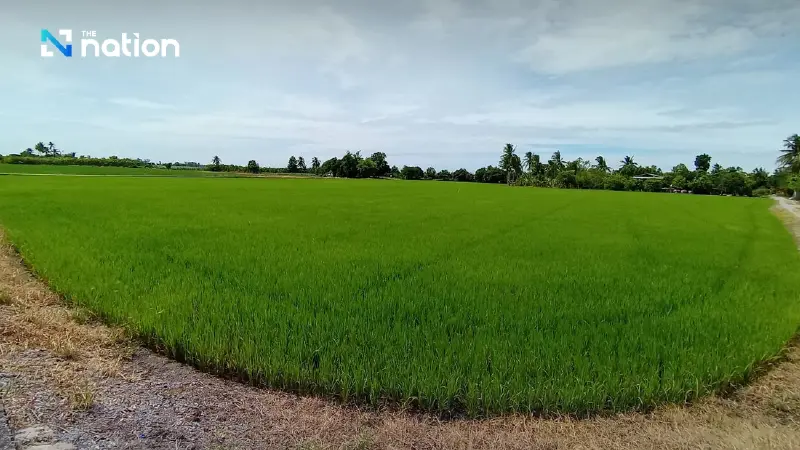


Central Plains farmers are emerging as a model for low-carbon rice, cutting methane, raising value and opening export opportunities
Thailand’s rice industry is currently facing mounting challenges, particularly in the white rice segment, which has been hit by falling prices and intense competition from rival producers such as India and Vietnam, both of which have lower production costs.
Jasmine rice, particularly Hom Mali 105 and RD15, has continued to hold on to its premium market position. However, a key problem lies in rice farming in the Central Plains, where strong irrigation systems allow farmers to accelerate dry-season production of off-season rice varieties that are not sensitive to photoperiod.
In some areas, farmers can grow rice as many as three times a year. As a result, they use large amounts of production inputs, including fertiliser, chemicals and water, causing cumulative costs to rise to the point where many farmers can no longer bear the burden when global market prices fluctuate.
Sommai Lertna, Director of the Rice Research and Development Division at the Rice Department, said that under the Paris Agreement, Thailand has set a target of reducing greenhouse gas emissions by 4 million tonnes of carbon dioxide equivalent by 2030. The agricultural sector has been assigned to cut 2 million tonnes, of which 1 million tonnes must come from rice cultivation.
This is because flooded rice paddies are a major source of methane emissions, produced by microbial decomposition under oxygen-free conditions.
The Rice Department has therefore adopted a policy to promote environmentally friendly rice farming, while supporting producers of organic rice, Climate-Smart Agriculture (CSA) rice and low-carbon rice. In addition to selling rice, farmers can also sell carbon credits.

Alternate wetting and drying cuts methane emissions
Sommai said that low-carbon rice production relies on an “alternate wetting and drying” method. Under this system, the soil surface must be allowed to dry and the underground water level must fall to 10 centimetres below the surface before water is reintroduced. The field is then allowed to dry again before being irrigated once more, in repeated cycles, typically twice.

This method can reduce methane emissions by 0.5 to 1 tonne per rai per crop cycle. Besides helping to reduce global warming, it also strengthens rice plants, lowers the risk of disease and pests, and reduces energy costs associated with pumping water.
“The Rice Department has been testing alternate wetting and drying for several decades, which has enabled us to quantify methane emission reductions. As for other methods, such as reducing fertiliser use and avoiding stubble burning, we are still working to establish equations for carbon emission reductions,” the Director of the Rice Research and Development Division said.
Farmers can sell rice and carbon credits
Beyond reducing fertiliser and chemical use, the alternate wetting and drying model also allows farmers to sell carbon credits generated by this method of cultivation. Sommai explained that to enter the carbon-credit market, farmers must be registered and certified by agencies such as the Thailand Greenhouse Gas Management Organisation (Public Organisation), or TGO.

The carbon credits generated will then be compiled by TGO into the country’s central database and submitted under Thailand’s Nationally Determined Contributions (NDCs) — each country’s self-defined greenhouse gas reduction plan under the Paris Agreement, designed to help limit global temperature rise to no more than 1.5 to 2 degrees Celsius. All parties to the agreement must submit these plans every five years.
To ensure international recognition, the Rice Department has integrated its work with TGO to establish a monitoring, reporting and verification (MRV) system. A registered central body, known as a Validation and Verification Body (VVB), will inspect rice fields systematically to certify that the rice is genuinely “low-carbon rice”.
Producers can then choose either to sell carbon credits or to apply for use of the “Carbon Footprint” label on rice packaging to strengthen their market position.
Central Plains rice gains carbon label certification
At present, the Rice Department has supported the “Khao Chaona Ruamjai” network, which has created a milestone in Thai agriculture by becoming the first farmer group in the Central Plains to have its rice products assessed and certified with a carbon label by the Thailand Greenhouse Gas Management Organisation (Public Organisation), or TGO.
“The success of the ‘Khao Chaona Ruamjai’ group also serves as a model and an inspiration for other farmer groups across the country, encouraging them to improve production processes in ways that reduce environmental impacts. This will help raise Thai agriculture to a stronger and more sustainable level of growth.”
The “Khao Chaona Ruamjai” network was born from a vision of self-reliance. It began as a pilot project in Khlong Sam Wa district, Bangkok, where farmers came together to create a full-cycle rice production model. It has since grown into a strong network comprising 99 members under four community rice centres in Pathum Thani province, covering more than 2,482 rai of farmland.
The group’s strength lies not only in collective action but also in its investment in infrastructure and commitment to international standards. All members have been certified under Good Agricultural Practice (GAP) standards.
Meanwhile, the group’s rice mill has passed Good Manufacturing Practice (GMP) standards and is in the process of obtaining HACCP certification and Thailand’s Q mark standard in order to raise food safety to the highest level and ensure consistently high-quality output.
A key gateway to export markets
A major turning point for the group came when it joined the project titled: “Development of integrated low-carbon, high-quality rice production and processing technology at farmer-group level to support exports”, led by Pathum Thani Rice Research Centre under the Rice Research and Development Division of the Rice Department.
The project aims to improve processes across the entire supply chain in order to reduce greenhouse gas emissions, with research funding provided by the Agricultural Research Development Agency (Public Organisation), or ARDA.
Through work under this project, the group compiled data and applied successfully for carbon label certification for its products. Four rice products have received carbon label certification:
- RD43 rice, 1-kilogram pack
- RD43 rice, 5-kilogram pack
- RD91 rice, 1-kilogram pack
- RD91 rice seed, 25-kilogram pack
The label is expected to serve as a crucial passport into export markets with strict environmental regulations, such as the European Union, helping to add value and strengthen the long-term security of Thai rice.
Global markets respond as Thailand targets 1 million rai
“At present, the low-carbon rice model is beginning to show concrete results in Sing Buri province, where exports have already reached department stores in Hong Kong.
We have also received interest from high-quality markets such as Singapore and Australia. The Rice Department therefore plans to expand the area under low-carbon rice promotion to 1 million rai across the Central, Western and Eastern regions, in order to move Thai agriculture towards genuine sustainability,” Sommai said, referring to the model’s success.
Alternate wetting and drying cuts costs and lifts yields
Somkuan Panthuean, a 59-year-old farmer in Pathum Thani, said he cultivates 15 rai and decided to adopt the alternate wetting and drying method more than three years ago. The results have gone beyond cost reduction, increasing yields from no more than 800 kilogrammes, or 0.8 tonnes, per crop to as much as 1.1 to 1.2 tonnes per cycle.
The starting point for the method was laser land levelling, which made the soil surface even across the entire field. This became a crucial foundation for easier water management. Once water distribution became more uniform, weed growth declined automatically, resulting in chemical use and pumping costs falling by more than half.
He also uses drone technology to sow seed and apply fertiliser, helping him use both more appropriately according to the field area. In addition, he has installed a smart sensor system to monitor water levels in pipes. If the water level falls below 15 centimetres, the system automatically activates the motor. This reduces the need to walk the fields constantly and allows the rice plants to grow almost 100% uniformly.
As a result, harvesters can work more easily because the soil is allowed to dry out fully before harvesting, preventing machinery from getting stuck in mud. He has also followed sustainable agricultural practices by avoiding straw burning for more than 10 years, instead ploughing the straw back into the soil to improve fertility.
More than low-carbon rice — rice for people with diabetes
Somkuan said he has chosen to grow RD43 and RD97 rice varieties, targeting people with diabetes and health-conscious consumers, because these varieties convert starch into sugar more slowly.
As a result, by milling and selling the rice himself, he is able to secure prices as high as 12,000 baht per tonne, compared with just 6,500 baht per tonne for ordinary paddy rice on the general market. This year, he was also certified as a producer of “low-carbon rice”.
Breaking away from the traditional farming model, in which fields remain flooded all year and farmers have to battle weeds while applying large amounts of fertiliser, the shift to alternate wetting and drying has not only increased rice yields but has also helped reduce global warming.

