
Bangkok cuts power use by 32MW in Earth Hour 2026
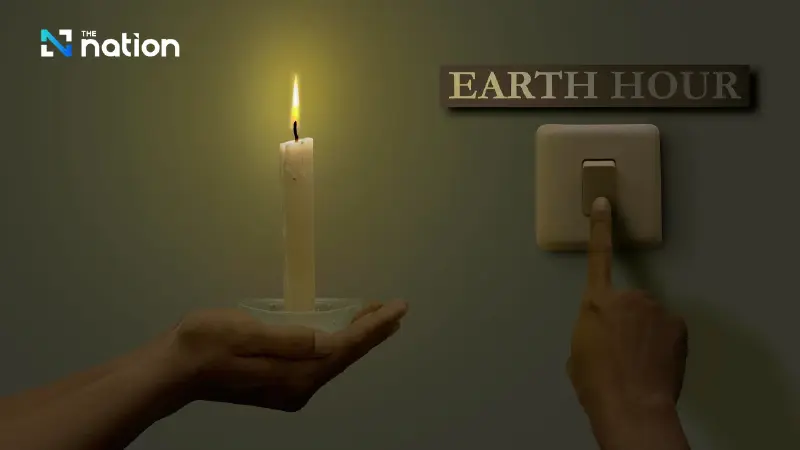


Bangkok reduced electricity use by 32 megawatts during the one-hour Earth Hour campaign, saving nearly Bt145,000 and cutting carbon emissions by 13.5 tonnes.
Bangkok reduced electricity use by 32 megawatts during the 60+ Earth Hour 2026 campaign on Saturday night, saving Bt144,958 in electricity costs and cutting carbon emissions by 13.5 tonnes of carbon dioxide equivalent, according to the Bangkok Metropolitan Administration.
Aekvarunyoo Amrapala, spokesperson for the BMA, said the campaign called on businesses, building operators, shops and households to cut energy use by switching off unnecessary lights, unplugging appliances not in use and reducing air-conditioning for one hour from 8.30pm to 9.30pm on March 28, 2026.
Three Bangkok landmarks join switch-off
This year, three major Bangkok landmarks also joined the symbolic lights-off campaign: Wat Arun Ratchawararam Ratchawaramahawihan in Bangkok Yai district, the Giant Swing and Wat Suthat Thepwararam Ratchawaramahawihan in Phra Nakhon district, and the Golden Mount (Wat Saket Ratchawaramahawihan) in Pom Prap Sattru Phai district.
The BMA said calculations by the Metropolitan Electricity Authority showed that electricity use in Bangkok during the campaign period was 32 megawatts lower than during the same hour on the previous Saturday, March 21, 2026.
Savings equal 1,350 trees
City Hall said the one-hour campaign’s emissions reduction was equivalent to the annual carbon absorption of 1,350 trees, based on an estimate of about 10 kilogrammes of carbon dioxide absorbed per tree per year.
The reduction was also compared to 112 Bangkok–Chiang Mai flights, 81,000 kilometres of diesel car travel, or the equivalent of switching off electricity in 60,750 households.
Part of a wider climate campaign
Bangkok has joined the one-hour lights-off campaign since 2008 in cooperation with public- and private-sector partners. Earth Hour, organised globally by WWF, is held on the last Saturday of March each year as a symbolic campaign to encourage more efficient energy use, reduce greenhouse gas emissions and promote longer-term behavioural change on climate action.
In recent years, the Earth Hour campaign has evolved from simply switching off lights to the broader idea of “Give an Hour for Earth” — encouraging people to spend one hour on environmentally friendly activities such as planting trees, reducing food waste or using clean energy.
Global participation continues to grow
Although Earth Hour is largely symbolic, the latest figures suggest that large-scale participation can still produce meaningful behavioural and energy impacts.
In 2024, participants worldwide dedicated more than 1.4 million hours to environmental activities. In 2025, that figure rose to nearly 3 million hours, with participants from more than 118 countries. Vietnam alone reportedly saved around 448,000 kilowatt-hours of electricity in a single hour in 2025.
Organisers of Earth Hour 2026 are aiming to increase total participation hours worldwide even further in an effort to drive longer-term change.
Small actions, wider impact
With the world facing rising temperatures, increasing greenhouse gas emissions, growing energy demand and worsening biodiversity loss, Earth Hour remains an important campaign in reminding people that small actions taken by large numbers can have a significant impact.
While switching off lights for one hour will not stop global warming on its own, the campaign is intended to create a ripple effect that can influence longer-term changes in policy, technology and everyday behaviour.
How people can take part
People can join Earth Hour by turning off unnecessary lights, unplugging electrical appliances, reducing air-conditioning use, spending one hour on an environmentally friendly activity, and encouraging family members or organisations to take part.
