
Most Thais back tougher traffic fines, but speeding draws pushback
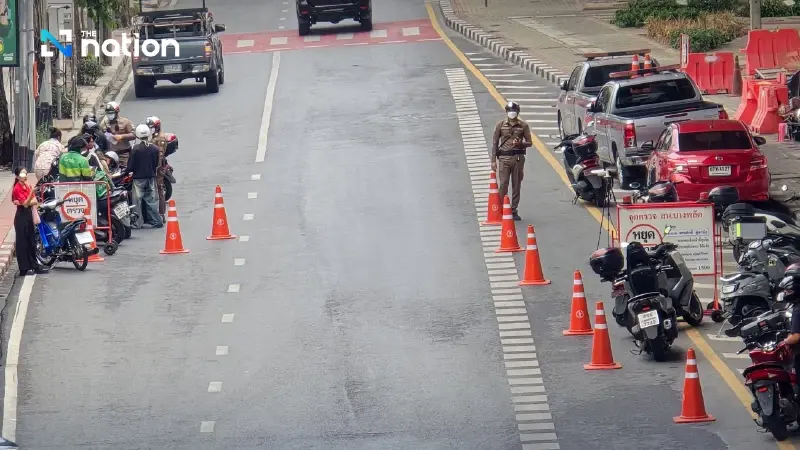


A NIDA Poll found broad support for penalties on 10 newly enforced traffic offences, though the fine for speeding was seen by most respondents as too severe.
NIDA Poll, run by the National Institute of Development Administration, has found broad public support for Thailand’s newly enforced penalties for 10 major traffic offences, although the fine for speeding stood out as the only measure viewed by most respondents as too harsh.
Survey covered 1,310 adults nationwide
The survey, titled “Actual fines for 10 traffic offences”, was conducted on April 7-8, 2026, among 1,310 people aged 18 and over from all regions of the country, across different education levels, occupations and income groups. It examined public opinion on the penalties for 10 key traffic offences that came into force on April 1, 2026.

NIDA Poll said the survey used probability sampling from its master sample database, with multi-stage sampling and telephone interviews. The margin of error was set at no more than 0.05 at a 97% confidence level.
Strong backing for stricter road safety penalties
Support was strongest for the most serious road safety violations. Some 74.66% of respondents said the penalty for driving without regard for safety — a fine of 5,000 to 20,000 baht and up to one year in prison — was appropriate. Another 70.38% said the same of the penalty for drink-driving, which carries an identical punishment.

A majority also said the penalties were appropriate for the remaining offences. These included not wearing a seat belt, at 60.15%; failing to stop for pedestrians at a zebra crossing, 60.08%; driving against the traffic flow, 58.40%; not carrying a driving licence, 58.24%; not wearing a crash helmet, 55.57%; using a phone while driving without a hands-free device, 55.11%; and running a red light, 54.28%.
The findings also showed that a sizeable share of the public wants tougher punishment for some dangerous offences. For driving against the traffic flow, 26.41% said the current penalty was too lenient. The figure was 20.38% for drink-driving, 12.67% for driving without regard for safety and 11.68% for failing to stop at a zebra crossing.
Speeding emerges as the main point of dissent
Speeding was the clear outlier. Asked about the penalty of up to 4,000 baht for exceeding the speed limit, 54.43% said it was too severe, while 40.69% said it was appropriate and 4.58% said it was too lenient.
