
Royal Thai Navy fires 21-gun salute for Coronation Day
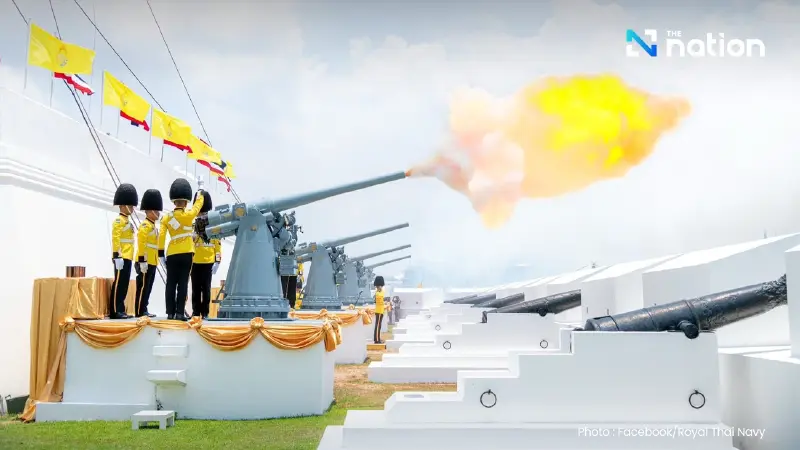


The Royal Thai Navy fired a 21-gun royal salute at Wichai Prasit Fort on May 4 to honour His Majesty the King on Coronation Day.
The Royal Thai Navy fired a 21-gun royal salute at Wichai Prasit Fort in Bangkok on Monday (May 4) to honour His Majesty the King on the occasion of Coronation Day.
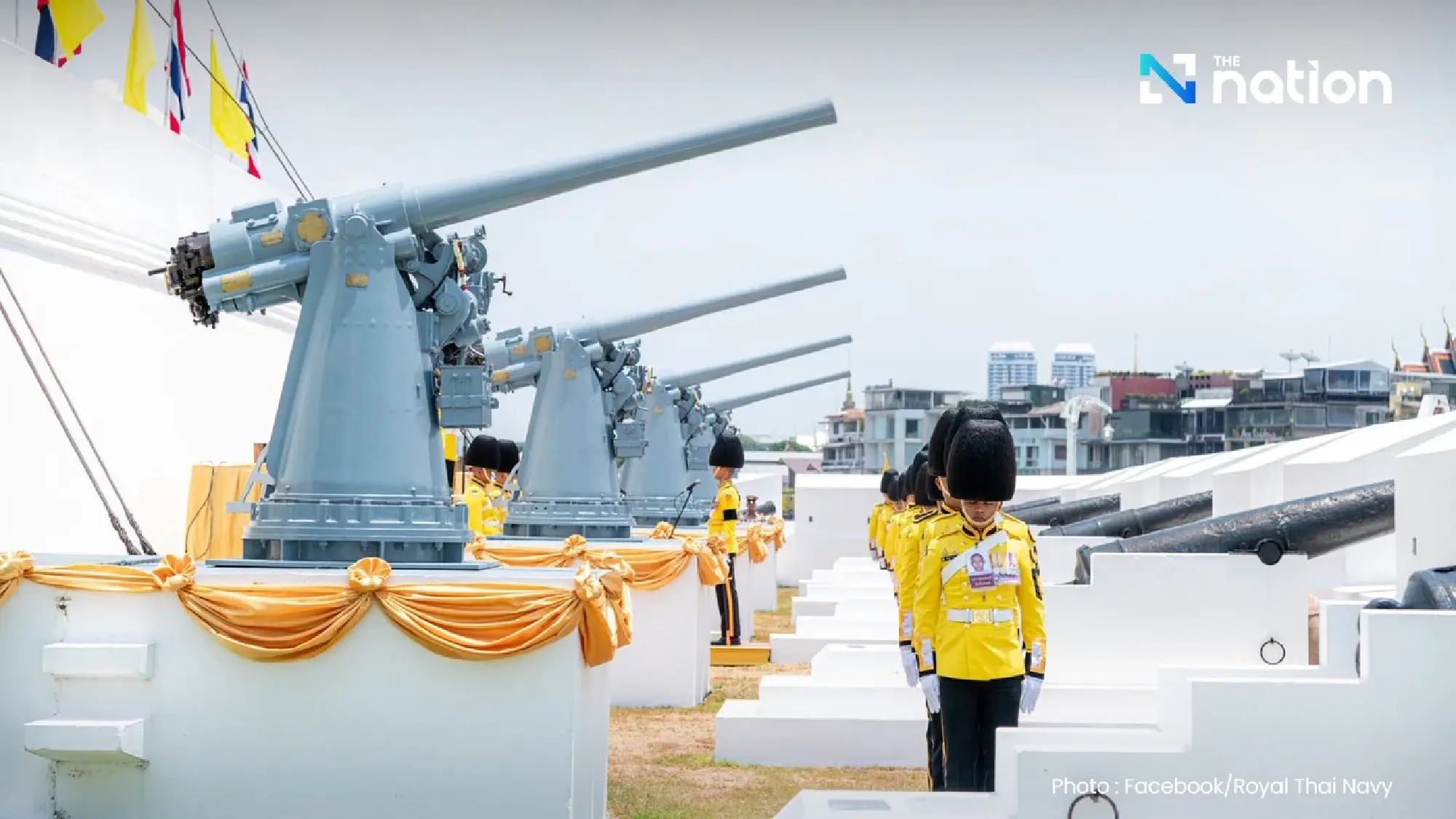
The salute was carried out at noon by the 1st Infantry Battalion, King’s Guard, 1st Infantry Regiment, Marine Division, Royal Thai Marine Corps, using 76/40mm artillery.
The ceremony took place at Wichai Prasit Fort inside Royal Thai Navy Headquarters at the Former Palace in Bangkok Yai district.
May 4 marks Coronation Day
Coronation Day falls on May 4 every year and marks the anniversary of His Majesty the King’s full accession to the throne as King of the Kingdom of Thailand in accordance with ancient royal tradition.

In the present reign, Coronation Day was set in line with the coronation of His Majesty King Maha Vajiralongkorn. His Majesty graciously ordered the Royal Coronation Ceremony to be held from May 4-6, 2019, with the official coronation taking place on May 4 that year.
As a result, May 4 has been observed annually as Coronation Day.
Gun salutes reflect an ancient tradition of honour
Gun salutes are a long-standing tradition observed in many countries as a formal mark of respect for a nation, national flag or distinguished person.
The salute is fired using artillery with black powder or smokeless powder, with the number of rounds determined by the level of honour accorded to the occasion or person being recognised.

The word “salute” is derived from the Latin root “Salutio”.
In Thailand, the first gun salute is recorded as having taken place at Wichayen Fort, now known as Wichai Prasit Fort, during the reign of King Narai the Great.
French records trace Thailand’s first salute
According to French archival records, a French warship named Le Vautour arrived at Wichayen Fort during the Ayutthaya period.
Monsieur Corneille, the ship’s captain, sent a message to the Ayutthaya court asking whether he could fire a salute in honour of Siam.
King Narai the Great then ordered Ok Phra Sak Songkhram, also known as Monsieur Comte de Forbin, a French military officer who was in charge of the fort at the time, to allow the French to fire the salute.
However, after the reign of King Narai ended, the new monarch, King Phetracha, did not favour the French, leading to the discontinuation of the gun salute tradition.
Salute tradition later revived under King Mongkut
The tradition was revived during the reign of King Mongkut, when Sir John Bowring, the British envoy, was welcomed to Siam in 1855.
In 1905, during the reign of King Chulalongkorn, regulations on gun salutes, R.S. 125, were enacted. These divided salutes into two categories: royal salutes and salutes in honour of government officials.
During the reign of King Vajiravudh, a new royal decree on gun salutes was issued in 1912, known as the Gun Salute Decree R.S. 131. It required no fewer than four guns to be used.
The decree divided gun salutes into three categories: royal salutes, salutes for government officials and international salutes.
Royal salutes were further divided into ordinary royal salutes of 21 rounds and special royal salutes of 101 rounds.

Current rules set salute rounds by rank and occasion
The Gun Salute Decree R.S. 131 was abolished in 1940. After the Second World War, the official gun salute tradition was revived on December 5, 1948, for the birthday of His Majesty King Bhumibol Adulyadej The Great.
Under current criteria, a 21-gun salute is fired for royal ceremonies marking the King’s birthday, Coronation Day, the birthday of Her Majesty the Queen or the Crown Prince, as well as ceremonies welcoming a monarch or head of state.
A 19-gun salute is fired for the prime minister, a defence minister who is a military officer, the commander-in-chief of the Royal Thai Navy, an admiral of the fleet and an ambassador.
A 17-gun salute is fired for a civilian defence minister, an admiral and a special ambassador, while a 15-gun salute is fired for a vice admiral and a minister.
A 13-gun salute is fired for a rear admiral and an envoy. Equivalent ranks across the three armed forces receive the same number of salute rounds.
A chargé d’affaires receives an 11-gun salute, while a consul-general receives a nine-gun salute.
