
Probe into rail safety warnings follows Makkasan train-bus crash
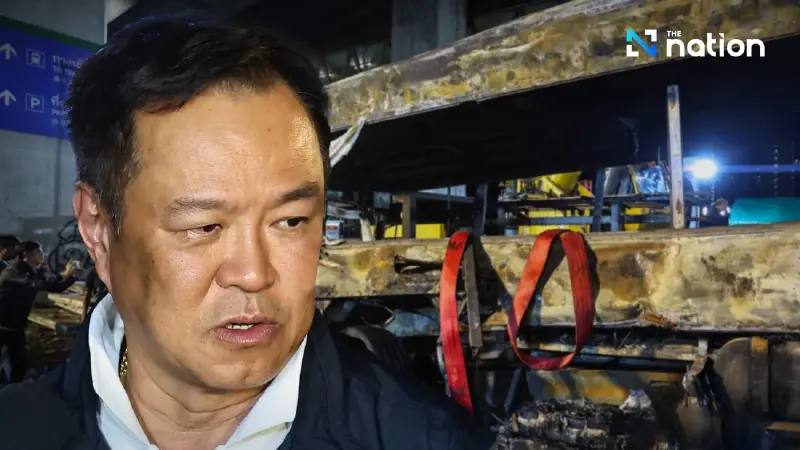


Officials are examining warnings, traffic control and possible negligence after a train hit a Route 206 bus near Makkasan, killing eight and injuring 32.
- A train collided with a bus that had stopped on the tracks near Makkasan Station, killing eight people and injuring 32, which has triggered an official investigation into safety warnings.
- The probe is focusing on why the train did not appear to slow down and why there was no warning system to alert the driver of the obstruction on the tracks.
- Investigators are examining potential negligence by both the bus and train drivers, as well as the coordination between the railway barrier operator and traffic police.
- Prime Minister Anutin Charnvirakul has ordered a review of existing safety measures, highlighting the need for stricter traffic discipline at railway crossings to prevent similar incidents.

Prime Minister Anutin Charnvirakul has ordered full care for victims and urgent checks into safety warnings after a train hit a Route 206 bus near Airport Rail Link Makkasan Station on Saturday (May 16), killing eight people and injuring 32 others.
The collision happened at about 3.40pm near the Asok-Phetchaburi intersection in Makkasan subdistrict, Ratchathewi district, Bangkok, before a fierce fire broke out. Officers from the Phaya Thai Fire and Rescue Station rushed to the scene to extinguish the blaze and help those affected.
By 8.30pm, the State Railway of Thailand had brought in a locomotive to move the damaged train engine from the scene to the Makkasan carriage repair workshop. Container bogies were also due to be moved to the same site.
The Bangkok Metropolitan Administration provided a large crane to remove the damaged Route 206 bus from the railway tracks. Officials proceeded with caution because the bus had been severely damaged by fire, while work was underway to restore the road surface and return traffic to normal before midnight.
Pol General Kitrat Phanphet, commissioner-general of the Royal Thai Police, arrived at the scene at 9pm. He said he had instructed the Metropolitan Police commissioner, the commander of Metropolitan Police Division 1 and Makkasan police to manage traffic so motorists could move through the area as smoothly as possible.


Police were also coordinating with the Department of Disaster Prevention and Mitigation and relevant agencies to remove the bus from the train. Kitrat said the bus had already been shifted, leaving only some concrete slabs to be cleared.
He said traffic information was being issued continuously to the public. Investigators had been instructed to take legal action against both the train driver and the bus driver in connection with alleged negligence causing death, while evidence, including CCTV footage and other material, was being gathered. He said the case had already made considerable progress.
Kitrat said reports indicated the bus driver was still alive, while the train driver had been injured. Given the scale of the damage, any detention or legal control of people linked to the case would have to proceed under the law and relevant regulations.
He also ordered investigators to check all relevant rules and laws, including provisions under the Land Traffic Act prohibiting vehicles from stopping within five metres of railway tracks, as well as the train’s speed. He expressed condolences to the families of those who died and described the crash as a serious lesson, especially for public transport drivers, who carry responsibility for other people’s lives and property.
Kitrat said CCTV footage clearly showed the bus stopped across the railway tracks. Whether or not a train was approaching, and whether or not the barrier was coming down, drivers were required to keep the legal distance from the rail line. The case, he said, showed the need for stricter traffic discipline.
He said the bus being positioned across the tracks was not merely “borderline” conduct, but something that should not have happened because the possible consequences were foreseeable.


Police are also checking the coordination between the barrier operator and the traffic police responsible for clearing the route. Kitrat said investigators would establish whether the barrier operator had notified police, and whether railway staff who knew the train was approaching the crossing had warned traffic officers or drivers to move vehicles and evacuate passengers. A timely warning, he said, may have reduced the loss.
On whether the train driver should have seen the bus from about 500 metres away and whether that could amount to negligence, Kitrat said investigators must examine three main issues: distance, speed and timing. They must also determine whether any warning was issued for the bus to be moved from the tracks and how agencies coordinated as the train approached the crossing.
He said the bus driver was initially seen as potentially negligent because stopping across railway tracks was dangerous, although the facts and legal issues still had to be fully investigated. CCTV footage showed the bus on the tracks as the train was travelling on its normal route.
As public questions grew over why the train did not stop if the bus was at fault, Kitrat said the investigation would be the deciding factor. Police would examine whether the train driver had exercised sufficient caution, including whether the train slowed down, whether any warning signal was received and whether the driver was aware of traffic conditions at the crossing.
Kitrat urged the public to treat the crash as a warning, especially by avoiding stopping vehicles near railway tracks, even during congestion. He said traffic discipline and shared safety awareness were needed to prevent similar losses. Although accidents of this kind occurred often, he believed they could be addressed through stronger discipline and safety awareness among road users.
Anutin arrived at the scene at about 10pm after completing duties outside Bangkok. He inspected several parts of the area, including the point where the bus wreckage was being moved and the section of track believed to be where the bus had stopped across the line before the collision. He was briefed by Deputy Transport Minister Siripong Angkasakulkiat and Kitrat.
Anutin expressed condolences to the families of those who died and to the injured in what he described as a tragic incident. He said he had instructed agencies to give full care to all injured people, speed up forensic identification of the dead and accelerate compensation and assistance for the families of both the dead and injured as much as possible.
On preventive safety measures, Anutin said measures already existed under administrative agencies and the State Railway of Thailand. After viewing video footage of the incident, he said he believed no car or vehicle should ever stop across railway tracks, adding that the matter would have to be urgently investigated.
He said his question was the same one members of the public were asking: how there had been no warning that a vehicle was across the tracks, despite the train passing two crossing points less than one kilometre apart. Asok, he noted, was congested throughout the day, so investigators would have to examine why such an incident had not occurred in the past, why it happened this time and what had been different.
Anutin said the footage appeared to show that the train did not slow down, making that one of the issues that must be urgently verified. For the time being, he said, the priority was to save the injured and prevent further loss of life. Medical units had been told to care for all injured people fully, while the deceased should be returned to their families for religious rites as quickly as possible.
Regarding the police chief’s view that the evidence showed the bus had stopped across the railway line, Anutin referred reporters to Kitrat for that detail.


