
Pink sea cucumbers wash ashore, turning Rayong beach reddish-pink
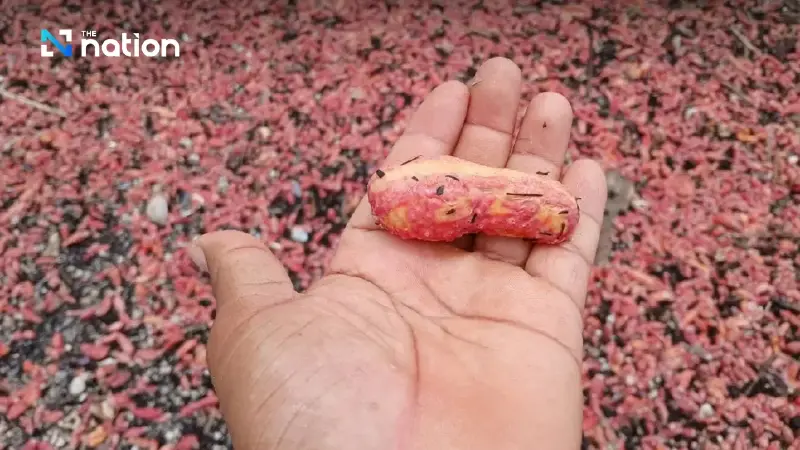


Marine officials are assessing possible impacts after waves pushed large numbers of pink sea cucumbers onto Suan Son Beach in Rayong.
- A vast number of pink sea cucumbers washed ashore on Suan Son Beach in Rayong, Thailand, turning a several-hundred-meter stretch of the coastline reddish-pink.
- Officials believe the rare event is a natural phenomenon likely caused by recent storms and strong waves pushing the seabed-dwelling creatures to the shore.
- The incident is not linked to pollution, but the public is advised to avoid touching the sea cucumbers as some species can release skin irritants when stressed.
The Ministry of Natural Resources and Environment has ordered an urgent inspection after a vast number of “pink sea cucumbers” were found washed ashore by waves at Suan Son Beach in Phe subdistrict, Mueang Rayong district, Rayong province.
A stretch of beach several hundred metres long appeared reddish-pink, attracting attention and causing alarm among tourists and residents.
Initial survey findings indicated that the incident was an uncommon natural phenomenon and was believed to be linked to unsettled weather and strong waves at sea.
Suchart Chomklin, Minister of Natural Resources and Environment, said he had instructed the Department of Marine and Coastal Resources to urgently verify the facts and assess possible impacts from the incident, to provide the public with accurate information and closely monitor the situation.
Following the order, the Office of Marine and Coastal Resources 1, together with relevant agencies, inspected the area around Suan Son Beach.
It found that the large number of marine animals washed ashore were “sea cucumbers”, particularly the pink sea cucumber group, known as “pink sea cucumbers” or “pink warty sea cucumbers”, with the scientific name Cercodemas anceps.
The species is an invertebrate that lives on the seabed.

It has a soft, cylindrical body resembling a cucumber or sausage, skin covered with small bumps or spines, and colour ranging from bright pink to reddish-orange.
When large numbers are washed ashore at the same time, the shoreline therefore appears clearly reddish-pink.
Marine resources experts explained that sea cucumbers play an important role in the marine ecosystem because they break down the remains of organisms and other organic matter that accumulates on sandy seabeds.
This helps circulate nutrients and maintain the quality of the underwater ecosystem, earning them the description “housekeepers of the sea”.
Based on a preliminary assessment, officials believed the phenomenon was likely caused by the influence of storms and rough seas in the recent period, which pushed sea cucumbers living on the seabed towards the shore in large numbers.
The incident is regarded as a rare natural phenomenon in the area.
“The situation is currently being monitored and assessed continuously. So far, no information has been found indicating abnormal pollution or other factors affecting the marine ecosystem,” a relevant official said.


However, the Department of Marine and Coastal Resources asked tourists and members of the public to avoid direct contact with sea cucumbers.
Although most sea cucumbers are not harmful to humans, some species may release substances to defend themselves when stressed or disturbed, which could irritate people with sensitive skin or allergies.
Officials also advised members of the public who find large numbers of marine animals stranded ashore or notice abnormalities in coastal areas to notify relevant agencies so they can inspect and assess the situation properly.
Joint surveillance will help monitor changes in the marine ecosystem effectively.
The pink sea cucumber wash-up at Suan Son Beach has drawn interest from many tourists because it is a rare sight and reflects the biodiversity of Thailand’s marine ecosystem.
State agencies are continuing to monitor the situation and collect further information to study the causes and possible impacts in the next stage.

