
Thai dairy sector warns 183 tonnes of raw milk left unsold daily
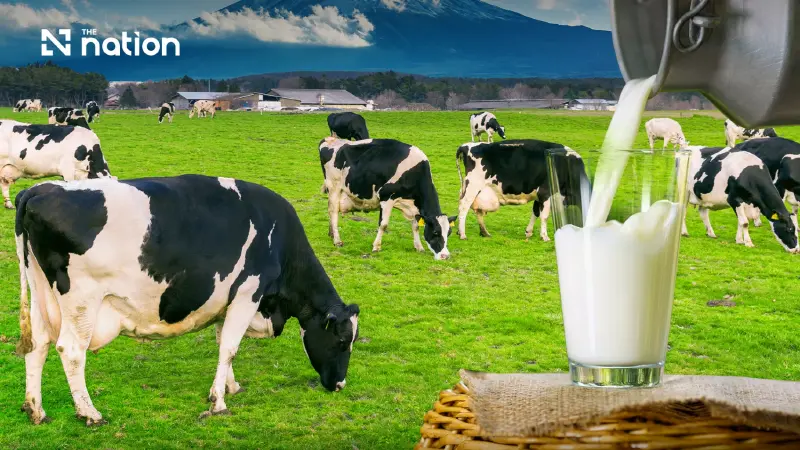


Thai dairy cooperatives warn that excess raw milk, zero-duty milk powder imports and school milk stocks could push 50 cooperatives into crisis
Thailand’s dairy industry is facing a major turning point as a worsening raw-milk surplus puts pressure on cooperatives nationwide and threatens the livelihoods of dairy farmers.
The oversupply has left dairy cooperatives struggling with liquidity shortages, while farmers have been hit by reduced raw-milk purchases. Industry leaders fear that without urgent government support, many farmers could be forced out of the sector and several cooperatives may no longer be able to continue operating.

Nairit Chamle, chairman of the National Farmers Council, told Thansettakij that dairy cooperatives across Thailand were facing a severe raw-milk sales crisis, with the impact spreading through the supply chain.
He said the crisis was affecting:
- Dairy farmers.
- Animal-feed raw material sellers.
- Animal-feed producers.
- Related businesses across the dairy industry.
If the situation is allowed to drag on, more than 50 dairy cooperatives nationwide could face financial problems serious enough to threaten their survival, he warned.
Government urged to clear 235 million school milk cartons
1. Nairit said the first proposed solution was to speed up the clearance of accumulated UHT school milk cartons.
A Cabinet resolution on September 9, 2025, had ordered quality checks on about 100 million cartons of school milk. However, the process stalled after the House of Representatives was dissolved.
The remaining stock has now risen to 235,467,819 UHT milk cartons, involving 25 dairy cooperatives and one unit under the Dairy Farming Promotion Organisation of Thailand, or DPO.
The unsold stock has worsened liquidity shortages among cooperatives and severely affected their ability to buy raw milk from members.
2. The second proposal is to support the use and sale of bio-liquid fertiliser made from fresh cow’s milk, in order to absorb excess raw milk that has no buyers.
More than 8,417 tonnes of raw milk have already been processed into bio-liquid fertiliser, representing raw-milk value of more than 151.5 million baht. Nairit said the government should promote the use of this product to reduce losses for farmers.
3. The third proposal is to expand the school milk programme from 260 days to 365 days per year.
The industry also wants the right to receive school milk extended from kindergarten to Prathom 6 pupils to students up to Mathayom 3, in order to absorb more domestic raw-milk output.
The proposal comes as the number of students from kindergarten to Prathom 6 has fallen from 7.95 million in 2016 to 6.08 million in 2026, a decline of more than 23.6%.
4. The fourth proposal is to revise milk product labelling rules so consumers can clearly distinguish between fresh cow’s milk made from domestic raw milk and products made from imported milk powder.
The aim is to allow consumers to make informed choices and create fairer conditions for Thai dairy farmers.
5. The fifth proposal is for the government to temporarily delay the second 2026 quota of skimmed milk powder imports under the Thailand-Australia-New Zealand free trade framework and World Trade Organisation commitments.
The delay should remain in place until the raw-milk surplus eases and memorandums of understanding on raw-milk purchases by operators are completed, Nairit said.
6. The sixth proposal is to urgently revive the DPO. If the organisation cannot carry out its normal mission, the impact would spread to more than 40 dairy cooperatives, dairy farmers and tens of thousands of families working in the system.
Dairy cooperatives to meet on July 7 over zero-duty milk powder
Separately, Sbiun Pom-ocha, chairman of the Dairy Cooperative Federation of Thailand Limited, has issued an urgent letter to dairy cooperative chairmen nationwide, inviting members to a meeting on July 7, 2026, at the Kamphaeng Saen Dairy Cooperative in Nakhon Pathom.
The meeting is intended to set a response to the crisis facing Thailand’s dairy industry following the impact of the Thailand-New Zealand and Thailand-Australia free trade agreements.
Under these agreements, import duties on skimmed milk powder were cut to 0% from January 1, 2026, increasing competition for domestic raw milk and contributing to a continuous decline in purchases.
“The raw-milk purchase volume under the 2025/2026 MOU from 158 raw-milk collection centres totals 3,024.53 tonnes per day, but operators are actually buying only 2,841.19 tonnes per day, or about 94%. This has left more than 183 tonnes of excess raw milk per day without buyers,” Subin said.
The situation has forced farmers in many areas to sell raw milk below normal prices.
Cooperatives have also been rushing to process raw milk into UHT milk, yoghurt drinks and other products to clear stock, but the effort has still not been enough.
As a result, many cooperatives are facing accumulated debt and shortages of working capital needed to:
- Buy raw milk.
- Purchase animal feed.
- Pay staff wages.
- Repay loans to financial institutions.
For the 2026 academic year school milk programme, the five operators allocated the largest distribution areas are Mary Anne Dairy Products Co Ltd, Nongpho Ratchaburi Dairy Cooperative Limited under Royal Patronage, Phatthalung Dairy Cooperative, Thai Milk Dairy Cooperative and the DPO.
Source: Thansettakij
