
Dairy Crisis: Thai Government Summons Industry Leaders Over 200-Tonne Daily Milk Glut


Internal Trade Department demands emergency talks as industry insiders slam "data failures" and a "broken" 30-year school milk monopoly
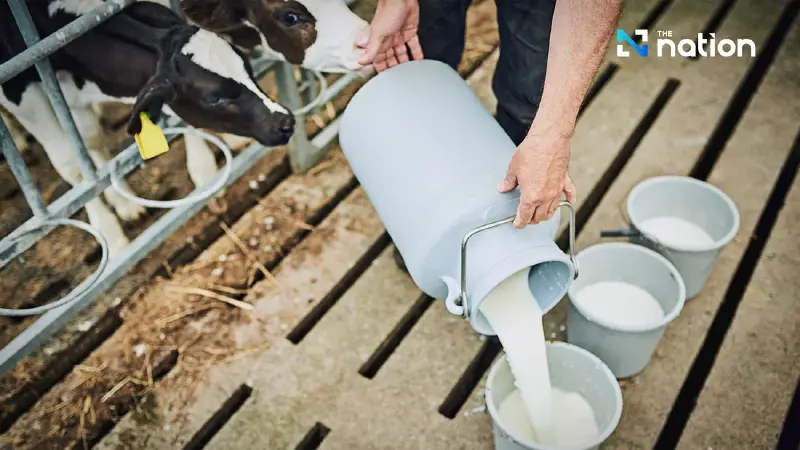
- The Thai government has summoned dairy industry leaders for an urgent meeting to address a daily raw milk surplus exceeding 200 tonnes that has left farmers without buyers.
- Industry insiders attribute the crisis to deep-seated structural issues, including a lack of government data on the surplus and market distortions caused by the National School Milk Programme.
- Proposed solutions to resolve the glut include dismantling the state's school milk monopoly, empowering cooperatives to develop commercial brands, and pursuing government-led export deals.
- The industry is advocating for an end to subsidies, pushing for improved productivity and lower costs to make Thai dairy farmers more competitive globally.
The Department of Internal Trade (DITP) has issued an "urgent" summons to commercial dairy operators for a crisis meeting on 13 March 2026.
The move follows reports of a massive raw milk surplus exceeding 200 tonnes per day, leaving dairy farmers across the country with no buyers despite existing purchase agreements (MOUs).
While government officials point to rising production levels in 2025, industry sources told Thansettakij that the crisis is a symptom of deep-seated structural issues rather than a simple matter of oversupply.
The "Data Vacuum" and Policy Traps
Industry insiders have been scathing in their assessment of the Ministry of Agriculture and Cooperatives’ management.
A primary concern is the lack of "Big Data," with sources claiming the government cannot pinpoint where the reported 211-tonne daily surplus is located or who is holding the stock.
Furthermore, the decades-old National School Milk Programme is being blamed for creating a market distortion.
Critics argue that the current system—where the government buys milk for only 260 days but pays based on a 365-day cycle—is economically dishonest.
Claims that the surplus is caused by "school holidays" are being dismissed by experts as a "distortion of economic facts."
Calls for Privatisation and Liberalisation
Radical proposals are now being put forward to overhaul the sector, including:
Dismantling the School Milk Monopoly: Proponents suggest decentralising procurement to governors and schools, allowing parents to "top up" payments for higher-quality brands or diverse flavours.
Empowering Cooperatives: Moving away from state dependency by allowing cooperatives to develop commercial brands that compete directly on supermarket shelves.
G2G Export Pushes: Urging the Ministry of Commerce to pursue "Government-to-Government" (G2G) deals to export Thai pasteurised milk to neighbouring markets, rather than attempting to roll back long-standing Free Trade Agreements (FTAs).
Survival of the Fittest
The industry’s message to the state is clear: the era of indefinite subsidies must end.
"The Thai dairy industry has reached a moment of truth," one source stated. "The state cannot prop up everyone forever. It is time to improve productivity and lower costs so Thai farmers can survive globally without a crutch."
