
Prolonged Hormuz closure could hammer food costs in Thailand
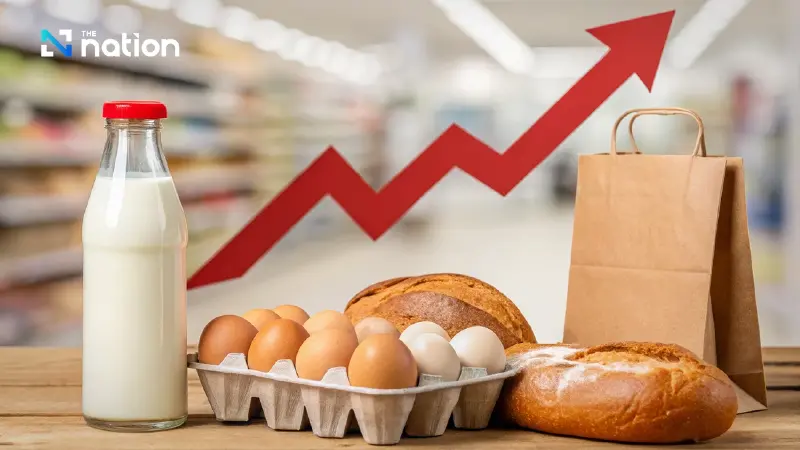


A prolonged closure of the Strait of Hormuz could hit fertiliser supplies and drive up global food prices, leaving Asia and Thailand facing rising costs.
The crisis in the Middle East, which is disrupting trade routes through the Strait of Hormuz, is raising global concern that the fallout could spread far beyond energy markets and trigger a rise in food prices worldwide.
The Strait of Hormuz is not only a major route for oil and natural gas shipments, but also a strategic corridor for transporting fertiliser, a key input for agriculture around the world. Analysts told CNBC that any disruption to shipping could raise farming costs, reduce crop yields and, ultimately, make food more expensive.
The International Food Policy Research Institute (IFPRI) said higher energy and input costs could reignite food inflation, even as retail food prices in many countries had only recently begun returning to normal levels.
Raj Patel, a research professor at the University of Texas, warned that war-related bottlenecks in fertiliser supplies would intensify the global food crisis on several fronts at once, saying the impact would be ‘more severe and faster than expected’.
The Strait of Hormuz is a critical chokepoint for fertiliser transport. Countries such as Qatar, Saudi Arabia, Oman and Iran are major exporters of urea and phosphate fertilisers, and almost all of those shipments must pass through this route, Patel said.
Industry experts said countries that rely on imported food and fertiliser could face higher costs within the next few weeks, particularly with the planting season approaching.
The first areas likely to feel the impact are countries closest to the conflict zone. A commodities analyst at BMI said consumers in Gulf Cooperation Council (GCC) countries face the risk of sharp short-term rises in food prices because they rely heavily on seaborne imports passing through the Strait.
If shipping restrictions persist, wealthier economies such as Qatar, Bahrain, Kuwait and Saudi Arabia may have to switch to air or land transport, both of which are far more expensive. But neighbouring countries with tighter financial constraints, such as Iraq and Iran, could even face shortages of goods.
Sub-Saharan Africa likely to be hit hardest
Beyond the Middle East, Sub-Saharan Africa is seen as the most vulnerable region because farmers there rely almost entirely on imported fertiliser, while households already spend a large share of their income on food.
Data from the University of Texas at Austin show that more than 90% of fertiliser used in the region is imported from other continents. Maize, a staple crop with high nitrogen requirements, is expected to be hit hardest, raising the risk of lower yields and higher food prices.
Thailand and Asia face soaring costs
South Asia and Southeast Asia will also struggle to avoid rising cost pressures. Major agricultural economies such as India, Bangladesh, Indonesia and Thailand all depend on fertiliser imports from the Gulf.
If shipping disruption continues for an extended period, farmers’ costs during the upcoming planting season will inevitably surge.
Professor Patel cited Thailand as a notable example, saying that Thai farmers rely on imports for 90% of their fertiliser, especially urea, which is produced from gas and shipped through Hormuz.
He said it is also priced in US dollars, at a time when the dollar is strengthening because of geopolitical risk. This means farmers are being hit on every cost front at once.
Rice and maize, two of Asia’s main crops, require large amounts of fertiliser. Analysts believe Indonesia and Bangladesh are likely to be among the hardest hit countries in the region.

Long-term impact: higher energy costs could push food prices up
In the longer term, if farmers respond to more expensive fertiliser by reducing usage, global agricultural output will decline, driving food prices higher through normal market mechanisms.
Brazil, one of the world’s largest agricultural exporters, imports 85% of its fertiliser and would face direct pressure on the production costs of soybeans and maize.
Experts said that even if agricultural output remains relatively stable in the short term, higher energy costs alone could still push up global food inflation. Energy is a major cost at every stage of the food supply chain, from powering farm machinery and producing fertiliser to transport and processing.
Joseph Glauber, a senior research fellow at IFPRI, said the main reason consumers may end up paying more for food is not necessarily the price of agricultural produce itself, but the large energy component embedded in retail food prices.
Chris Barrett, an agricultural economist at Cornell University, said the severity of this latest food price crisis would depend largely on how long the shipping route remained closed.
